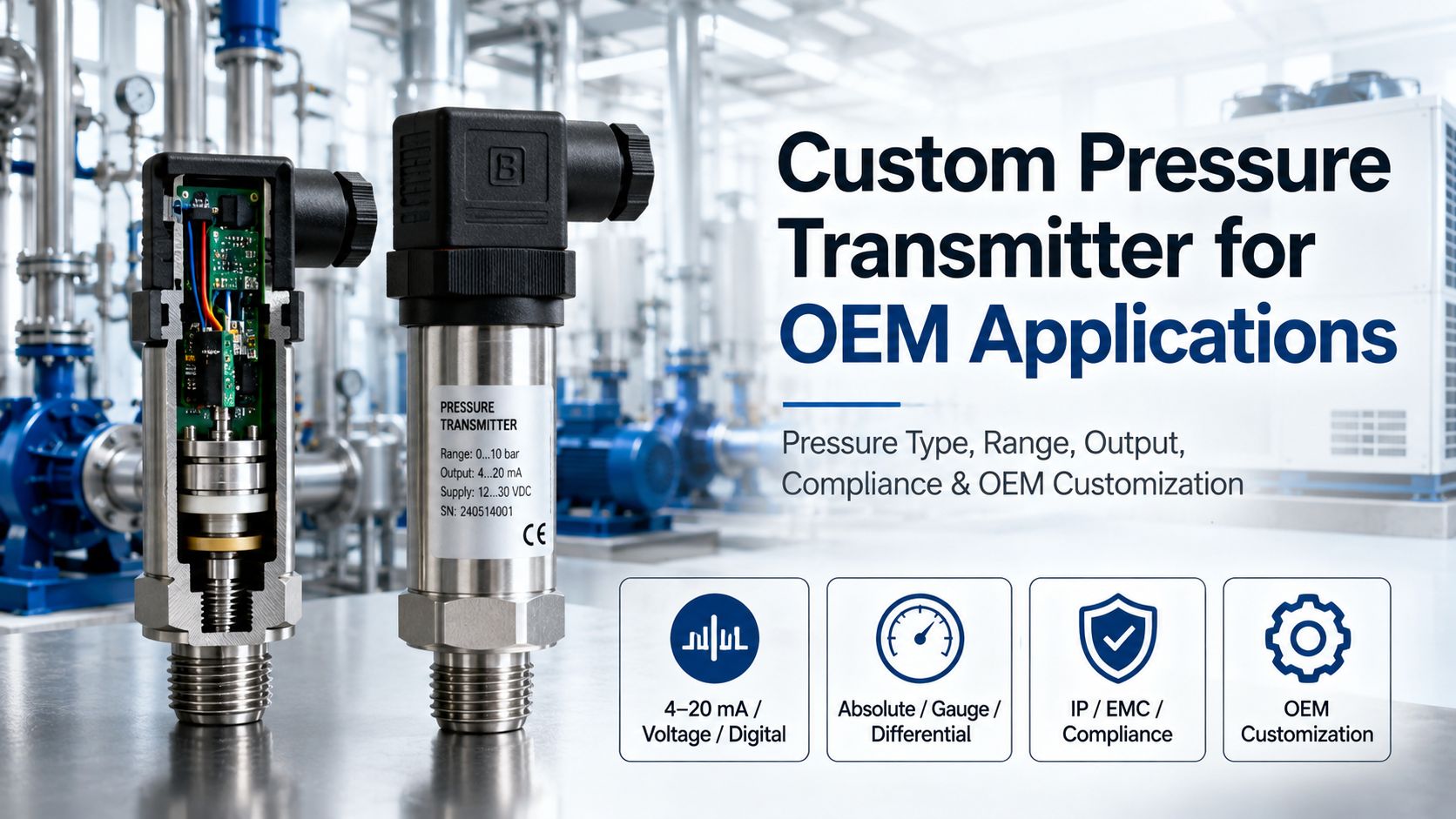
A pressure transmitter is the “industrialized” form of a pressure sensor: it measures pressure and outputs a standardized signal (most commonly 4–20 mA) that can travel long distances reliably in plant environments. The 4–20 mA current loop is widely used in industrial instrumentation because current is robust over wiring runs and common noise sources.
For OEMs (industrial equipment builders), “custom” usually means: your mechanical interface + your media + your accuracy across temperature + your electrical interface + your compliance package, delivered consistently at volume.
Pressure transmitter vs pressure sensor (quick clarification)
Pressure sensor: sensing element (piezoresistive/capacitive/etc.) that may output mV/V or a raw digital value.
Pressure transmitter: includes signal conditioning + compensation + packaging, and outputs an industry-friendly signal like 4–20 mA (often loop-powered), 0–10 V, or digital.
2-wire (loop-powered) vs 3/4-wire transmitters
For OEM equipment, 2-wire loop-powered transmitters are common because power and signal share the same loop wiring.
Why OEMs choose a custom pressure transmitter
A custom program is most valuable when you need one (or more) of the following:
Non-standard range (e.g., tight low-pressure DP, or special overload behavior)
Media isolation (oil fill / isolation diaphragm / special elastomers)
Output match (exact scaling, response time, diagnostics, digital protocol)
Compliance (IP rating, EMC, RoHS/REACH, hazardous area versions)
Lifecycle control (traceability, PCN policy, long-term supply)
Core technology choice: Capacitive vs piezoresistive (OEM perspective)
Both can be used in absolute, gauge, and differential transmitters; the right choice depends on your application constraints.
Topic
Capacitive core
Piezoresistive core
Typical “sweet spot”
Low pressure / low DP sensitivity
Broad industrial ranges, rugged general-purpose
System risks
Parasitics/EMI/layout sensitivity (needs good AFE/shielding)
Temperature drift management (requires compensation)
Integration tendency
Often paired with CDC/AFE + careful grounding
Bridge + amplifier/ADC is straightforward
Practical rule: for HVAC/cleanroom low DP, capacitive is often attractive; for pumps/hydraulics/process skids, piezoresistive transmitters are extremely common.
Customization options (what you can actually specify)
1) Pressure reference and porting
Absolute / Gauge / Differential
Single port vs dual port (DP)
Port geometry to avoid clogging (especially for dirty media or condensate)
2) Range, overload, and dynamic response
Operating range + proof + burst
Response time / damping (fast alarms vs stable control loops)
Pressure spikes (water hammer, pump pulsation)
3) Wetted materials and sealing
316L stainless vs higher alloys
Elastomers: NBR/EPDM/FKM/FFKM (media + temperature driven)
Isolation diaphragm / fill fluid (critical for corrosive media or particulate-laden fluids)
4) Electrical output & interface
Common OEM options:
4–20 mA (2-wire loop-powered is common in industrial plants)
0.5–4.5 V ratiometric (embedded controllers)
0–10 V (building automation)
Digital (I²C/SPI/UART, CAN/LIN, IO-Link—if your ecosystem requires)
5) Enclosure & environmental protection (IP)
If your transmitter lives outdoors, in washdown, or dusty areas, specify an IP rating. The IEC’s IP rating system (IEC 60529) grades enclosure resistance to dust and liquids.
6) EMC performance
Industrial environments can be noisy. IEC 61326-1 is a widely referenced EMC requirements standard for electrical equipment used in measurement/control/lab contexts, covering immunity and emissions requirements.
7) Materials compliance (EU)
If you sell into the EU, RoHS/REACH paperwork is often mandatory:
RoHS restricts hazardous substances in electrical/electronic equipment.
REACH is the EU’s main chemicals regulation framework.
8) Hazardous area versions (when required)
If your equipment is used in explosive atmospheres:
ATEX Directive 2014/34/EU covers equipment intended for use in potentially explosive atmospheres in the EU.
IECEx is an international certification system intended to facilitate trade for equipment/services used in explosive atmospheres while maintaining safety.
9) Quality system expectations
Many OEMs require ISO 9001 as a baseline quality management system standard.
OEM development workflow (prototype → mass production)
Pilot run (yield, test fixtures, traceability, packaging validation)
Ramp to production (PCN rules, ongoing QC, reliability monitoring)
FAQs
What’s the best output for industrial OEM equipment—4–20 mA or voltage?
If you’re integrating into plant instrumentation over longer cable runs, 4–20 mA is often preferred and is widely used in process control. For embedded controllers inside a machine, voltage or digital may be simpler.
Do I need an IP67 pressure transmitter?
Only if your environment demands it (outdoor, washdown, dust). IP ratings are defined under the IEC IP rating system (IEC 60529).
When do I need ATEX or IECEx?
Only when the transmitter will be used in potentially explosive atmospheres. ATEX applies to the EU market, and IECEx is widely used internationally.