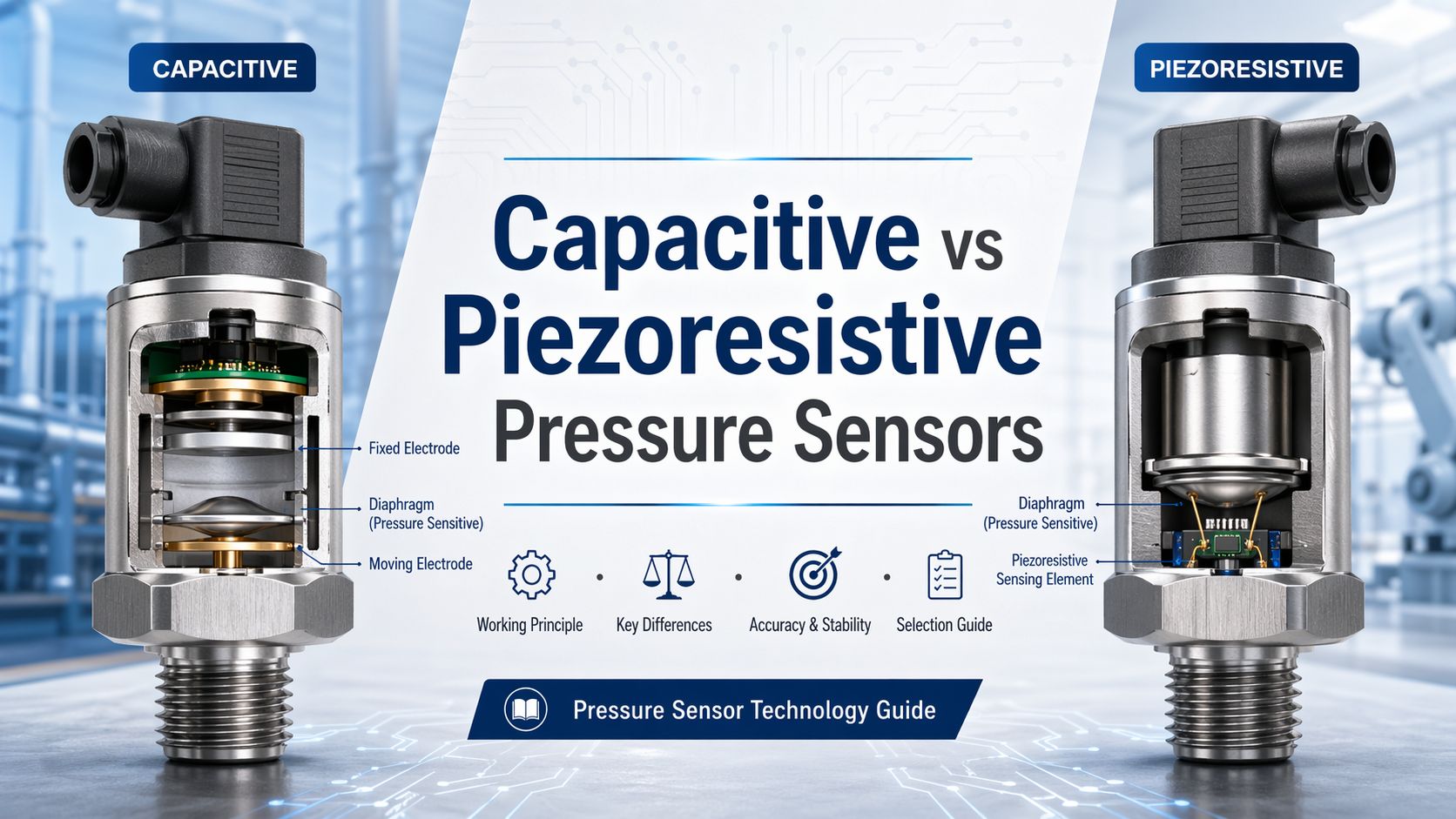
Capacitive and piezoresistive sensing are the two most common cores behind modern pressure transducers (including MEMS). On a quiet bench, both can look “good enough.” In the field, their differences show up quickly—especially with temperature swings, low-pressure differential measurements, EMI/parasitics, overpressure events, and power budget limits.
Both technologies can be implemented as absolute, gauge, or differential pressure sensors.
1) How each technology works
Piezoresistive pressure sensors
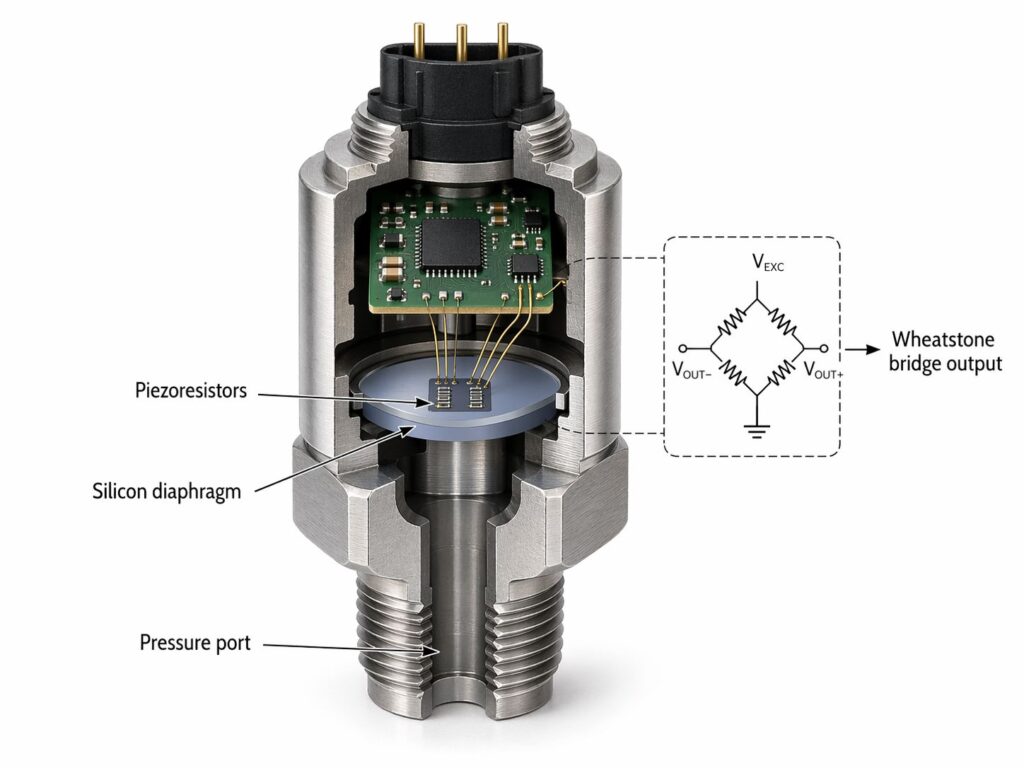
A piezoresistive sensor uses a diaphragm that flexes under pressure. Strain on the diaphragm changes the resistance of piezoresistors, typically arranged as a four-resistor Wheatstone bridge on the sensor die (very common in automotive MEMS pressure transducers).
What you measure: bridge output voltage (often mV/V) proportional to pressure.
Capacitive pressure sensors
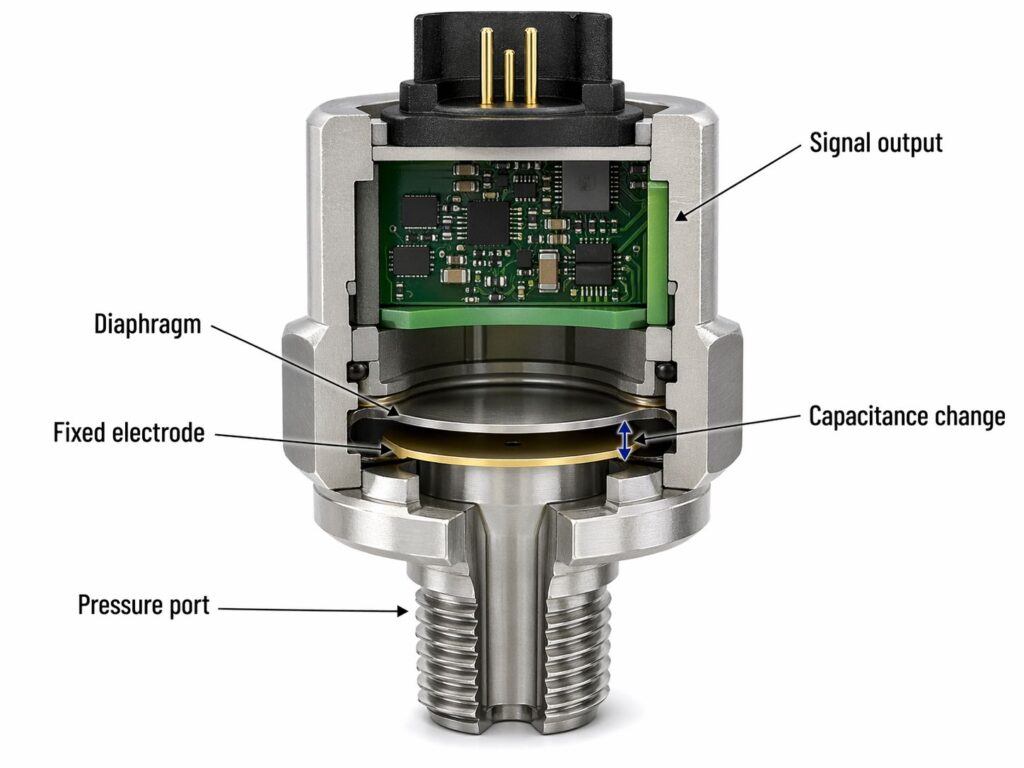
A capacitive sensor forms a capacitor where one plate is a pressure-deflected diaphragm. Pressure changes the diaphragm position (gap), changing capacitance. That capacitance change is read out using an AC method (charge/discharge timing, oscillator frequency shift, etc.).
What you measure: capacitance (or a derived frequency/time signal) proportional to pressure.
2) Key performance differences (what matters in real designs)
A) Power consumption
- Capacitive: typically lower power at the sensing element because no DC current needs to flow through the capacitor; current mainly flows during measurement cycles, and passive/readout-powered schemes are possible in some designs.
- Piezoresistive: requires excitation power for the bridge; scaling down resistance can increase power demand, which hurts battery systems.
Rule of thumb: if you’re building battery/remote/IoT pressure nodes, capacitive often has an advantage in power budget.
B) Temperature behavior (offset/span drift)
- Piezoresistive outputs are temperature dependent and usually require compensation (offset + span drift are classic issues).
- Capacitive sensors are often described as having low temperature sensitivity and good repeatability (in many implementations), though electronics and packaging still matter.
Practical implication: if your application sees large temperature cycles (e.g., under-hood, outdoor, tire/road thermal cycling), temperature compensation strategy becomes a major differentiator—often more important than the sensing principle itself.
C) Linearity, hysteresis, repeatability
- Piezoresistive: generally provides linear output with pressure and simple signal conditioning.
- Capacitive: can show nonlinearity because capacitance is inversely proportional to the electrode gap; “touch mode” designs can improve linearity and over-range robustness, but may introduce hysteresis tradeoffs.
If you need very low hysteresis at low pressures, capacitive is often attractive (many designs report low hysteresis + good repeatability), but confirm this in the actual datasheet and under your mounting/environment conditions.
D) EMI, parasitics, cabling/layout sensitivity
This is where capacitive designs often demand more system-level discipline:
- Capacitive: performance can be strongly affected by parasitic capacitance, grounding, cable length, and nearby conductors; active shielding/guarding is a common mitigation strategy in capacitive sensing front ends.
- Piezoresistive: bridge sensors are generally more straightforward to route and read (though they still require good analog practices for offset/drift/noise).
Design takeaway: if your electronics are far from the sensing element, capacitive can become challenging unless you use a well-designed CDC/AFE and shielding approach.
E) Overpressure tolerance and harsh events
- Capacitive sensors are often described as tolerant of short-term overpressure, and touch-mode structures can provide large over-range capability.
- Piezoresistive sensors are widely considered robust with good resistance to shock/vibration and dynamic pressure changes (implementation-dependent).
Reality check: overload performance is heavily driven by mechanical design (diaphragm thickness, stops, isolation diaphragm/oil fill, porting), not only the sensing principle.
3) Typical pressure ranges and “sweet spots”
Published ranges vary widely, but a representative guide summarizes:
- Piezoresistive: commonly used from low pressures up to very high pressures (e.g., up to ~20,000 psi / 150 MPa noted in one engineering guide).
- Capacitive: can cover vacuum/low pressure to high pressure (e.g., down to a few hundred Pa and up to ~10,000 psi / 70 MPa in the same guide), with strong performance in lower-pressure applications.
Practical “sweet spot” summary
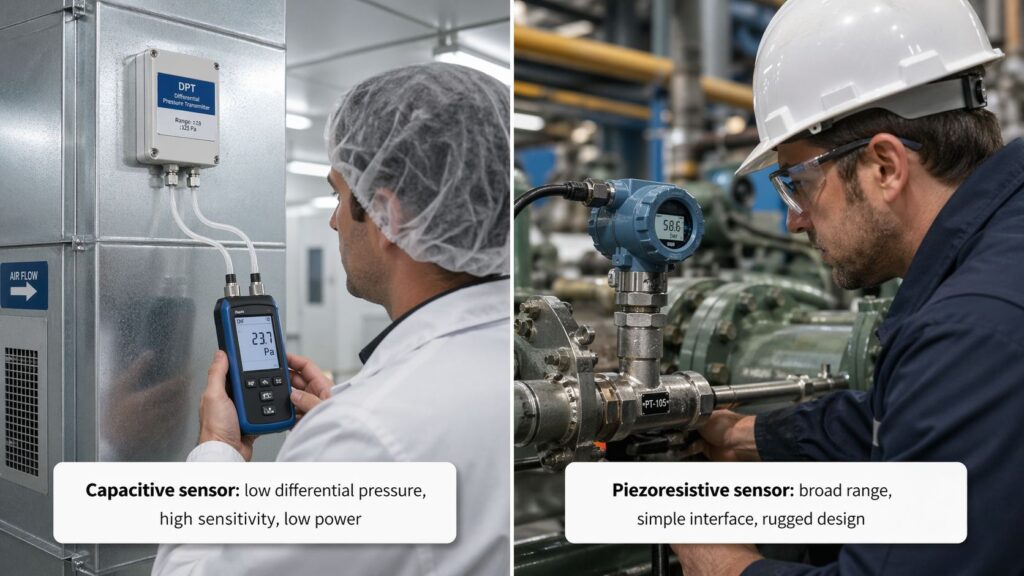
- Very low differential pressure (Pa to low kPa): capacitive often shines (sensitivity).
- Very high pressure / rugged industrial transmitters: piezoresistive is extremely common and cost-effective.
4) Application-based decision guide

HVAC duct static pressure / filter monitoring (low DP)
- Often favors capacitive for sensitivity at very low ΔP, but only if you control moisture/EMI/parasitics well.
- Piezoresistive DP sensors are also common; choose based on total error band across temperature and installation constraints.
Hydraulics, compressors, general industrial gauge pressure
- Piezoresistive is typically the default choice: mature, durable, simple readout, wide range availability.
Battery-powered / wearable / implanted / passive-readout concepts
- Capacitive can be attractive because it can be inherently low-power and can be integrated into resonant/AC readout schemes.
Environments with challenging EMC or long cabling
- If you can’t guarantee short connections + shielding, piezoresistive often reduces risk (simpler analog chain).
5) Selection checklist (what to put in your RFQ/datasheet)
Regardless of principle, specify these clearly:
- Pressure type: absolute / gauge / differential
- Range & overload: working range + proof/burst requirements
- Accuracy definition: %FS vs %reading, include temp range and “total error band” approach
- Temperature profile: operating + compensated range; ask how offset/span drift is handled
- Environment: humidity/condensation, vibration, EMI, ingress rating
- Mechanical: port/thread, media isolation needs, mounting stress sensitivity
- Electronics/interface: mV/V bridge vs voltage/current vs digital; for capacitive, ask about CDC/AFE and shielding guidance
6) Common pitfalls (and how to avoid them)
Pitfall 1: Assuming capacitive is “always more accurate”
Capacitive can offer excellent performance, but parasitic capacitance, layout, and shielding can dominate real accuracy if not handled correctly.
Pitfall 2: Underestimating temperature drift in piezoresistive designs
Temperature influence often appears as offset and span changes, so compensation is part of the product, not an optional extra.
Pitfall 3: Comparing only the sensing element, ignoring packaging
Isolation diaphragm + fill fluid + mechanical stops can decide hysteresis, overload survivability, and long-term drift more than the core principle.
FAQs
Which is better for low differential pressure: capacitive or piezoresistive?
Often capacitive, because it can be very sensitive at low pressures and shows good repeatability in many designs—but only if parasitics/EMI are controlled with proper front-end design and shielding.
Which technology is easier to interface?
Piezoresistive bridge sensors usually have simpler readout (bridge + amplifier/ADC). Capacitive sensors often need a dedicated capacitive front end (CDC/oscillator timing) and careful layout.
Which one handles temperature swings better?
Many guides describe capacitive sensors as having low temperature sensitivity, while piezoresistive sensors need stronger compensation due to temperature-dependent output characteristics.
Can both be used for absolute, gauge, and differential pressure?
Yes—both piezoresistive and capacitive pressure sensors can be implemented for absolute, gauge, relative, or differential measurements.