
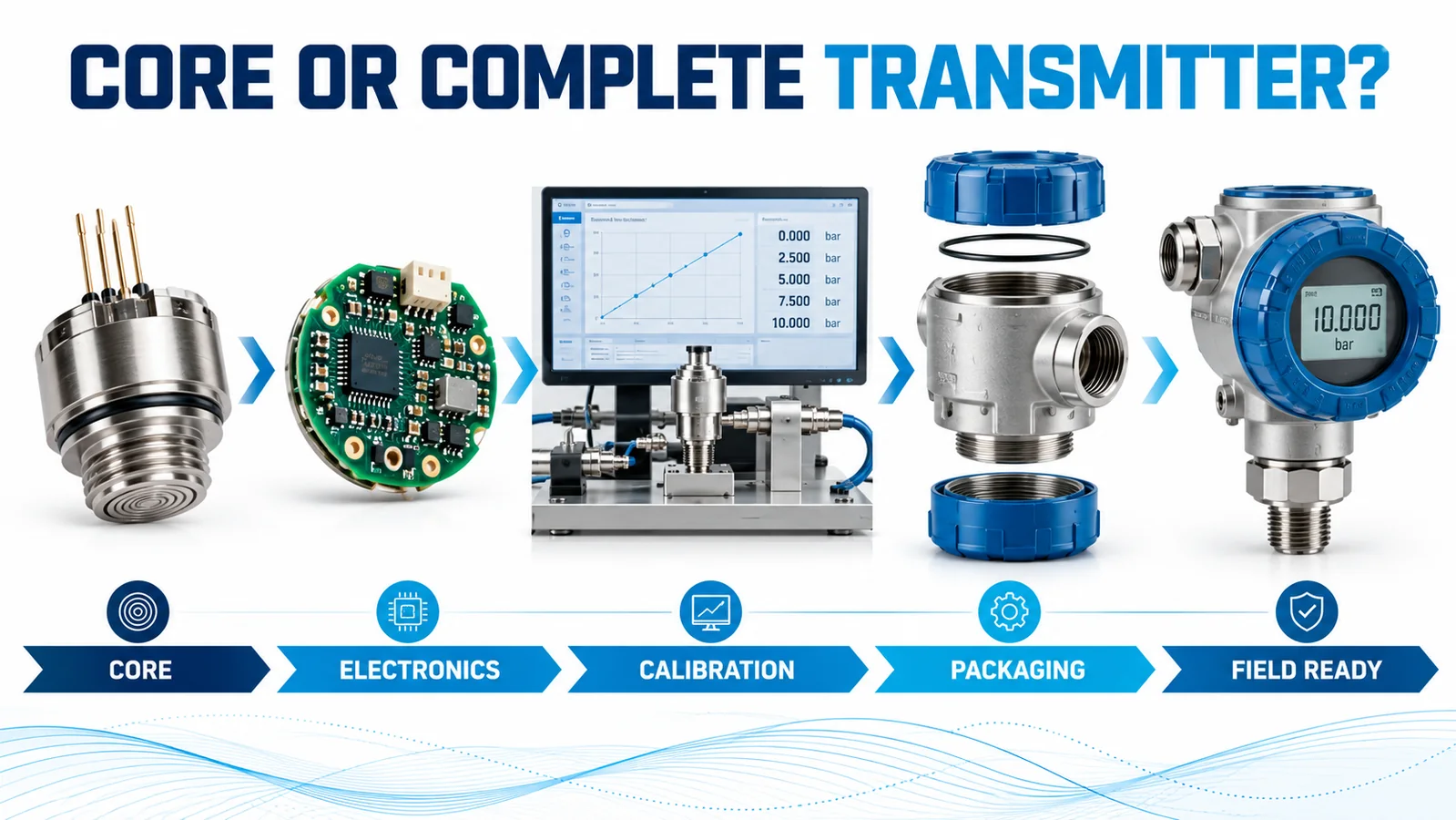
Choosing a pressure sensor core vs transmitter is a decision about engineering ownership. A pressure core can reduce the purchased component cost and give an OEM control over electronics, packaging and product form. A complete transmitter arrives with signal conditioning, calibration, a pressure port, housing and a defined electrical interface. The difference reaches far beyond the purchase price.
For an OEM, the correct question is: which parts of the measurement chain can our team design, validate, manufacture and support throughout the product life? A core is attractive when volume, packaging constraints and internal capability justify the added work. A transmitter is attractive when time to market, production certainty and a clear supplier boundary are more valuable than the lowest component cost.
| Decision factor | Pressure core | Complete transmitter |
|---|---|---|
| Purchased item | Sensing element in a basic pressure package | Calibrated, conditioned pressure instrument |
| OEM engineering | Yüksek | Daha düşük |
| Packaging freedom | Highest | Limited to offered formats |
| Calibration ownership | Usually OEM | Usually supplier |
| Production equipment | Fixtures, references and programming may be required | Final system test is still required |
| Unit purchase price | Usually lower | Usually higher |
| Time to production | Longer unless the platform already exists | Usually shorter |
| Field replacement | OEM-defined assembly or board | Replaceable instrument or subassembly |
What Is the Short Answer?
Choose a pressure core when the sensing assembly is part of your product architecture, your team can own the analog and digital signal chain, and production volume can absorb non-recurring engineering. Choose a complete transmitter when you need a specified output, pressure connection and calibrated performance with less internal integration work.
A third option sits between them: a compensated sensor module. It can provide a normalized analog or digital signal while leaving the enclosure, connector and final environmental protection to the OEM. This middle level is useful when packaging must remain proprietary but building compensation and calibration from raw sensor behavior does not create customer value. For the broader buying context, see how to choose an industrial pressure sensor.
The decision should be made for the complete program rather than for one prototype. Include engineering labor, calibration equipment, test time, yield, supplier management, documentation, warranty investigation and future design changes.
What Exactly Are You Buying at Each Integration Level?
The word “sensor” is used loosely. Two suppliers may both offer a pressure sensor while delivering very different amounts of completed engineering. Define the boundary in the request for quotation.
Pressure core
A core typically contains the pressure-sensitive structure, diaphragm and electrical terminals or leads. Its output may be a low-level bridge signal. The OEM normally adds excitation, amplification, temperature compensation, filtering, analog-to-digital conversion, output protection, connector, housing and final calibration.
Compensated module
A module may include compensation data, signal conditioning or a digital interface. It reduces some electronics and calibration work, but the OEM can still own the mechanical package and final product interface. Verify whether quoted accuracy applies to the module alone or to the completed installation.
Complete transmitter
A transmitter converts pressure into a defined system signal such as 4–20 mA, voltage, I²C or RS485. It typically includes the pressure port, electronics, calibration and environmental enclosure. The OEM still owns correct installation, power, system scaling, software behavior and validation in the final machine.
Which Responsibilities Move to the OEM with a Core?
Buying a core moves several coupled responsibilities inside the OEM organization. The electronics team cannot complete the design without the mechanical package, and the production team cannot define the test line without the calibration method.
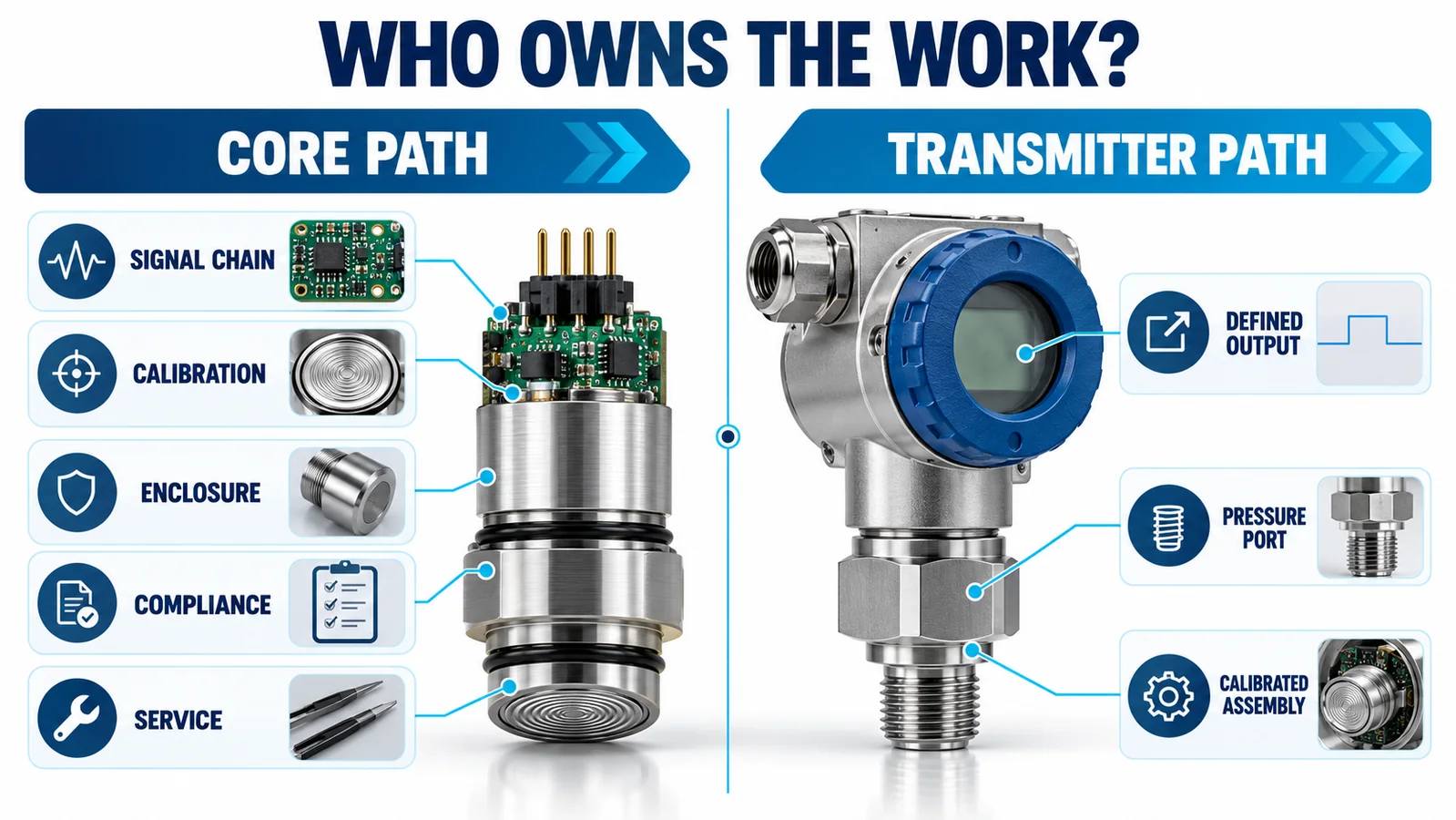
| Work item | Core path: typical owner | Transmitter path: typical owner |
|---|---|---|
| Bridge excitation and amplification | OEM | Supplier |
| Temperature compensation | OEM or jointly defined | Supplier within specified conditions |
| Pressure port and sealing | OEM | Supplier for the transmitter assembly |
| Housing and connector | OEM | Supplier options plus OEM installation |
| Calibration equipment and coefficients | OEM | Supplier |
| Final machine validation | OEM | OEM |
| Product compliance evidence | OEM integrates all component evidence | OEM integrates transmitter evidence |
| Field fault diagnosis | OEM to core and circuit level | OEM system diagnosis; supplier instrument diagnosis |
| Warranty boundary | Broad OEM responsibility | Clearer component boundary if specifications are met |
Responsibility is not eliminated by buying a transmitter; it is moved to a clearer interface. The OEM must still define pressure range, reference type, output, supply, process media, temperature, mechanical connection and abnormal conditions.
How Do PCB and Signal-Chain Requirements Change?
A piezoresistive pressure core often behaves as a Wheatstone bridge with a millivolt-level output. Small errors in excitation, gain, reference voltage, grounding and layout can become measurement errors. A complete transmitter performs much of this work internally.

Excitation and analog front end
The design must match constant-current or constant-voltage excitation requirements. The amplifier needs suitable input range, common-mode behavior, offset, drift and noise. Protection components must survive the electrical environment without adding unacceptable leakage or temperature error.
Conversion, filtering and output
ADC resolution alone does not determine useful resolution. Reference stability, noise, sampling rate and digital filtering must support the required response time. The output stage must match the host system and cable length. A 4–20 mA loop, voltage output and digital bus have different grounding, diagnostic and EMC requirements.
Firmware and diagnostics
If compensation coefficients are stored in production, firmware must manage identity, version, programming and verification. Decide how the system detects open circuits, short circuits, out-of-range signals and corrupted calibration data. These functions become part of the OEM product specification and validation plan.
Who Owns Compensation and Calibration?
Raw sensor output changes with applied pressure and temperature. Compensation converts that behavior into an output that meets the stated error limits. Calibration establishes the relationship between known pressure references and the product output.

Compensation is more than a room-temperature trim
A one-point zero adjustment cannot characterize span, nonlinearity and temperature behavior. The required pressure and temperature points depend on the accuracy model, operating range and compensation algorithm. The OEM must specify how coefficients are generated, stored and protected.
Assembly can require final calibration
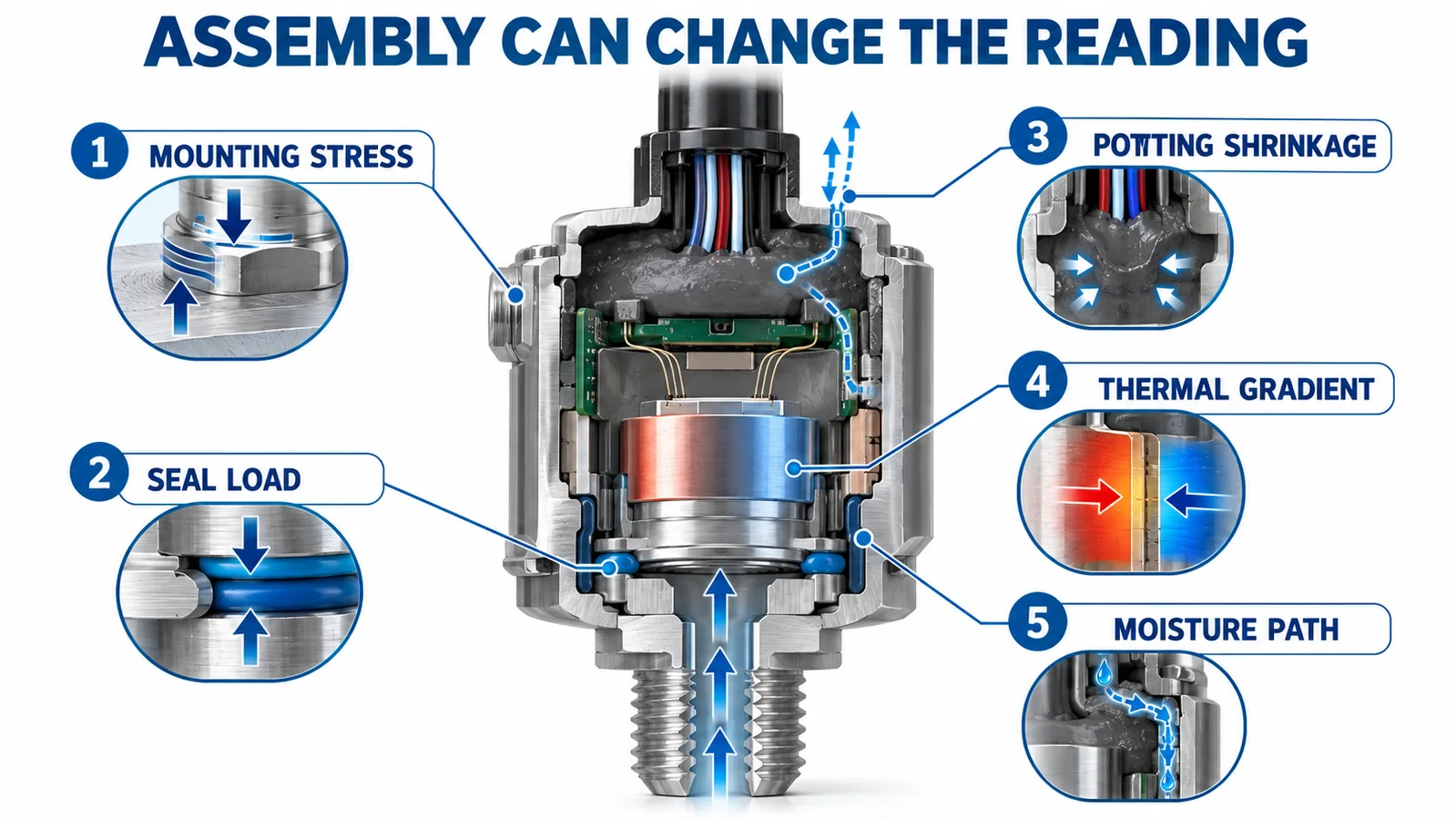
Mounting stress, welding, seals, potting and thermal paths can shift zero or span after a core has been characterized. A calibration performed before final assembly may not represent the finished product. The validation plan should compare the sensor before and after the actual production processes.
Traceability must be designed into production
Reference instruments need suitable uncertainty, calibration status and environmental control. Each product record should link the unit identity to test limits, results, coefficients, software version and operator or station. A failed unit needs a controlled disposition rather than an undocumented retrim.
What Changes in Packaging, Sealing and EMC?
The pressure package is part of the measurement system. Mechanical and environmental decisions can alter both reliability and accuracy.
Pressure interface and media compatibility
Define wetted materials, pressure reference, sealing method, proof conditions and cleaning requirements. Thread geometry alone does not define a safe connection. The mating port, seal location, tightening method and installation load all matter.
Enclosure and moisture control
A core does not automatically provide cable strain relief, condensation control or ingress protection. Venting for gauge pressure needs a clean atmospheric reference without creating a moisture path. Potting can protect electronics, but shrinkage and thermal expansion can stress the sensing assembly.
EMC and electrical protection
The final product needs immunity and emissions performance appropriate to its environment. Cable shields, connector pinout, grounding, surge protection and PCB layout work as a system. A transmitter with a defined interface reduces design scope, but the complete machine still needs validation with its real wiring and power architecture.
How Do NRE, Unit Cost and Production Volume Interact?
Unit price is only one line in the make-or-buy model. The core path adds non-recurring engineering, equipment and ongoing process costs. The transmitter path usually has a higher purchase price but can reduce development time and factory complexity.

Use a program cost model:
Total program cost = purchased parts + engineering + tooling + calibration and test + scrap and rework + compliance + warranty + lifecycle support.
Core economics improve with reuse
A core platform becomes more attractive when one validated electronics and calibration architecture can serve multiple product ranges. Reuse spreads the engineering and equipment cost over more units and programs. Customization that creates a different process for every variant weakens this advantage.
Transmitters reduce schedule exposure
A complete transmitter can shorten the critical path when the project team does not already have pressure calibration and packaging capability. Earlier launch, lower inventory risk and fewer production stations may justify a higher unit price. Model schedule risk explicitly instead of treating it as zero.
Avoid invented break-even volumes
There is no universal annual volume at which a core becomes cheaper. Labor rate, calibration time, yield, number of ranges, compliance scope and warranty exposure vary widely. Calculate break-even with quotations and measured process times from the actual program.
Who Owns Yield, Traceability and Change Control?
Prototype performance does not predict production yield by itself. The make-or-buy decision must include the controls required to reproduce the measurement at scale.
Incoming and in-process control
For a core, incoming inspection may cover identity, visual condition and electrical checks, while functional acceptance occurs after assembly and calibration. Define how lots are segregated and how failures are returned. For a transmitter, incoming checks can focus on configuration, documentation and sampled performance.
Change notification
Ask how the supplier controls sensing die, materials, process, firmware and manufacturing-site changes. Internally, the OEM also needs revision control for PCB, coefficients, test software, fixtures and work instructions. A small component change can invalidate calibration assumptions.
End-of-line verification
Every path needs a final check that represents the customer interface. A core-based product may require multiple pressure and temperature stages. A transmitter-based machine may only need configuration, zero, scaling and communication checks, but those checks still require recorded acceptance limits.
How Does Field Service and Warranty Change?
Field support exposes the practical value of a clear system boundary. With a complete transmitter, service teams can often replace and configure a defined instrument. With an embedded core, the service unit may be a PCB, manifold or complete OEM assembly.
Define how technicians will isolate a fault among the pressure connection, sensor, wiring, power, configuration and controller. Provide safe replacement steps and determine whether field calibration is allowed. If a returned product cannot preserve its calibration data and event history, root-cause analysis becomes difficult.
Warranty terms should match the architecture. A core supplier can evaluate the supplied core, but the OEM owns stresses introduced by welding, seals, electronics and installation. A transmitter supplier can evaluate the integrated instrument, while the OEM remains responsible for selection and use outside the stated limits.
Decision Matrix: Core, Module or Transmitter
Score each question using evidence from the current program. A high production volume alone is insufficient if the organization lacks calibration discipline or if every unit needs a different enclosure.
| Program condition | Core | Modül | Verici |
|---|---|---|---|
| Proprietary miniature package is essential | Strong | Strong | Sınırlı |
| Existing analog and calibration platform | Strong | Strong | Acceptable |
| Fastest launch is the priority | Weak | Orta | Strong |
| Multiple standard industrial outputs required | Weak | Orta | Strong |
| OEM can operate pressure and temperature calibration | Strong | Orta | Not required for component production |
| Low or uncertain volume | Weak | Orta | Strong |
| Field-replaceable instrument required | Weak | Orta | Strong |
| Exact connector and housing are already available | Weak | Orta | Strong |
| Product family can reuse one sensing platform | Strong | Strong | Orta |
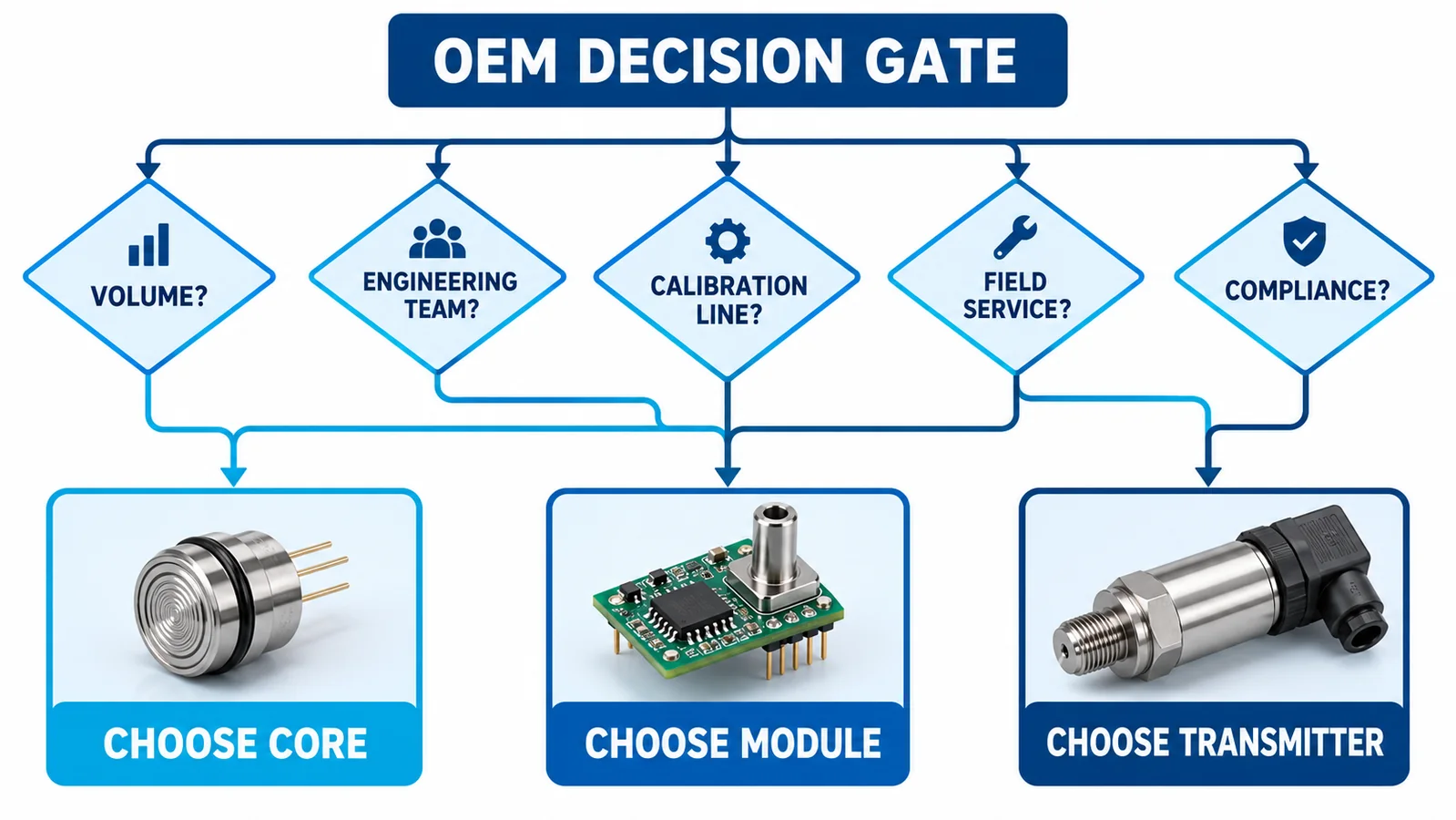
Run a design review with engineering, operations, quality, sourcing and service. If any essential capability is only assumed, assign an owner and validation action before selecting the architecture.
How Do Winsen WPAK63 and WPCK07 Represent the Two Paths?
Winsen WPAK63 is an OEM pressure core. According to its product documentation, it uses a diffused-silicon sensing chip in a 316L stainless-steel housing and diaphragm. It is offered for gauge, absolute and sealed-gauge measurement, with ranges from negative pressure through high pressure, constant-current or constant-voltage excitation options, and a response time of 1 ms or less. The OEM uses the core as the sensing foundation and completes the rest of the product architecture.
. Winsen WPCK07 is a complete pressure transmitter. Its internal circuit converts the core’s millivolt signal to a standard electrical output. Available interfaces include 4–20 mA, several voltage outputs, I²C and RS485, with configuration depending on the selected version. The stainless-steel transmitter provides a defined pressure connection and a calibrated interface for the host system. OEM teams that have already chosen a complete transmitter can use the separate custom pressure transmitter guide to structure detailed customization work.
These products are not interchangeable levels of the same bill of materials. WPAK63 offers more integration freedom and more OEM responsibility. WPCK07 packages the sensing, conditioning and mechanical interface into a defined transmitter. Confirm range, reference, output, supply, thread, media, temperature and performance for the exact ordered configuration.
What Should Go in the RFQ?
A useful request for quotation describes the measurement and the intended responsibility boundary. Include:
- normal, minimum and maximum pressure, including transients;
- gauge, absolute, sealed-gauge or differential reference;
- media, wetted-material and cleaning requirements;
- operating, storage and compensation temperature ranges;
- accuracy definition, including whether it is full-scale or reading based;
- response time and filtering needs;
- output, supply, load, cable length and connector;
- pressure port, seal and installation torque;
- overload, proof, burst, vibration and shock conditions;
- EMC, ingress, regulatory and industry requirements;
- expected annual volume, ramp profile and product life;
- calibration, traceability and change-notification expectations;
- service unit, warranty boundary and failure-analysis process.
For a core, also provide packaging constraints, excitation method, target signal chain and the planned calibration process. For a transmitter, define the acceptable mechanical envelope and host-system interface. Request samples that match the intended configuration rather than a convenient demonstration range.
Sıkça Sorulan Sorular
Is a pressure core always cheaper than a transmitter?
Its purchase price is usually lower, but the completed OEM product can cost more after electronics, packaging, calibration, scrap, compliance and support are included. Compare total program cost.
Can a calibrated core be installed without final verification?
It should be verified after the real assembly process. Mounting, welding, seals, potting and thermal paths can change the output. The amount of final calibration depends on the design and validated process capability.
Does a complete transmitter remove all OEM testing?
No. The OEM still verifies configuration, installation, system scaling, communication, alarms and performance in the final machine. The transmitter reduces component-level integration work.
When is a compensated module the best choice?
It is useful when the OEM needs a proprietary package or connector but does not want to build the raw bridge compensation and calibration process. The exact boundary varies by supplier, so specify what the module output includes.
What information should be agreed before samples are ordered?
Agree on range, pressure reference, media, temperature, accuracy definition, output, supply, connection, package, abnormal pressure, environmental tests and calibration responsibility. Samples without a frozen interface can create misleading results.
Build the Decision Around the Capability You Can Sustain
The pressure sensor core vs transmitter decision should match the capabilities the OEM can maintain through design changes, production ramp and field service. A core supports deep integration and platform reuse when the organization is prepared to own the signal chain, package and calibration process. A complete transmitter provides a clearer interface and a shorter path to a validated system.
Use the responsibility matrix and total-cost model before comparing quotations. For a project-specific review of WPAK63, WPCK07 or an intermediate integration level, request the OEM pressure-sensing selection checklist or contact Winsen engineers with your pressure range, media, output, package and annual-volume requirements.
