

A hygienic pressure sensor for food processing must do more than measure pressure accurately. Its product-contact geometry, surface condition, materials, seal, process connection, mounting orientation and cleaning exposure must work as one cleanable measurement point. A flush diaphragm can remove the narrow pressure-port cavity that traps viscous food, but “flush,” “sanitary” or “food-grade” wording does not by itself prove 3-A Symbol authorization or EHEDG certification.
For a defensible selection, define the food product and pressure task, document the complete CIP or SIP cycle, choose the range and output, specify the hygienic connection and seal, and verify every required certificate against the exact model and configuration. The sensor element, adapter and installed assembly all matter.
| Engineering question | Evidence to request |
|---|---|
| Will the product contact a cavity or crevice? | Section drawing of the installed diaphragm, adapter and seal |
| Can the measurement point be cleaned and drained? | Installation drawing, orientation rules and cleaning-validation plan |
| Are wetted materials suitable? | Material declarations, elastomer data and product compatibility review |
| Can it survive cleaning? | Permitted temperature, pressure, chemical, duration and thermal-cycle limits |
| Is a hygiene approval required? | Current certificate covering the exact model, connection and conditions of use |
| Will the signal fit the control system? | Configured range, reference type, output, excitation and calibration data |
Why Use a Flush Diaphragm in Food Processing?
A conventional pressure port places the sensing diaphragm behind a narrow passage. That arrangement can work well with clean, low-viscosity utilities, but yogurt, cream, syrup, sauce, fruit preparations and products containing particles can collect in the passage. Product can dry, harden, ferment or block the port. The resulting reading may drift or respond slowly, and the trapped material can be difficult to expose to cleaning flow.
A flush diaphragm brings the sensing surface close to the process wall. It reduces the internal cavity and presents a broad face to the product and cleaning solution. This can improve response with viscous media and reduce blockage risk.

Flush does not mean automatically hygienic
Flush industrial sensors are also sold for paint, adhesive, sludge and other dirty media. A flush thread and ceramic cell may resist blockage without meeting food-process hygienic-design or certification requirements. The word describes geometry; it does not establish surface finish, seal design, food-contact declarations, cleanability testing or certification.
The diaphragm still needs application review
Confirm compatibility with the product, cleaning chemicals and temperature cycle. Thin metallic diaphragms can be sensitive to mechanical impact, aggressive scraping, vacuum conditions, thermal shock and incorrect clamp assembly. A diaphragm material such as 316L is one part of the wetted system; seals, adapters and any internal fill fluid also require review.
What Makes the Complete Measurement Point Hygienic?
Hygienic performance belongs to the installed assembly. A well-designed sensor can be undermined by a recessed adapter, a seal that intrudes into the bore, a horizontal pocket that does not drain or a spray pattern that misses the sensing face.

Flush alignment and cavity control
Review a section drawing of the final connection. The diaphragm should sit where the design intends, without an unintended annular gap, step or pocket. “Clamp connection” alone does not prove flush alignment because ferrule dimensions, adapter geometry, gasket compression and sensor dimensions determine the final profile.
Drainability and orientation
After cleaning, liquid should not remain trapped around the diaphragm, seal or adapter. Tank-wall and pipe installations may need different orientations. Consider whether the line drains under gravity, whether air pockets form and whether the sensor body creates an external ledge that collects soil or wash water.
Surface finish and fabrication
Ask which surfaces contact product, how their finish is specified and how it is documented. A nominal stainless grade does not define roughness, weld quality, passivation or electropolishing. Scratches, poorly finished welds and damaged diaphragm surfaces can change cleanability even when the original design was sound.
Seal placement and material
The gasket must match the connection and remain correctly located after clamp tightening and thermal cycling. Verify product and cleaning-chemical compatibility, temperature limits, compression behavior, traceability and any required food-contact declaration. A protruding, rolled or damaged seal can create a product trap.
Cleaning coverage and service access
The cleaning process must reach the sensing face with the required flow, chemistry, temperature and time. Service access should allow inspection and replacement without damaging the ferrule or contaminating the line. Define how the line is made safe before loosening any clamp.
Does Hygienic Design Mean 3-A or EHEDG Certified?
No. These terms describe different kinds of evidence.
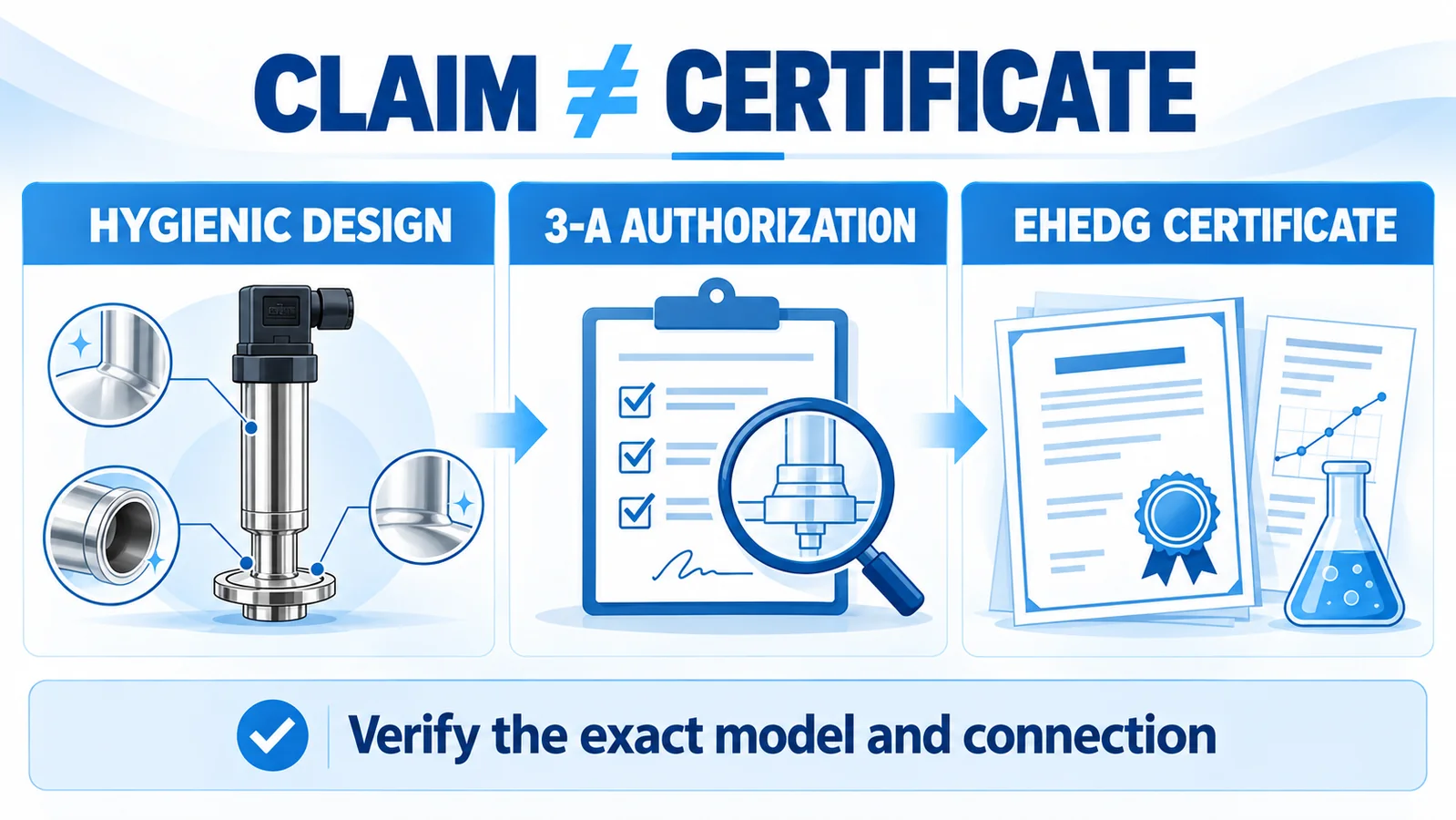
Hygienic design claim
A manufacturer may describe geometry, materials and intended applications as hygienic. The claim can be technically useful, but buyers still need the supporting drawings, specifications and declarations. It does not automatically grant the right to display a certification mark.
3-A Symbol authorization
3-A Sanitary Standards, Inc. states that the 3-A Symbol identifies equipment meeting applicable sanitary standards for design and fabrication. Authorization involves independent Third Party Verification, and certificate information is publicly searchable. Sensors and their fittings have a dedicated standard, 3-A 74-07.
Verify the manufacturer, authorization number, covered model family, process connection and certificate status. A company holding a 3-A authorization for one product does not make every product in its catalog authorized.
EHEDG certification
EHEDG publishes guidance for hygienic design and application of sensors. Certification uses defined hygienic-design criteria and, where applicable, cleanability testing. The certificate has a scope and conditions of use. Confirm that the exact sensor and connection are covered and that installation follows the stated conditions.
How to write the purchase requirement
State whether certification is mandatory, which scheme and equipment class applies, and what evidence must accompany delivery. Avoid phrases such as “designed to hygienic principles or equivalent” when the project actually requires a current certificate. Conversely, do not demand a certificate automatically for a non-product-contact utility measurement if the process risk assessment does not require it.
How Should CIP and SIP Exposure Be Specified?
CIP and SIP are operating cycles, not single temperature labels. The sensor may see changing pressure, vacuum, chemical concentration, flow velocity and temperature. Rapid transitions can be more demanding than steady process conditions.

Document every stage
For each stage, record the medium, concentration, temperature, pressure or vacuum, duration, flow condition and transition rate. Include pre-rinse, alkaline or acid wash, intermediate rinse, final rinse, sanitizing or steam step and return to production. Note whether the sensor remains powered and whether readings are used during cleaning.
Separate process and cleaning limits
The normal product temperature may be modest while cleaning is much hotter. A published working-temperature range does not automatically approve repeated exposure to a specific thermal cycle. Confirm the limit for the assembled sensor, diaphragm, seal, connector and cable, plus allowable exposure time and thermal-shock conditions.
Check vacuum and pressure reversals
Tank draining, cooling after a hot cycle or blocked venting can create vacuum. Low-pressure and absolute-pressure applications need particular attention to diaphragm behavior, reference type and overload in both directions. State credible positive and negative pressures rather than only the normal operating value.
Revalidate after changes
A different gasket, adapter, cleaning chemical, temperature profile or mounting orientation can change the measurement point. Treat these as controlled changes and decide whether cleaning validation, calibration or certificate review must be repeated.
How Do You Select the Pressure Range and Signal?
The hygienic connection solves only the product-interface problem. The sensing and electrical design must still match the measurement task.

Pressure range and reference
Record normal pressure, minimum pressure, vacuum, maximum operating pressure, cleaning pressure and credible transients. Choose the narrowest configured range that covers the required envelope with suitable margin. Confirm overload and burst limits separately.
Gauge pressure is common for vented tanks and process lines. Absolute pressure may be needed for vacuum processes, sealed systems or calculations that must not change with atmospheric pressure. The controller and engineering documents must use the same reference.
Accuracy and temperature effects
Read the entire specification: non-linearity, zero offset, span output, temperature compensation, drift and repeatability may be separate. A percentage-of-full-scale term depends on the selected range; oversizing the range increases the absolute error allowance. See the guide to pressure sensor accuracy in %FS and %reading.
Sensor element versus transmitter
A millivolt bridge sensor requires stable excitation, amplification, temperature compensation and system calibration. It is not a drop-in 4–20 mA transmitter. Decide whether the OEM will integrate a sensing element into its electronics or needs a complete housed transmitter with a standardized industrial output.
Product behavior and diaphragm size
Low pressure, viscosity, particles and allowable pressure drop can affect diaphragm and installation choices. A larger flush diaphragm may improve low-pressure sensitivity but also changes mechanical dimensions and cleaning geometry. Ask for the range-specific drawing rather than assuming all ranges share the same construction.
How Should the Process Connection Be Selected?
Match the sensor connection to the plant standard, ferrule dimensions, pressure rating and cleaning method. A nominal 2-inch clamp description may not define every dimension or gasket standard needed for interchangeability.
Verify the exact connection drawing
Compare sensor, ferrule, gasket and clamp drawings. Confirm diaphragm position, gasket compression, bore diameter and pressure-temperature rating. Do not adapt a hygienic clamp sensor with an improvised threaded pocket that recreates a recess.
Treat thread information separately
Some sensor assemblies have rear threads or electrical attachment threads that are not process connections. The NPT versus G thread guide helps identify ordinary threaded pressure interfaces, but hygienic clamp assemblies require their own dimensional and seal verification.
How Is the Installation Commissioned and Verified?
Commissioning should prove identity, assembly, measurement and cleaning readiness before the line enters production.
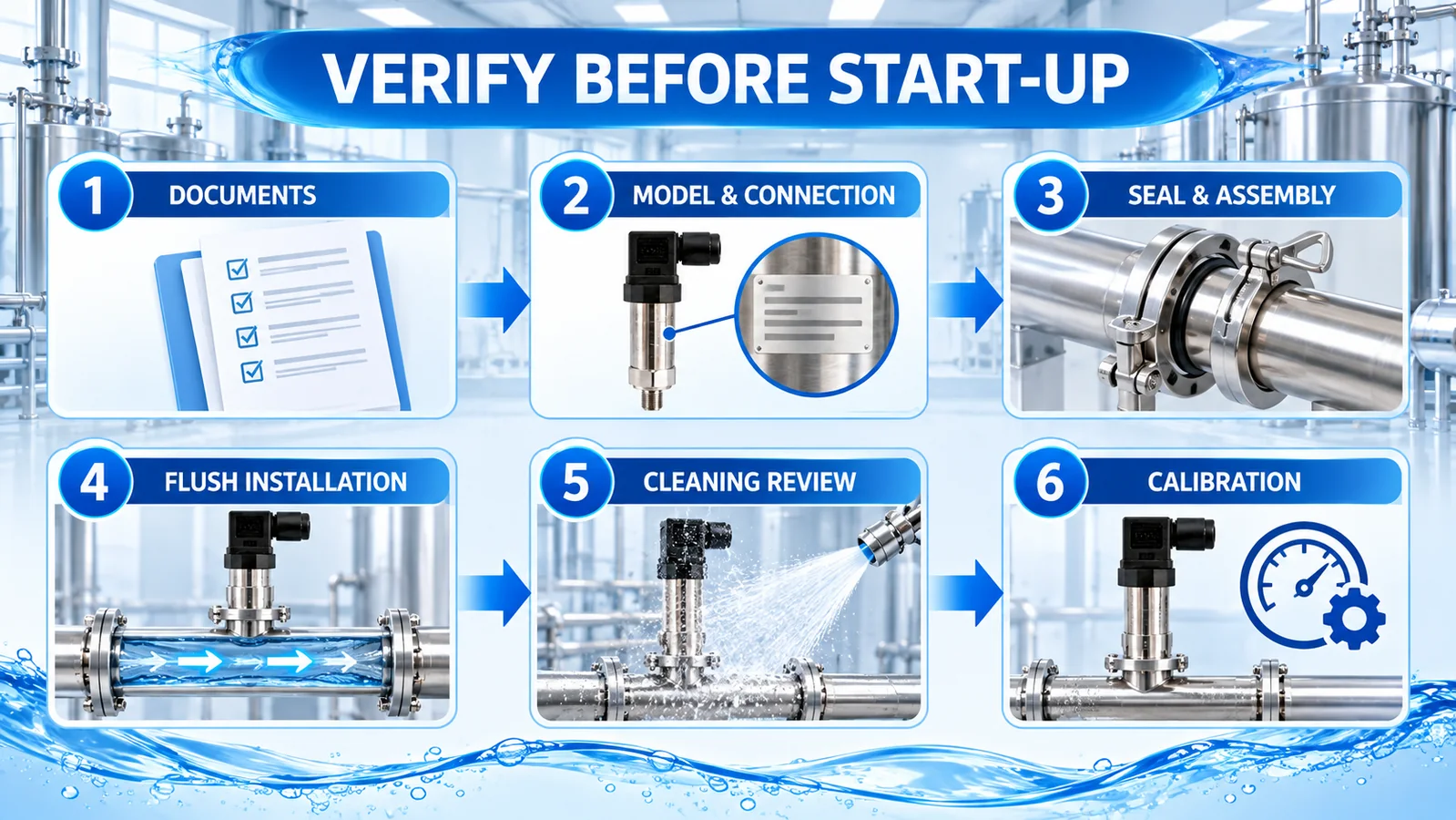
- Documents: collect the current data sheet, drawing, material declarations, calibration record and required certificate.
- Model and connection: confirm the delivered model, range, reference, excitation or output, diaphragm material, clamp size and rear connection.
- Seal and assembly: verify gasket material, condition, location and clamp installation using the approved procedure.
- Flush installation: inspect the product-contact profile and orientation; confirm there is no unintended recess or pocket.
- Cleaning review: compare the actual CIP/SIP recipe and spray coverage with the approved limits and validation plan.
- Calibration: check the complete signal chain at appropriate pressure points and confirm controller scaling, units and alarms.
Record photographs, part numbers and configuration data. After the first cleaning cycles, inspect for gasket movement, leakage, residue, moisture ingress and zero shift. Define periodic inspection and calibration intervals from process risk, drift history and quality-system requirements.
Where Can Winsen WPAK76 and WPAK77 Be Evaluated?
Winsen’s current public pages describe both models as clamp-type flush-diaphragm pressure sensors for industrial, medical, food and beverage processing applications. They are sensor elements with millivolt bridge output, intended for integration and calibration in a complete device or system.
| Yayınlanan öğe | WPAK76 | WPAK77 |
|---|---|---|
| İlke | Diffused-silicon piezoresistive, flush diaphragm | Diffused-silicon piezoresistive, flush diaphragm |
| Range family | 0–10 kPa through 0–6 MPa | 0–10 kPa through 0–6 MPa |
| Basınç referansı | Gauge or absolute | Gauge or absolute |
| Output/excitation | Millivolt bridge; 1.5 mA, 5 V or 10 V excitation listed | Millivolt bridge; 1.5 mA, 5 V or 10 V excitation listed |
| Doğrusal olmama | ≤0.25%FS | ≤0.25%FS |
| Çalışma sıcaklığı | −40°C to 120°C | −40°C to 120°C |
| Diyafram | 316L default; Hastelloy C optional | 316L default; Hastelloy C optional |
| Published clamp options | 2-inch or 2.5-inch | 2-inch or 2.5-inch |
The two public pages currently show essentially the same core specification set. Request the latest data sheets and dimension drawings to establish the actual mechanical or ordering differences. Neither public page provides a model-specific 3-A authorization number or EHEDG certificate. Do not claim those approvals without current documents covering the exact ordered configuration.
The listed −40°C to 120°C working temperature also does not, by itself, approve a particular CIP or SIP recipe. Confirm duration, chemical exposure, thermal transitions, seal limits and the complete assembly.
RFQ'ya Neler Dahil Edilmelidir?
Provide:
- food or beverage product, viscosity, particles and cleaning residues;
- measurement location and purpose;
- pressure range, vacuum, overload and transients;
- gauge or absolute reference;
- process and full CIP/SIP cycle conditions;
- diaphragm, seal and other wetted-material requirements;
- required surface-finish evidence and traceability;
- exact process connection, ferrule and gasket standard;
- output or bridge excitation, cable and controller interface;
- housing, connector and washdown exposure for the complete assembly;
- required 3-A, EHEDG or other certificates with scope;
- drawings, material declarations, calibration and inspection records.
Sıkça Sorulan Sorular
Is every flush-diaphragm pressure sensor suitable for food contact?
No. Flush geometry can help with viscous or dirty media in many industries. Food-contact suitability also depends on wetted materials, surface condition, seals, cleanability, installation and required declarations or certificates.
Does a sanitary clamp prove 3-A compliance?
No. A clamp is a connection style. Verify a current 3-A Symbol authorization covering the exact equipment model and configuration when the project requires it.
Can a sensor rated to 120°C be used in SIP?
Only after the manufacturer confirms the complete assembled device for the actual temperature, duration, pressure, steam or cleaning medium and thermal transition. A working-temperature range alone is insufficient.
Why use absolute pressure in a food process?
Absolute pressure can suit vacuum vessels and processes where the measurement must reference vacuum rather than local atmosphere. The correct choice depends on the control calculation and operating envelope.
Are WPAK76 and WPAK77 complete transmitters?
Their current pages describe millivolt bridge sensor elements with excitation requirements. OEM electronics must provide signal conditioning and calibration, or a complete transmitter should be selected.
Çözüm
A hygienic food-process pressure measurement point combines cleanable geometry, compatible materials, a correct seal and connection, documented cleaning limits and a signal design that meets the control task. A flush diaphragm is valuable for viscous and particle-containing products, but certification claims require evidence for the exact model and configuration.
For a WPAK76 or WPAK77 evaluation, send Winsen the product, pressure envelope, complete CIP/SIP cycle, clamp dimensions, diaphragm material, excitation, integration requirements and mandatory certificates. Request the latest data sheet and drawings before approving the design.
