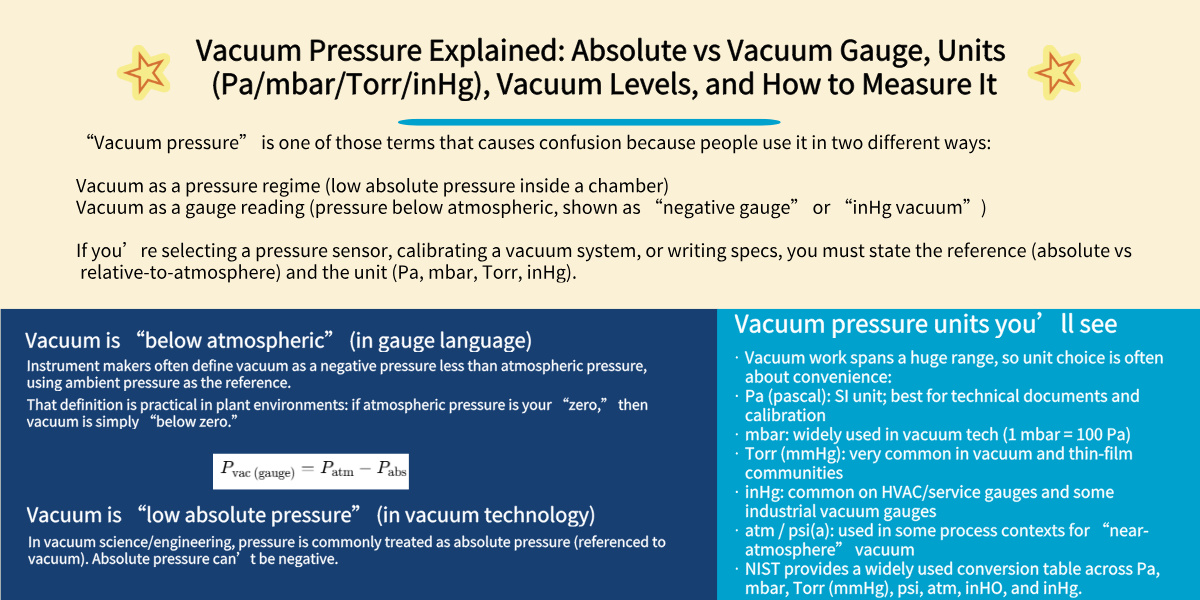
“Vacuum pressure” is one of those terms that causes confusion because people use it in two different ways:
- Vacuum as a pressure regime (low absolute pressure inside a chamber)
- Vacuum as a gauge reading (pressure below atmospheric, shown as “negative gauge” or “inHg vacuum”)
If you’re selecting a pressure sensor, calibrating a vacuum system, or writing specs, you must state the reference (absolute vs relative-to-atmosphere) and the unit (Pa, mbar, Torr, inHg).
1) What is vacuum pressure?
Vacuum is “below atmospheric” (in gauge language)
Instrument makers often define vacuum as a negative pressure less than atmospheric pressure, using ambient pressure as the reference.
That definition is practical in plant environments: if atmospheric pressure is your “zero,” then vacuum is simply “below zero.”
Vacuum is “low absolute pressure” (in vacuum technology)
In vacuum science/engineering, pressure is commonly treated as absolute pressure (referenced to vacuum). Absolute pressure can’t be negative.
2) Absolute pressure vs vacuum gauge pressure (the key difference)
Absolute pressure (Pabs)
- Reference: absolute vacuum (ideal zero)
- Examples: 80 kPa(a), 20 mbar(a), 1 Torr (absolute)
Ashcroft describes absolute pressure as referenced to absolute vacuum (zero pressure) and notes there is no negative absolute pressure.
Gauge pressure (Pg)
- Reference: ambient atmospheric pressure
- Gauge can be positive or negative, depending on whether you’re above or below atmosphere.
“Vacuum pressure” in many industries = a vacuum gauge reading
A common “vacuum” number is really the difference between atmospheric pressure and the absolute pressure in the system:

This matches the idea that vacuum is “below atmospheric” with atmosphere as the reference.
Important: The same physical condition can look different depending on how you report it:
- Chamber pressure = 20 kPa(a)
- If Patm ≈ 101.3 kPa(a), then vacuum gauge reading ≈ 81.3 kPa vacuum (or ≈ 24 inHg vacuum, depending on units)
Related Read: Absolute Pressure vs. Gauge Pressure vs. Differential Pressure
3) Vacuum pressure units you’ll see (and when to use them)
Vacuum work spans a huge range, so unit choice is often about convenience:
- Pa (pascal): SI unit; best for technical documents and calibration
- mbar: widely used in vacuum tech (1 mbar = 100 Pa)
- Torr (mmHg): very common in vacuum and thin-film communities
- inHg: common on HVAC/service gauges and some industrial vacuum gauges
- atm / psi(a): used in some process contexts for “near-atmosphere” vacuum
NIST provides a widely used conversion table across Pa, mbar, Torr (mmHg), psi, atm, inH₂O, and inHg.
Fast conversion anchors (from NIST)
- 1 Torr (mmHg) = 133.3224 Pa
- 1 atm = 101325 Pa = 760 Torr = 29.9213 inHg
- 1 inHg = 3386.389 Pa
4) Vacuum “levels” (rough → UHV) and what they mean
Vacuum technology often splits the pressure spectrum into regimes. Leybold gives a common mbar-based classification and explicitly notes the boundaries are somewhat arbitrary.
Vacuum regimes (mbar-based, common in vacuum tech)
| Regime | Pressure range (mbar) | Typical meaning |
|---|---|---|
| Rough vacuum | 1000 → 1 mbar | pump-down from atmosphere, basic vacuum tasks |
| Medium vacuum | 1 → 10⁻³ mbar | better removal of gas load, prep for high-vac pumps |
| High vacuum | 10⁻³ → 10⁻⁷ mbar | thin films, electron optics, cleaner processes |
| Ultrahigh vacuum (UHV) | 10⁻⁷ → 10⁻¹⁴ mbar | surface science, advanced research |
Source: Leybold’s vacuum fundamentals page.
Vacuum regimes (Torr-based, commonly used in pump selection notes)
Kurt J. Lesker (vacuum pumps technical notes) lists an industry-recognized set of regimes in Torr:
| Regime | Pressure range (Torr) |
|---|---|
| Coarse vacuum | 760 → 1 Torr |
| Rough vacuum | 1 → 10⁻³ Torr |
| High vacuum | 10⁻⁴ → 10⁻⁸ Torr |
| Ultra-high vacuum | 10⁻⁹ → 10⁻¹² Torr |
These two tables look different because the exact boundaries vary by convention—so in specs, always state the actual pressure range you need, not only the regime name.
5) How vacuum pressure is measured (and which gauge works where)
A vacuum system often needs multiple gauge types, because no single gauge covers the entire dynamic range accurately.
5.1 Diaphragm gauges / capacitance manometers (high accuracy, gas-independent)
Capacitance manometers are valued because they measure diaphragm deflection (a more direct pressure measurement) and are often treated as more “absolute” in accuracy than many other vacuum gauge types. Lesker notes capacitance manometers have a useful range spanning roughly 25,000 Torr down to 10⁻⁵ Torr (with per-head dynamic range limits).
Best for: accurate pressure control, calibration, processes where gas composition changes.
5.2 Thermal conductivity gauges (Pirani / thermocouple)
MKS explains that at very low pressures, diaphragm deflection becomes too insensitive, and gauges for that regime are based on gas density and molecular properties—highlighting thermal conductivity gauges as a major category.
Best for: rough-to-medium vacuum monitoring (pump-down), general vacuum systems where extreme accuracy isn’t required.
5.3 Ionization gauges (hot/cold cathode; Bayard–Alpert for high vacuum)
For high vacuum, ionization gauges become important. Lesker gives a practical example: a common Bayard–Alpert gauge operates from about 10⁻⁴ Torr down to ~10⁻⁹ Torr.
Best for: high vacuum and UHV measurement.
5.4 A critical warning: many vacuum gauges are gas-dependent
Lesker cautions that most vacuum gauges (except capacitance manometers and diaphragm gauges) have different response factors for different gases, and should not be treated as “absolute truth” without calibration.
This matters a lot in:
- reactive gas processes
- leak testing with helium
- plasma/etch tools
- any system where gas composition changes
6) How to specify a vacuum sensor/transducer correctly
When a customer asks for “vacuum pressure,” clarify these items up front:
- Reference
- absolute (Pa(a), Torr abs) or vacuum gauge (inHg vacuum, “kPa vacuum”)
- Required range
- Example: 1000 mbar → 1 mbar (rough pump-down) vs 10⁻⁶ mbar (high vacuum)
Use actual numbers; regime names vary by convention.
- Example: 1000 mbar → 1 mbar (rough pump-down) vs 10⁻⁶ mbar (high vacuum)
- Accuracy expectations
- “% of reading” vs “%FS,” and whether gas composition changes
Gauge choice strongly affects accuracy claims.
- “% of reading” vs “%FS,” and whether gas composition changes
- Gas/media and contamination
- clean dry air vs solvents vs corrosives vs condensables
- Environment
- vibration, temperature, EMI, and mounting constraints
- Output/interface
- mV/V bridge (piezoresistive), voltage/current, or digital (I²C/SPI) for embedded systems
7) Common vacuum pressure mistakes (and how to avoid them)
Mistake 1: Treating “inHg vacuum” as an absolute pressure
InHg on many service gauges is a relative scale referenced to local atmosphere; it changes with weather and altitude. NIST shows 1 atm corresponds to 29.9213 inHg (absolute).
Fix: state whether the value is absolute inHg or “inHg vacuum” (relative).
Mistake 2: Using a gauge outside its intended range
Different gauge types have limited usable ranges (thermal conductivity vs ionization vs capacitance manometer).
Fix: choose gauge(s) based on the lowest pressure you must measure and the accuracy needed—you may need more than one gauge type.
Mistake 3: Ignoring gas-dependence
Many gauges require gas correction factors; reading “pressure” without considering the gas can be misleading.
FAQs
Is vacuum pressure negative?
It can be negative in gauge terms (below atmospheric), but absolute pressure is never negative.
What’s the difference between Torr and Pa?
They’re different units for the same quantity. NIST lists 1 Torr = 133.3224 Pa.
What vacuum level is “high vacuum”?
Definitions vary by convention. One common set is 10⁻³ to 10⁻⁷ mbar (Leybold). Another common Torr-based set places high vacuum around 10⁻⁴ to 10⁻⁸ Torr (Lesker pump notes).
Which vacuum gauge is the most accurate?
Capacitance manometers/diaphragm gauges are commonly treated as the most accurate “pressure-direct” gauges in vacuum systems, while many other gauges are gas-dependent and need calibration.
Why do I need more than one vacuum gauge?
Because different gauges cover different pressure ranges and have different limitations; even capacitance manometers often require multiple sensing heads to cover very wide ranges.