Pressure units look simple until you start mixing SI, imperial, vacuum, and manometer-based units in the same project. If you design or buy pressure sensors, set alarm thresholds, calibrate transmitters, or write datasheets, choosing the right unit (and converting it correctly) prevents expensive mistakes.
This guide consolidates the core topics typically covered by high-ranking engineering references—definitions, the most-used units, conversions, gauge vs absolute, vacuum units, and practical selection tips.
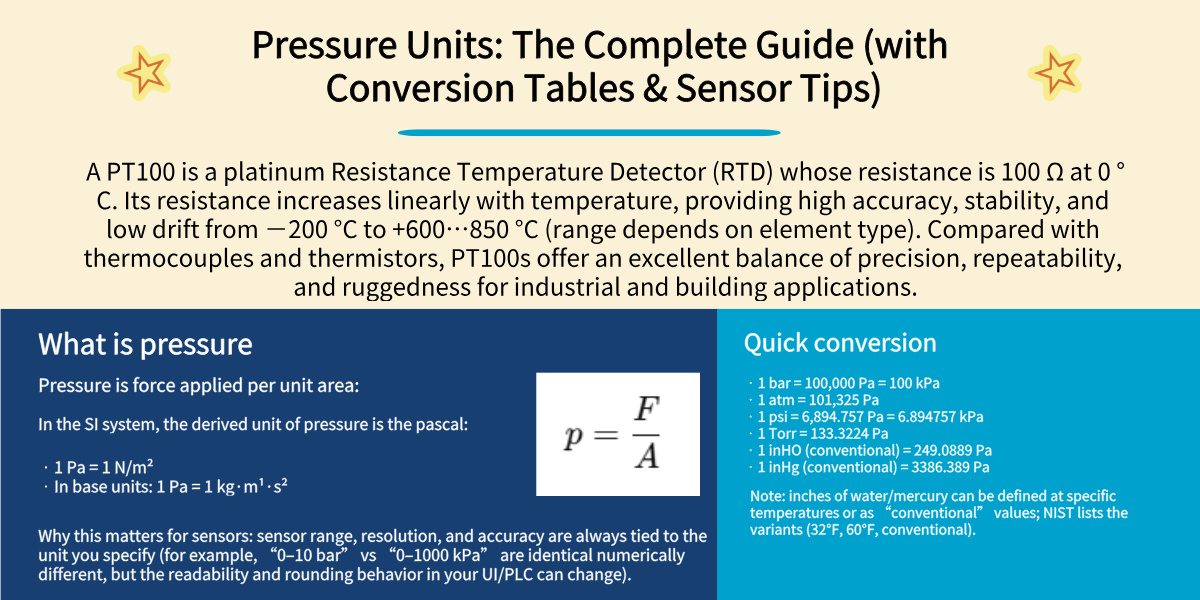
1) What is pressure (and why units matter)?
Pressure is force applied per unit area:

In the SI system, the derived unit of pressure is the pascal:
- 1 Pa = 1 N/m²
- In base units: 1 Pa = 1 kg·m⁻¹·s⁻²
Why this matters for sensors: sensor range, resolution, and accuracy are always tied to the unit you specify (for example, “0–10 bar” vs “0–1000 kPa” are identical numerically different, but the readability and rounding behavior in your UI/PLC can change).
2) The most common pressure units (and where they’re used)
SI units (recommended for engineering documentation)
- Pa (pascal): very small; good for low-pressure differentials, lab work
- kPa (kilopascal): HVAC, pneumatics, general engineering
- MPa (megapascal): hydraulics, high-pressure systems, industrial equipment
Industrial / regional favorites
- bar / mbar: extremely common in Europe and industrial specs; mbar also common in meteorology (often written as hPa, numerically equal to mbar in practice)
- psi: common in the US (compressed air, hydraulics, automotive, process)
Vacuum & manometer-based units
- atm: standard atmosphere (reference value)
- Torr / mmHg: vacuum and some instrumentation; mmHg also appears in medical contexts
- inHg: barometric pressure, vacuum gauges in some regions
- inH₂O: duct/static pressure in HVAC, cleanrooms, filters, fans
3) Quick conversion “anchors” (memorize these)
From authoritative NIST conversion factors:
- 1 bar = 100,000 Pa = 100 kPa
- 1 atm = 101,325 Pa
- 1 psi = 6,894.757 Pa = 6.894757 kPa
- 1 Torr = 133.3224 Pa
- 1 inH₂O (conventional) = 249.0889 Pa
- 1 inHg (conventional) = 3386.389 Pa
Note: inches of water/mercury can be defined at specific temperatures or as “conventional” values; NIST lists the variants (32°F, 60°F, conventional).
4) Universal conversion formula (works for any two units)
To convert Unit A → Unit B reliably:

Example factors (Pa per unit) are listed in the tables below (from NIST).
5) Pressure unit conversion table (to Pascals)
| Unit | Symbol | Exact/Standard value in Pa | Notes |
|---|---|---|---|
| pascal | Pa | 1 | SI base derived |
| kilopascal | kPa | 1,000 | 10² kPa = 1 bar |
| megapascal | MPa | 1,000,000 | hydraulics common |
| bar | bar | 100,000 | industrial standard |
| millibar | mbar | 100 | meteorology/low pressure |
| standard atmosphere | atm | 101,325 | reference |
| pound per square inch | psi | 6,894.757 | US common |
| Torr (≈ mmHg) | Torr | 133.3224 | vacuum |
| mmHg (conventional) | mmHg | 133.3224 | same table value |
| inH₂O (conventional) | inH₂O | 249.0889 | HVAC ducts |
| inHg (conventional) | inHg | 3386.389 | barometric/vacuum |
| kgf/cm² | kgf/cm² | 98,066.5 | legacy industrial |
| ksi | ksi | 6,894,757 | high stress/pressure |
6) Worked conversion examples (common in real projects)
Using NIST factors:
Example A: bar → psi
10 bar = 10×100,000 Pa ÷ 6894.757 Pa/psi = 145.038 psi.
Example B: kPa → psi
100 kPa = 100,000 Pa ÷ 6894.757 Pa/psi = 14.504 psi.
Example C: psi → kPa
10 psi =
10×6.894757 kPa = 68.9476 kPa.
Example D: Torr → kPa (vacuum)
500 Torr =
500×133.3224 Pa = 66.6612 kPa.
Example E: Pa → inH₂O (HVAC duct pressure)
250 Pa ÷ 249.0889 Pa/inH₂O = 1.0037 inH₂O.
7) Gauge vs absolute vs differential (units look the same—meaning doesn’t)
This is one of the most common sources of specification errors in pressure sensing.
Gauge pressure (relative to ambient)
- Written as psig, barg, kPa(g)
- A gauge sensor reads ~0 when open to atmosphere.
Absolute pressure (relative to perfect vacuum)
- Written as psia, bara, kPa(a)
- Needed for altitude compensation, vacuum, sealed chambers, barometric measurements.
Differential pressure (between two ports)
- Written as ΔP, “0–500 Pa DP”, “±1 kPa”
- Used for filters, flow elements, cleanrooms, and leak tests.
Tip: Always put the reference in the datasheet line item, not just the unit. “0–10 bar” is incomplete; “0–10 barg” or “0–10 bara” is unambiguous.
8) How to choose the “best” unit for your application
High-ranking technical references tend to converge on the same practical advice: pick units that keep your numbers readable and match regional expectations.
Quick selection rules
- ≤ 1 kPa differentials → use Pa (better resolution/readability)
- 1–1000 kPa → use kPa
- > 1 MPa or industrial systems → use MPa or bar
- US customer/spec sheet → include psi (often mandatory)
- HVAC ducts/filters → Pa or inH₂O
- Vacuum systems → Pa, mbar, Torr, sometimes inHg
Sensor specification tip (OEM-friendly)
When you publish a pressure sensor page or datasheet, include:
- Measurement type: gauge / absolute / differential
- Full-scale range and overpressure
- Output scaling (e.g., 0.5–4.5V corresponds to 0–10 bar)
- Temperature compensation range
- Media compatibility (air, water, oil, refrigerants, corrosives, etc.)
9) Pressure units in common industries
| Industry / use case | Typical unit(s) | Why |
|---|---|---|
| Hydraulics | MPa, bar, psi | high pressures, compact numbers |
| Pneumatics & compressors | kPa, bar, psi | regional preference + controller defaults |
| HVAC duct static pressure | Pa, inH₂O | small differentials |
| Meteorology/barometric | hPa/mbar, inHg | legacy + reporting standards |
| Vacuum pumps/chambers | Pa, mbar, Torr, inHg | vacuum gauge conventions |
| Process control transmitters | kPa, bar, psi | plant standardization |
10) FAQs (Google-friendly)
What is the SI unit of pressure?
The SI unit is the pascal (Pa), defined as 1 N/m².Is bar an SI unit?
bar is not an SI unit, but it’s widely used with SI. NIST lists 1 bar = 100,000 Pa.How many kPa are in 1 psi?
1 psi = 6.894757 kPa (NIST).What’s the difference between Torr and mmHg?
In many engineering contexts they’re treated similarly; NIST conversion tables give 1 Torr = 133.3224 Pa and list mmHg (conventional) with the same factor.Why do inH₂O and inHg sometimes have different values?
Because they can be defined at specific temperatures (e.g., 32°F, 60°F) or as “conventional” values. NIST lists multiple variants.What does psig vs psia mean?
psig is gauge pressure (relative to atmosphere). psia is absolute pressure (relative to vacuum). Same unit size, different zero reference.Which unit is best for HVAC duct pressure sensors?
Most HVAC static pressure work is small differential pressure, so Pa or inH₂O makes readings easy to interpret (and matches common instruments).How do I avoid conversion mistakes in specifications?
Always convert via Pa using the universal formula and publish both the unit and the pressure reference (gauge/absolute/differential). Use authoritative factors (like NIST).11) Need pressure sensors that match these units?
If you’re sourcing pressure sensors in bulk (OEM/ODM), the fastest way to avoid mis-specs is to align on:
- unit + reference (barg/bara/psig/psia/ΔP)
- range/overpressure
- output (I²C/SPI/UART, 4–20 mA, 0–10 V, ratiometric)
- media + port + sealing + temperature range
If you want, tell me your target application (HVAC, hydraulics, water, refrigerants, etc.) and the required range, Winsen will recommend best sensor to you.