
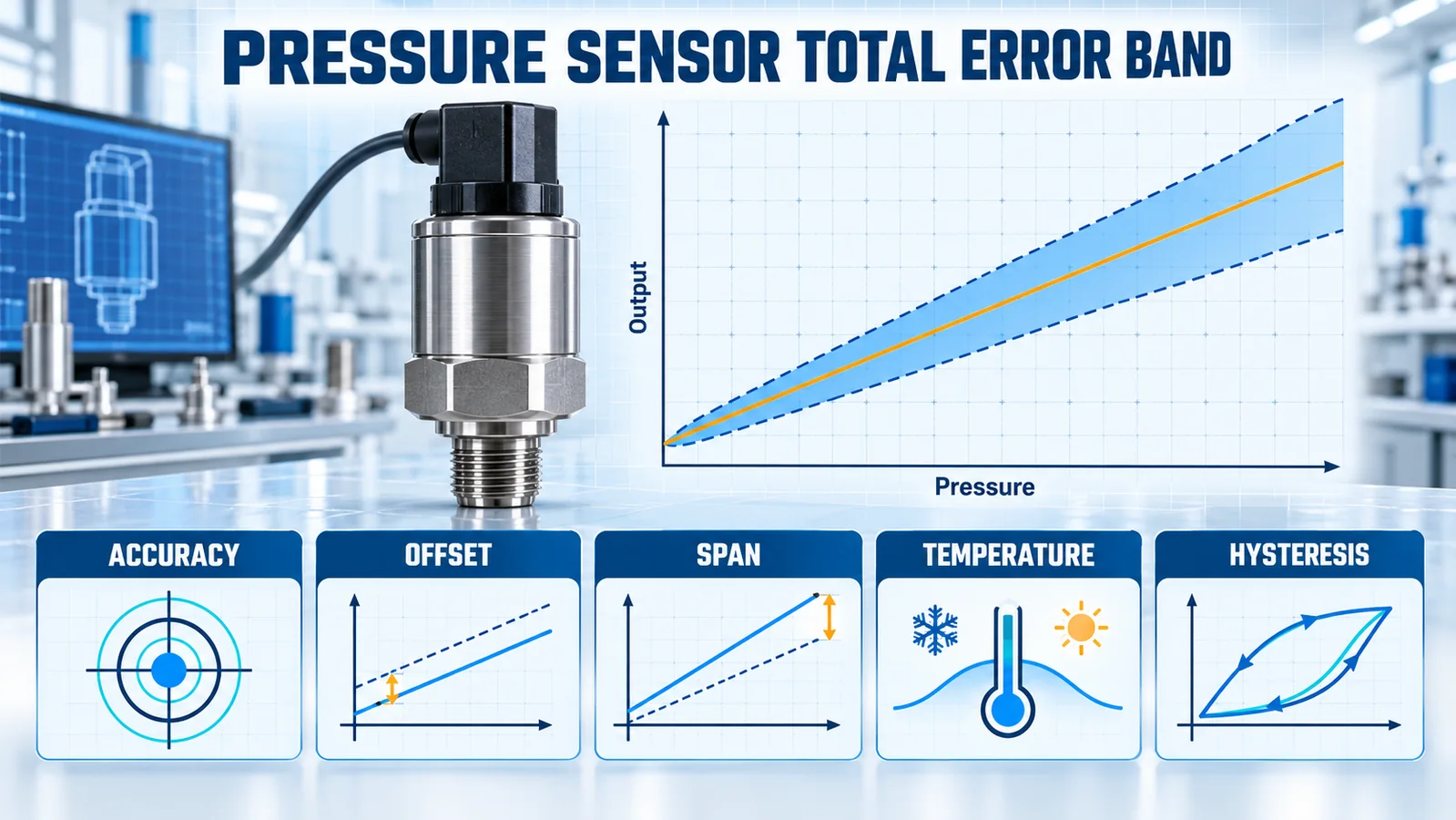
A pressure sensor may advertise ±0.25% accuracy and still allow a much larger measurement error across its working temperature range. The small number often describes performance near a reference temperature and may cover only non-linearity, hysteresis and repeatability. It may exclude zero offset, span offset, temperature effects and long-term drift.
Pressure sensor total error band, or TEB, is intended to provide a more complete error envelope over stated operating conditions. It can make system design easier, but the label is not enough. Engineers still need to check which errors are included, the temperature range, whether the value is typical or maximum, and which effects remain outside the specification.
| Datasheet number | Question it answers | Common limitation |
|---|---|---|
| Room-temperature accuracy | How close is the pressure response under stated reference conditions? | May exclude zero, span and thermal errors |
| Temperatuurafwijking | How much can zero or sensitivity change across a stated temperature range? | May be split into separate terms or use a different reference |
| Total error band | What error envelope is specified over stated pressure and temperature conditions? | Included terms and exclusions vary by supplier |
| Langdurige stabiliteit | How much can output change over time under stated conditions? | Often excluded from initial TEB |
| System accuracy | How close is the final installed measurement? | Includes electronics, calibration and installation beyond the sensor |
What Is the Short Answer?
TEB is a single bounded error specification intended to combine several pressure-sensor errors over a defined temperature range. It is normally more useful for worst-case system design than a room-temperature accuracy number alone.
However, there is no safe universal rule that every manufacturer includes exactly the same terms. One supplier may include initial zero and span errors, while another may assume the sensor is zeroed after installation. A TEB may apply only after board mount, after autozero or within a compensated range narrower than the operating range.
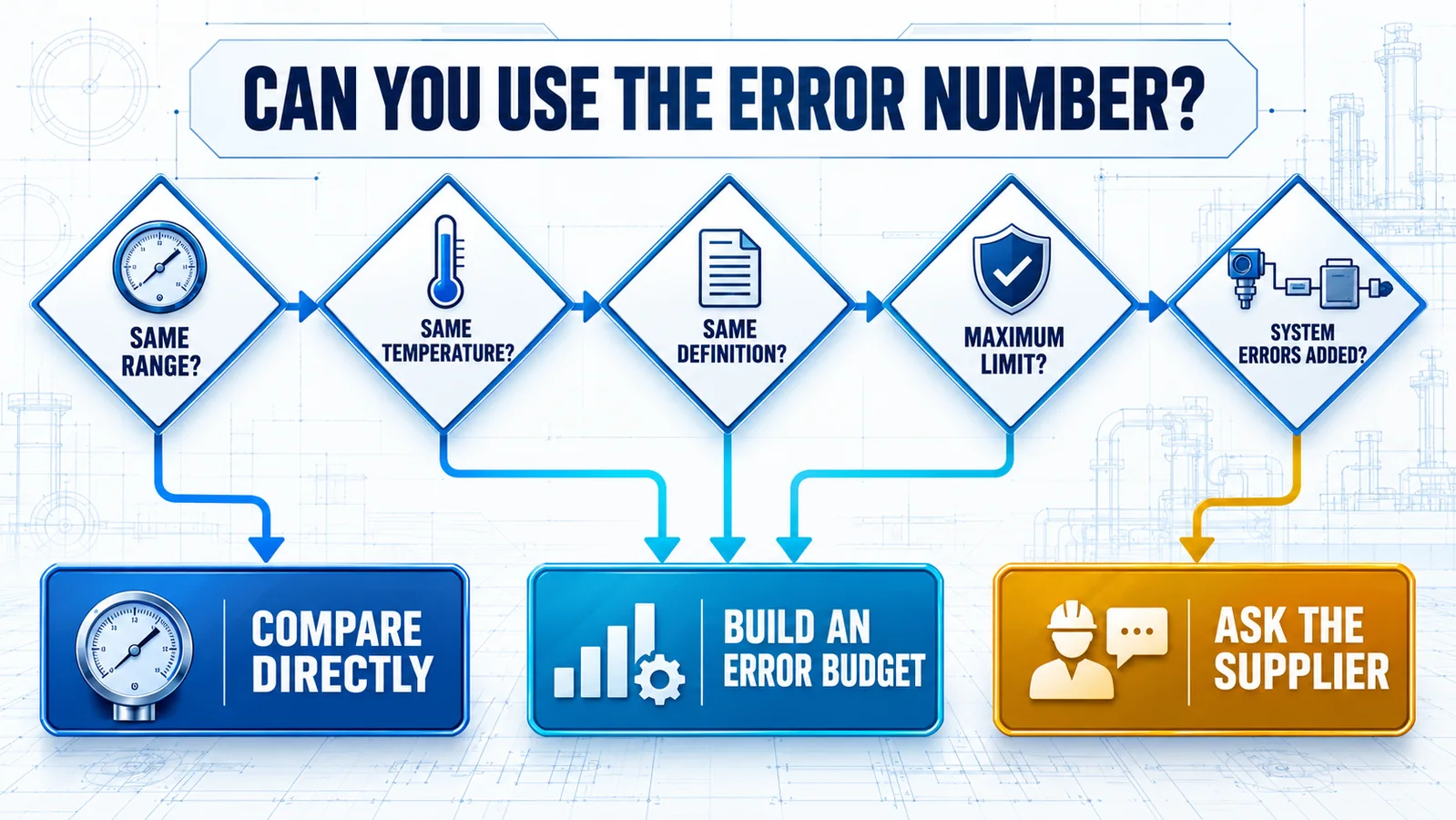
The practical rule is simple: compare TEB values only after matching the definition, temperature range, pressure range, calibration state and limit type. When a datasheet publishes separate error terms but no TEB, preserve those terms and build an application-specific error budget. Do not convert the result into an official supplier TEB.
What Does Total Error Band Mean?
An ideal sensor follows a perfectly known transfer function from pressure to output. A real sensor departs from that line because of manufacturing tolerances, mechanical behavior, electronics and temperature. TEB draws an upper and lower boundary around the allowed output or calculated pressure.
De Honeywell TEB technical note describes accuracy as one component of TEB and shows a broader group of offset, span, pressure-response and thermal errors. The important point is the envelope, not the marketing name.
A bounded specification needs conditions
A statement such as “±1%FS TEB” is incomplete without its temperature range, supply, load, pressure range and calibration assumptions. A useful specification might state ±1%FS over -20 to 85°C after autozero. That is materially different from ±1%FS at 25°C.
TEB is not measurement uncertainty by itself
TEB is a product performance limit defined by the manufacturer. A formal uncertainty analysis can also include calibration-reference uncertainty, resolution, sampling, installation, process dynamics and statistical treatment. Do not use the words interchangeably in regulated or metrology work.
How Is Accuracy Different from TEB?
Accuracy is an overloaded word. In one datasheet it may mean best-fit straight-line non-linearity. In another, it may combine non-linearity, hysteresis and repeatability. Some products add zero and span setting errors. The only reliable definition is the footnote attached to that product.
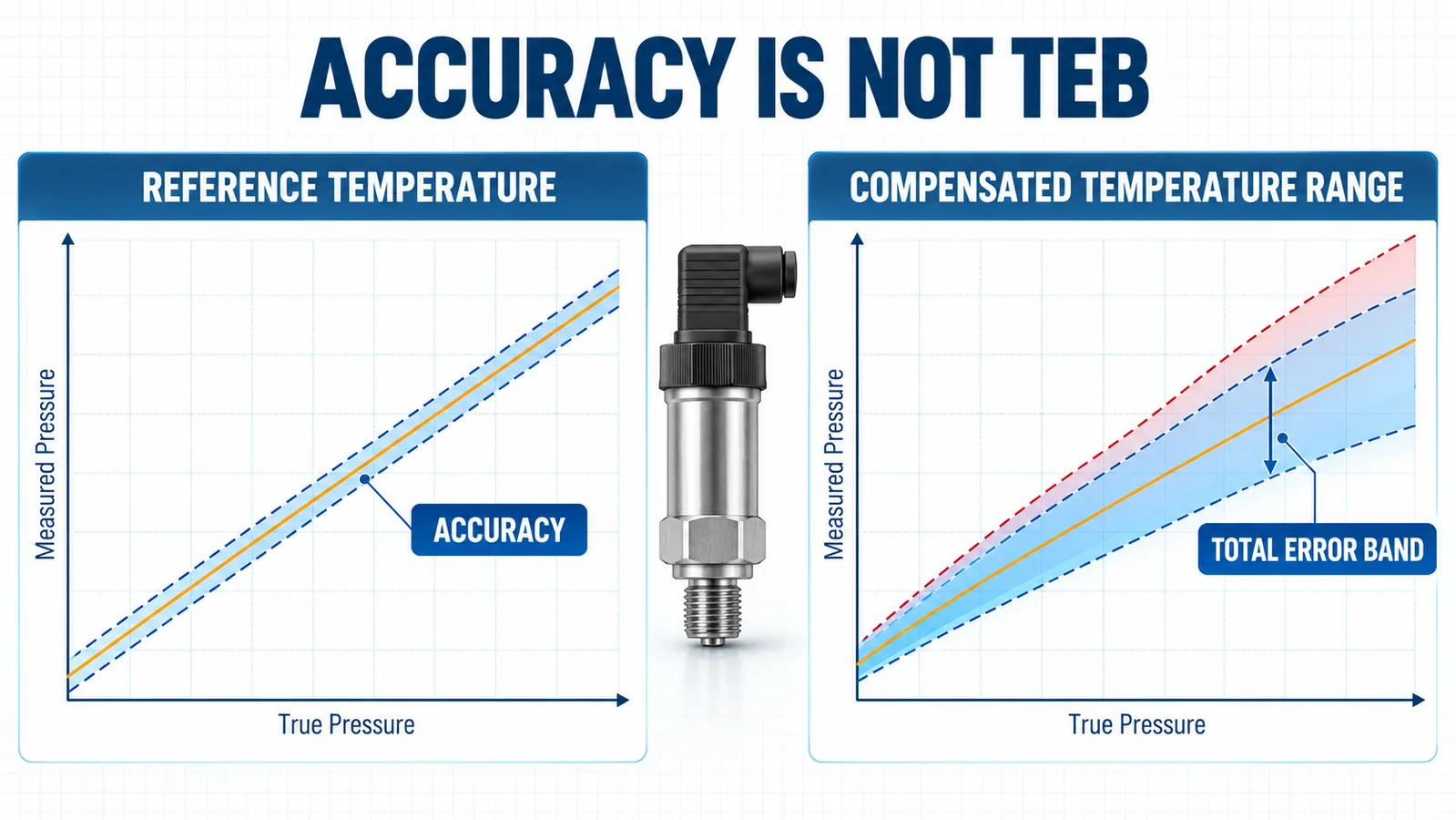
Reference-temperature accuracy is a narrower test
A room-temperature accuracy figure is useful for comparing the pressure transfer curve under controlled conditions. It can support calibration-line design and component screening. It does not automatically describe a sensor installed outdoors or near a hot process.
TEB extends the envelope across temperature
De Sensata PTE7100 specification provides a clear example: BFSL accuracy is listed at 25°C, while a separate TEB covers -20 to 85°C and includes additional zero, span and thermal effects. The example shows why two percentages on the same page are not contradictory.
For more detail on denominators, read pressure sensor accuracy: %FS vs %reading.
Which Error Terms Can Appear Inside TEB?
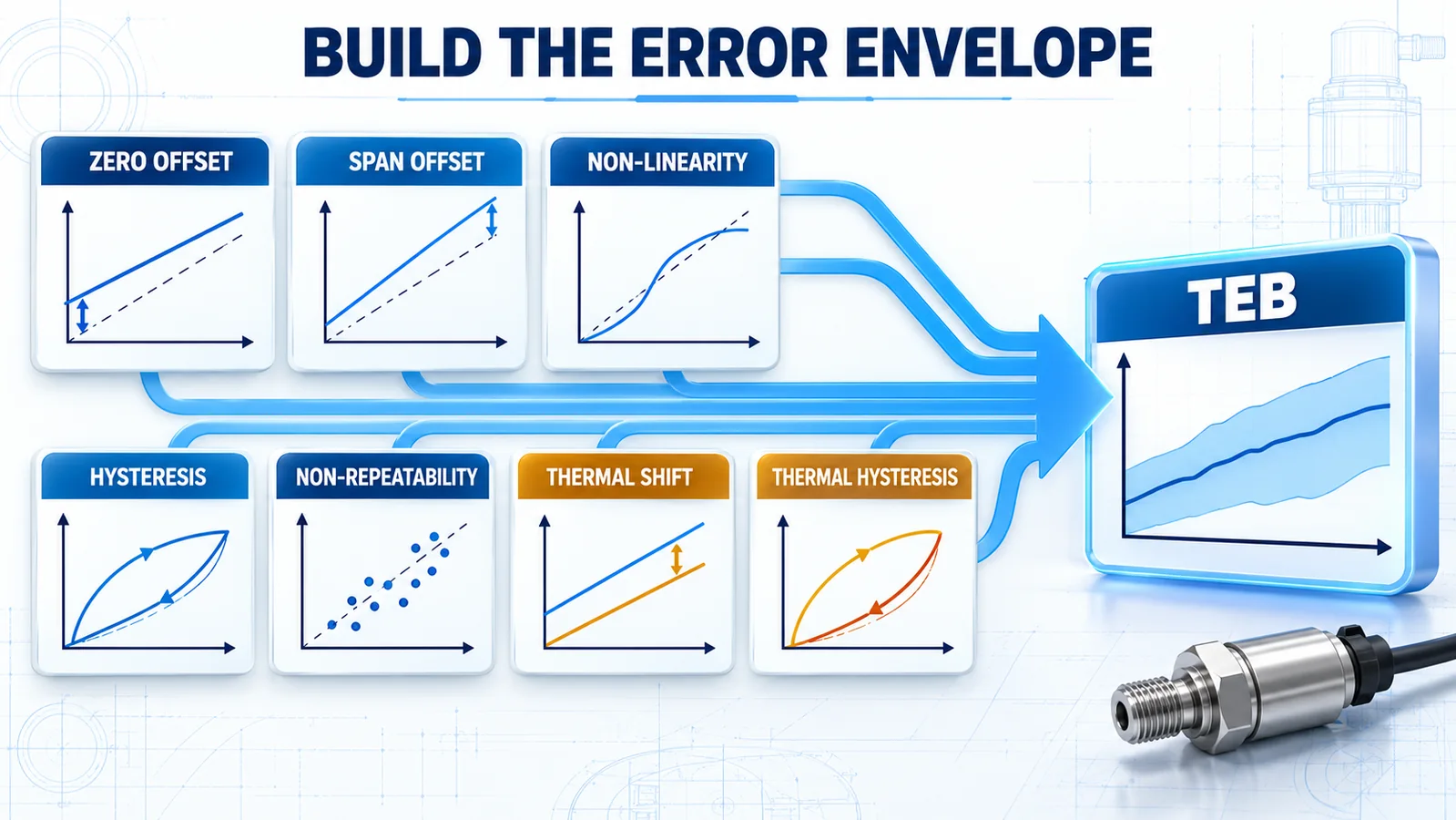
The exact list varies, but a complete review should look for the following components. Their definitions must be checked for overlap before any calculation.
Zero and span setting error
Zero offset shifts the entire transfer function when the reference pressure is applied. Span offset changes the output difference between the lower and upper calibration points. A system-level zero or two-point calibration can remove some initial error, but it does not necessarily remove thermal movement or future drift.
Niet-lineariteit
Non-linearity is the departure from the chosen reference line. Best-fit straight line, terminal-point and independent linearity methods can produce different values from the same data. A comparison is valid only when the method matches.
Hysteresis and non-repeatability
Pressure hysteresis is the difference at the same pressure depending on whether the point is approached from increasing or decreasing pressure. Non-repeatability is the spread when the same sequence is repeated under the same stated conditions. Neither is corrected by a single zero adjustment.
Thermal zero and span shift
Thermal zero shift moves the output at reference pressure as temperature changes. Thermal span shift changes sensitivity. They can produce different errors at zero, midspan and full scale, so a single temperature coefficient may not describe the complete curve.
Thermal hysteresis
After a hot or cold excursion, the output may not return to exactly the same value at the reference temperature. Thermal hysteresis is different from instantaneous temperature drift and may be specified after a defined cycle.
Why Does the Temperature Range Matter So Much?
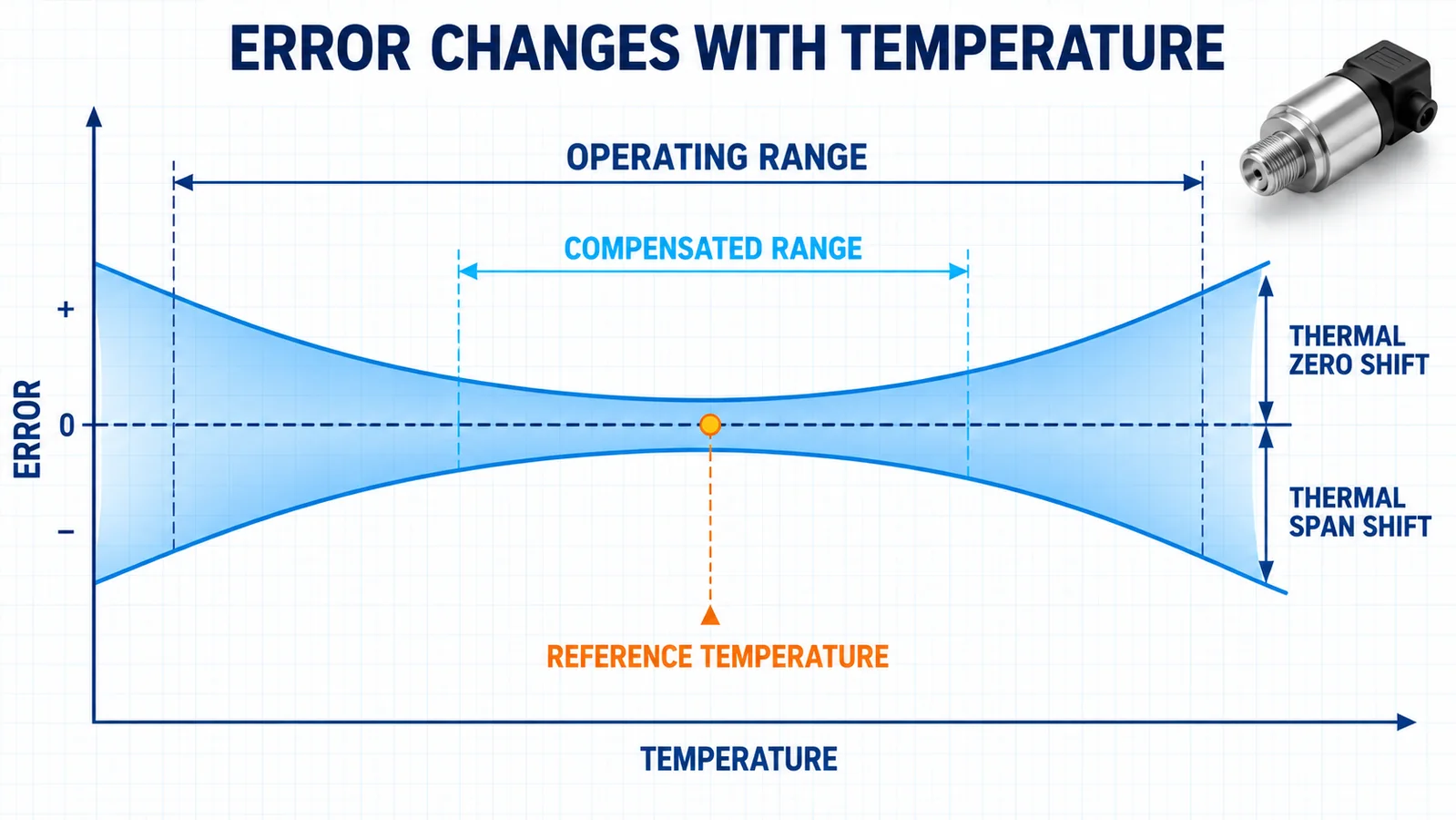
Temperature range labels answer different questions. Bedrijfstemperatuur describes where the device can function. Compensated temperature describes where stated pressure performance or correction applies. Media temperature concerns the process fluid, and storage temperature applies when the device is not operating.
A wider range usually demands a wider envelope
At the reference temperature, calibration can reduce zero and span errors. As the sensor moves away from that point, diaphragm properties, bridge resistance, electronics, seals and packaging all change. A manufacturer may therefore publish one TEB within the compensated range and a larger limit outside it.
Temperature coefficients need a reference and interval
A coefficient in %FS/°C must state the reference temperature and applicable interval. Multiplying a maximum coefficient by the full temperature swing can be conservative, but only if the coefficient is defined as a bound across that interval. Some datasheets publish a total shift over a range instead of a per-degree coefficient.
Low-pressure ranges are often more temperature-sensitive
The same absolute thermal stress or offset can represent a larger fraction of a small pressure span. This is why a product family may specify a different thermal limit for its lowest ranges. Compare the exact ordered range rather than applying a family headline to every configuration.
Can You Add Datasheet Errors to Calculate TEB?
Sometimes an engineering error budget is possible. It is not always valid, and the result should be labeled as an estimate or design limit rather than a manufacturer TEB.
Arithmetic worst-case addition
Adding maximum absolute errors assumes every term can reach its worst value in the same direction at the same time. For non-overlapping bounded terms, this provides a conservative limit. It may be needlessly large, and it becomes wrong if one term already includes another.
Root-sum-square combination
Root-sum-square, or RSS, can estimate the combined effect of independent random terms. Many pressure errors are systematic, temperature-correlated or bounded rather than independent normal variables. RSS is not a guaranteed limit unless the underlying assumptions and required confidence are defined.
Do not mix incompatible definitions
Do not combine a typical BFSL value, a maximum terminal-point value and a thermal coefficient from a different range as if they formed one warranted number. Also check whether hysteresis and repeatability are already included in “accuracy.” When the footnotes are unclear, ask the supplier for the error model.
How Does a Worked Error Budget Look?
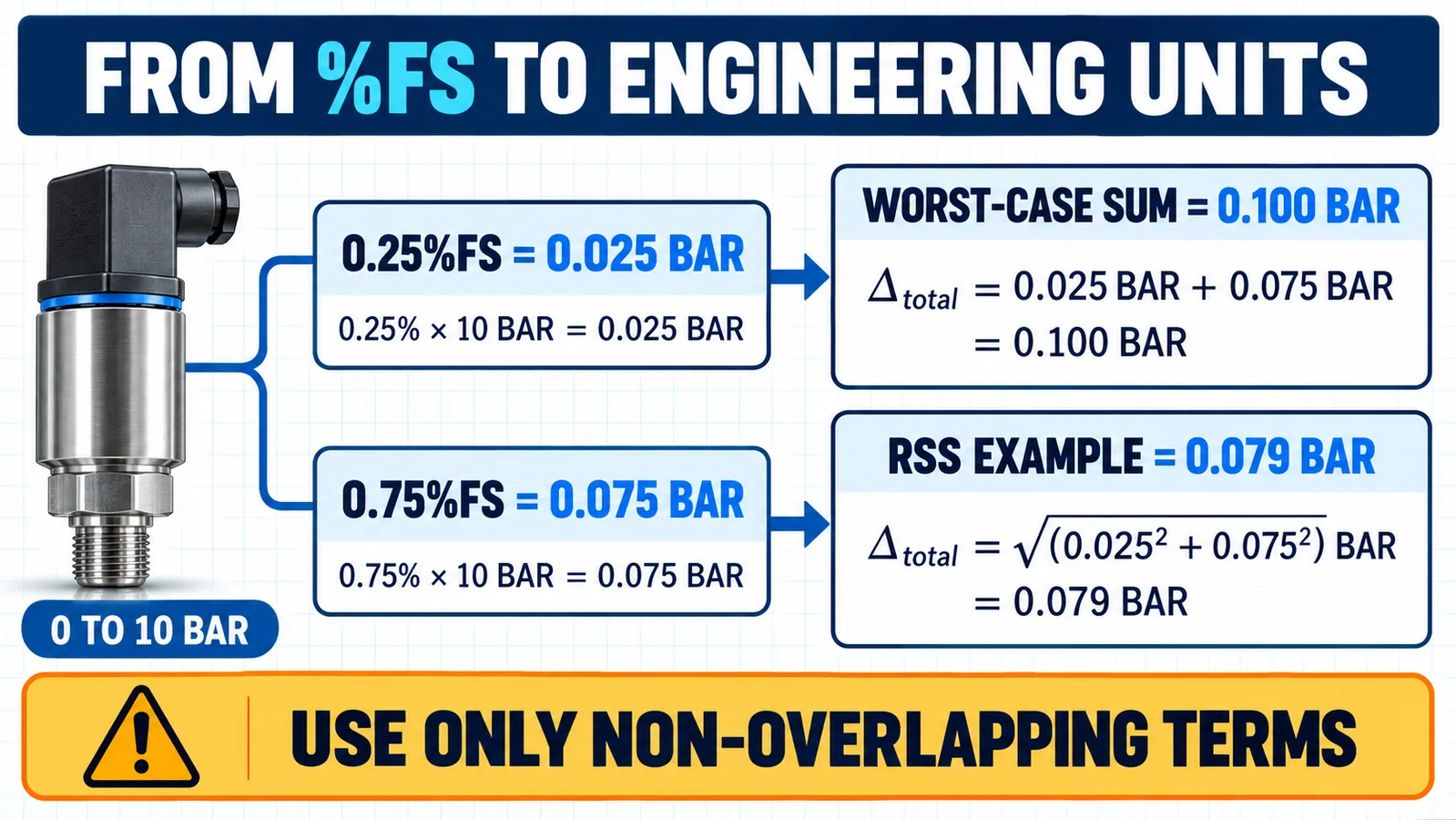
Consider a hypothetical 0–10 bar sensor with two explicitly non-overlapping maximum terms: ±0.25%FS reference-condition accuracy and ±0.75%FS total thermal effect over the required temperature range.
Convert every term to engineering units
For a 10 bar span:
- 0.25%FS = 0.0025 × 10 bar = 0.025 bar.
- 0.75%FS = 0.0075 × 10 bar = 0.075 bar.
- Arithmetic worst-case sum = 0.100 bar, or 1.00%FS.
- Illustrative RSS = √(0.025² + 0.075²) = 0.079 bar, or about 0.79%FS.
The arithmetic result is a conservative bound if both published maxima are non-overlapping. The RSS value is an estimate only if independence and statistical treatment are justified. Neither should be presented as a manufacturer-certified TEB.
Check the error at the actual operating point
At 2 bar, a ±0.100 bar full-scale-based limit equals ±5% of the reading. At 8 bar, it equals ±1.25% of the reading. The sensor has not changed; the denominator has. This is why oversizing the pressure range can reduce useful measurement quality at normal operating pressure.
How Should You Read a Pressure-Sensor Datasheet?
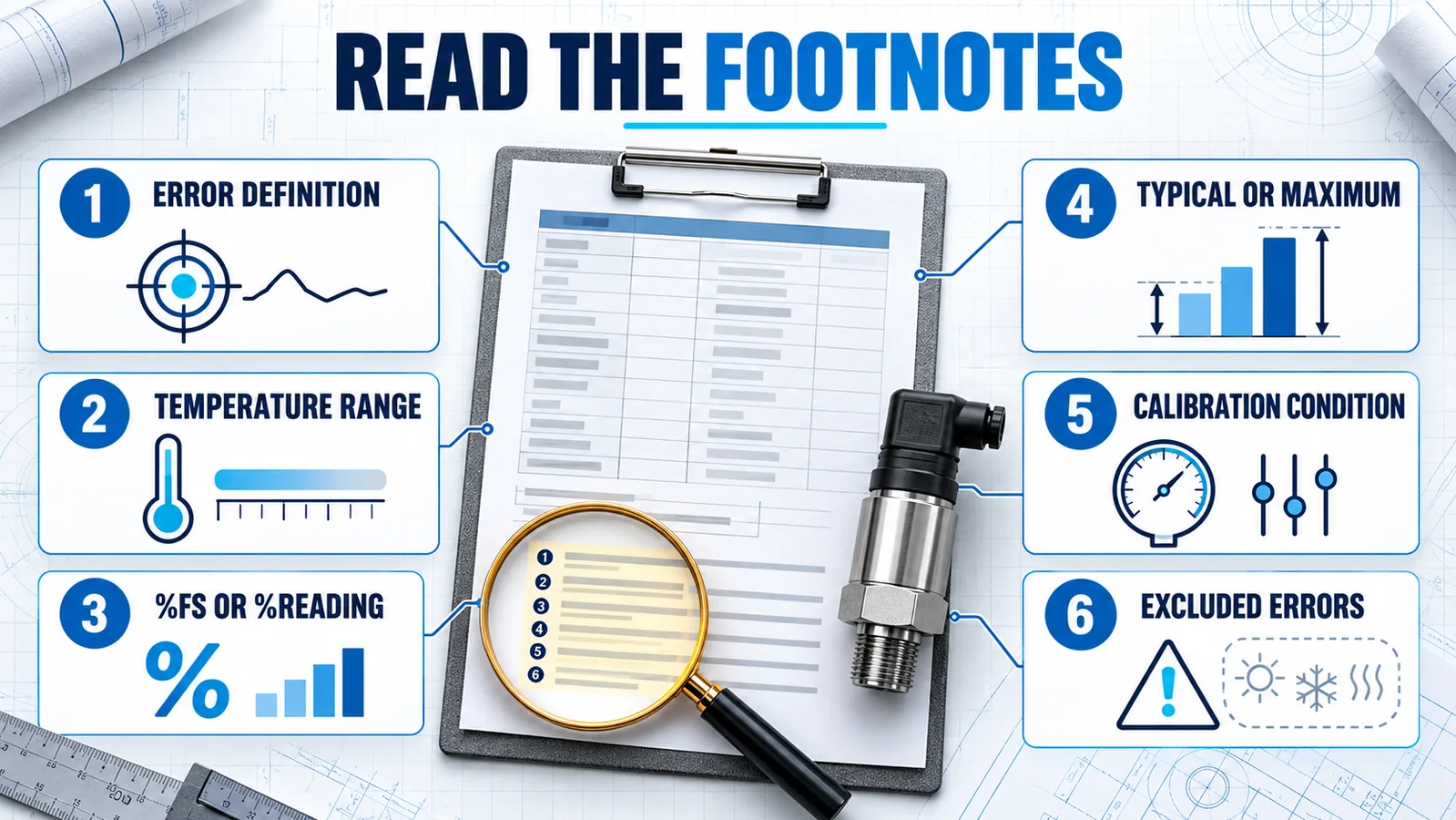
Start with definitions and footnotes before comparing headline percentages. Build a one-page comparison table using the same columns for every candidate.
Record the denominator
Write down whether the term is %FS, %span, %reading, %output or an absolute pressure. Full scale and span are the same only for a zero-based range. A compound range from -1 to 9 bar has a 10 bar span even though its upper range value is 9 bar.
Separate typical from maximum
A typical value describes expected performance and is useful for design insight. It is not a guaranteed acceptance limit. Procurement specifications, safety margins and warranty decisions should use maximum limits or an agreed statistical quality plan.
Match pressure and temperature conditions
Capture the exact pressure range, reference type, supply, load, mounting, calibration state, reference temperature and compensated range. A figure for a different range or output variant may not apply.
List excluded effects
Common exclusions include long-term stability, warm-up, supply sensitivity, load effects, EMC, vibration, mounting stress, media-temperature gradients and system electronics. An excellent sensor TEB does not guarantee the same system accuracy after installation.
How Do Range and Turndown Affect Real Error?
Most industrial sensor errors are expressed as a percentage of full span. The absolute pressure error stays similar across the span, so its percentage of reading rises as measured pressure approaches zero.
Do not buy range only for overpressure
Selecting a 100 bar range for a process that normally runs at 10 bar may protect against peaks, but it can multiply the relative measurement error. A better design may use an appropriate normal range with a specified proof-pressure margin or a pulsation-control device.
Separate resolution from accuracy
A digital output may show many decimal places while the absolute result remains limited by offset, thermal shift and calibration. Resolution describes the smallest output step or detectable change. It does not cancel TEB.
Which Errors Sit Outside the Sensor TEB?
The final measured value travels through a complete chain. The sensor specification may stop at its electrical output, while the application depends on wiring, analog input, reference voltage, scaling, process connection and installation.
Electronics and conversion
For voltage and bridge outputs, include supply or excitation tolerance, amplifier offset and gain, ADC reference, quantization, noise and grounding. For 4–20 mA, include input resistance, loop supply margin, analog-input accuracy and conversion scaling.
Mechanical installation
Mounting torque, port stress, orientation, trapped gas or liquid, impulse lines, seals and thermal gradients can shift the result. A system calibration after installation may remove initial offset, but it cannot guarantee immunity to future temperature or mechanical changes.
Process dynamics
Pulsation, water hammer, vibration, particle blockage and response-time mismatch can create apparent errors that are not static TEB terms. Verify the sensor and installation under representative transients.
What Do Calibration, Autozero and Stability Change?
Calibration changes which initial errors remain. A one-point zero removes offset at that condition. A two-point calibration can correct offset and span. Multi-point pressure and temperature calibration can correct more of the transfer surface if the sensor behavior is sufficiently repeatable.
Read “after calibration” conditions carefully
Some TEB claims apply to a fully calibrated sensor as shipped. Others apply after the OEM performs board-level autozero or system calibration. The TE SM9000 description is an example where the TEB statement explicitly refers to board mount and system-level autozero.
Long-term stability is a lifecycle term
Annual stability is frequently separate from initial TEB. Estimate the allowed calibration interval from the process requirement, environmental severity and field evidence. Avoid multiplying a typical annual value by service years and treating it as a guaranteed linear drift model unless the supplier defines it that way.
What Do Winsen WPCK07 Specifications Show?
De Winsen WPCK07 is a complete diffused-silicon pressure transmitter with multiple analog and digital outputs. Its current page and manual publish accuracy, hysteresis, repeatability and temperature drift as separate lines.
For common ranges, the published values include ±0.5%FS accuracy, 0.1%FS hysteresis, 0.1%FS repeatability and a separate temperature-drift limit. The lowest 35 kPa range has a different temperature condition and limit from other ranges. These entries are valuable inputs to an error review, but Winsen does not label their combination as a single TEB in the cited manual.
Therefore, an engineer should request the exact accuracy definition, whether hysteresis and repeatability are already included, and a warranted total error envelope if the project needs one-number interchangeability across temperature. Do not simply add all published lines without confirming overlap.
What Do Winsen WPAK63 Specifications Show?
De Winsen WPAK63 manual illustrates why an OEM pressure core needs a more detailed error budget. It lists BFSL non-linearity, hysteresis, repeatability, zero output, zero-temperature drift, sensitivity drift, thermal hysteresis and annual stability separately.
| Published item | WPCK07 transmitter | WPAK63 OEM core | Engineering interpretation |
|---|---|---|---|
| Pressure-response accuracy | ±0.5%FS listed | BFSL non-linearity, hysteresis and repeatability listed separately | Definitions are not directly interchangeable |
| Temperature performance | Drift limit published by range and temperature interval | Zero and sensitivity drift plus thermal hysteresis published | Preserve the individual terms and conditions |
| Calibration boundary | Complete transmitter with conditioned output | Bridge-level core for OEM integration | OEM electronics and package add errors for WPAK63 |
| Langdurige stabiliteit | Confirm for ordered version | Separate annual stability line in manual | Usually a lifecycle term, not initial TEB |
| Official single TEB | Not stated in cited source | Not stated in cited source | Request supplier clarification; do not invent one |
For the WPAK63 path, the OEM also owns excitation, amplification, compensation, mechanical packaging and final calibration. See the pressure sensor core versus transmitter decision guide for the broader responsibility boundary.
What Should an RFQ and Validation Plan Request?
A strong RFQ replaces a vague “high accuracy” requirement with an error envelope tied to actual operating conditions.
Minimum supplier questions
Ask for the exact error definition, included and excluded terms, maximum or typical status, pressure range, reference temperature, compensated temperature range, supply and load conditions, calibration state, pressure cycling method, thermal cycling method and long-term stability basis.
Application data to provide
State normal pressure, maximum pressure, transient peaks, required error in engineering units, reference type, media, ambient and media temperatures, output, supply, installation, warm-up time, calibration capability and expected service interval.
Validation matrix
Test multiple production-representative units at the required pressure points and temperatures. Include increasing and decreasing pressure, thermal soak, return to reference temperature, power cycling, installation torque and system electronics. Record whether failures come from the sensor, package, electronics or process setup.
| Validation stage | Minimum evidence | Decision supported |
|---|---|---|
| Datasheet review | Definitions, ranges, limits and exclusions | Candidate comparison |
| Supplier clarification | Written answers for missing TEB terms | RFQ acceptance |
| Incoming test | Zero, span and selected pressure points | Lot screening |
| Thermal validation | Pressure points across application temperature | Real error envelope |
| Installed-system test | Sensor, electronics, mounting and process path | Final system accuracy |
| Lifecycle plan | Stability evidence and recalibration interval | Maintenance strategy |
Veelgestelde vragen
Is TEB always larger than accuracy?
Usually, because TEB commonly includes more error sources and a wider temperature range. The relationship depends on the definitions. Never assume it without reading the footnotes.
Does TEB include long-term drift?
Often it does not. Long-term stability is commonly listed separately. Some suppliers may include a defined life or endurance effect, so check the product-specific definition.
Can system calibration eliminate TEB?
Calibration can reduce initial zero, span and curve errors at the calibrated conditions. It cannot automatically remove hysteresis, non-repeatability, temperature movement, aging or installation changes.
Is %FS the same as %reading?
No. A %FS error is based on the calibrated span and produces a roughly constant absolute-pressure limit. Its percentage of the measured reading becomes larger at low pressure.
What if a datasheet does not publish TEB?
Keep the individual terms, identify overlap and exclusions, and ask the supplier for a warranted error envelope over your required conditions. Build a documented system error budget without relabeling it as the supplier’s TEB.
Specify the Complete Error Envelope
A small room-temperature accuracy number cannot describe pressure measurement across temperature, time and installation. Pressure sensor total error band is useful because it moves the discussion toward a bounded envelope, but only when the included errors and conditions are clear.
For WPCK07 and WPAK63, use the separate published terms and the exact ordered configuration. Define the final requirement in bar, kPa or another engineering unit at real operating points, then add system electronics, installation and lifecycle effects. To review a specific range and application, contact Winsen engineers with your pressure, temperature, output, media and accuracy requirements.
