
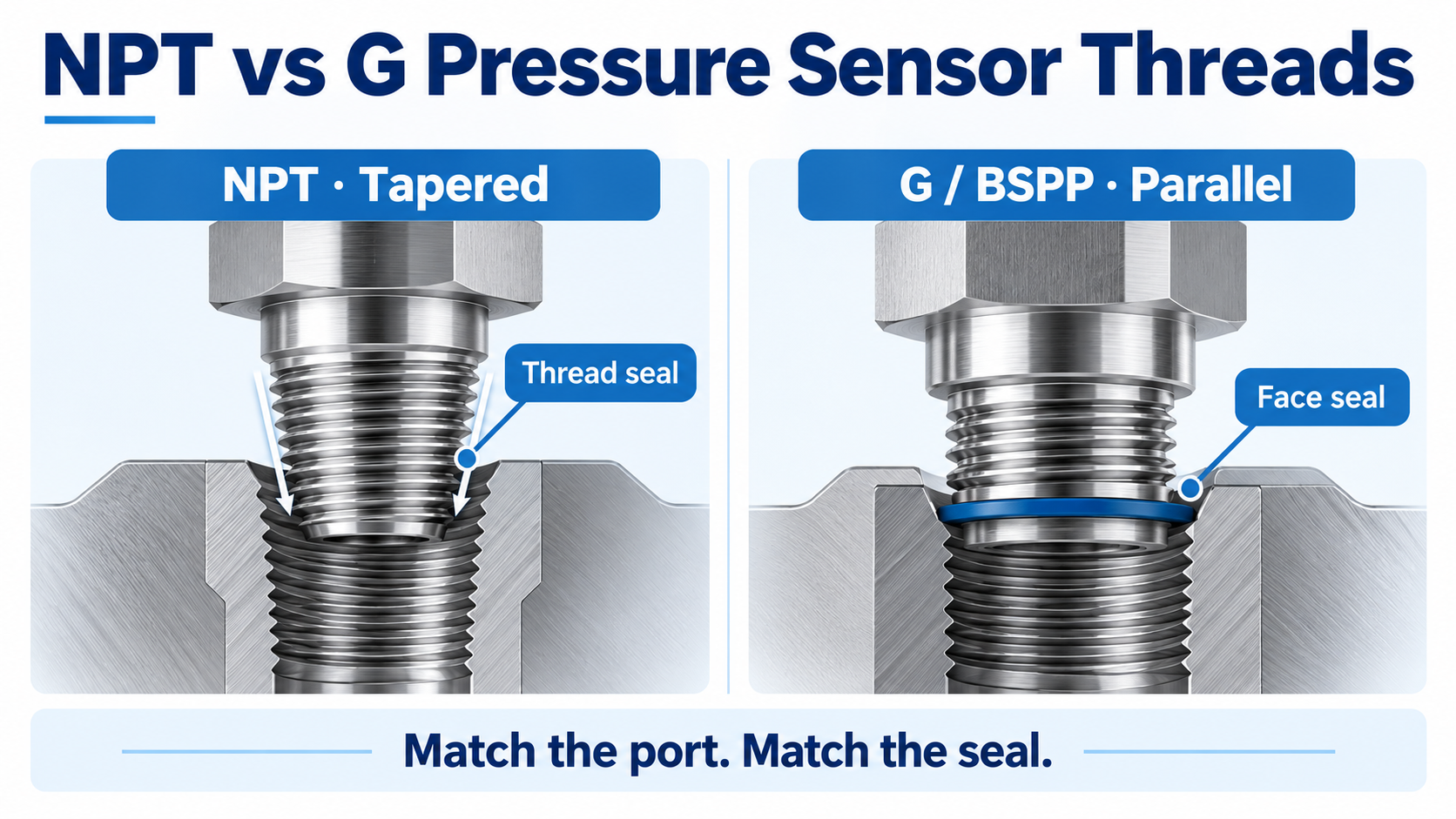
NPT and G threads are different pressure-sensor process connections. NPT is tapered and is designed for a seal at properly mated threads with a suitable sealant. G (BSPP) is parallel: its threads retain the fitting, while a separately designed washer, gasket or O-ring seals at a face or shoulder. A sensor marked G1/4 cannot be specified as a substitute for 1/4 NPT merely because both include “1/4.” Confirm the thread standard, mating port and seal geometry before ordering or installing a pressure transmitter.
| Decision point | NPT | G / BSPP |
|---|---|---|
| Governing thread family | ASME B1.20.1 NPT | ISO 228-1 G parallel pipe thread |
| Form | Tapered; 60° thread angle | Parallel; 55° thread angle |
| Typical pressure seal | Within matching threads, using a suitable approved sealant | At a specified face or shoulder with the correct washer, gasket or O-ring |
| What the nominal label does non tell you | Sealant, port material, engagement or allowable torque | Whether the port has the required seal land, seal material or exact face geometry |
That comparison is the starting point, not a universal assembly instruction. A pressure connection is a system of parts: male thread, female port, sealing surface, seal material and operating conditions. An apparently close thread fit can still leak, damage a port or place load on a sensing diaphragm.
What makes NPT and G threads different?
IL ASME B1.20.1 standard description identifies the NPT pipe-thread family. Its tapered geometry becomes progressively tighter as a correctly matched male fitting engages its female port. The thread profile has a 60° included angle. NPT is common in North American instrumentation and piping, but the region where equipment is installed does not override the drawing: the actual port designation is decisive.
IL Swagelok thread-identification guide explains the ISO 228-1 family of parallel pipe threads, commonly marked G O BSPP in instrumentation. The G form has a 55° thread angle. Its parallel threads provide mechanical engagement; the pressure boundary needs an appropriate seal compressed between designed surfaces outside the thread.
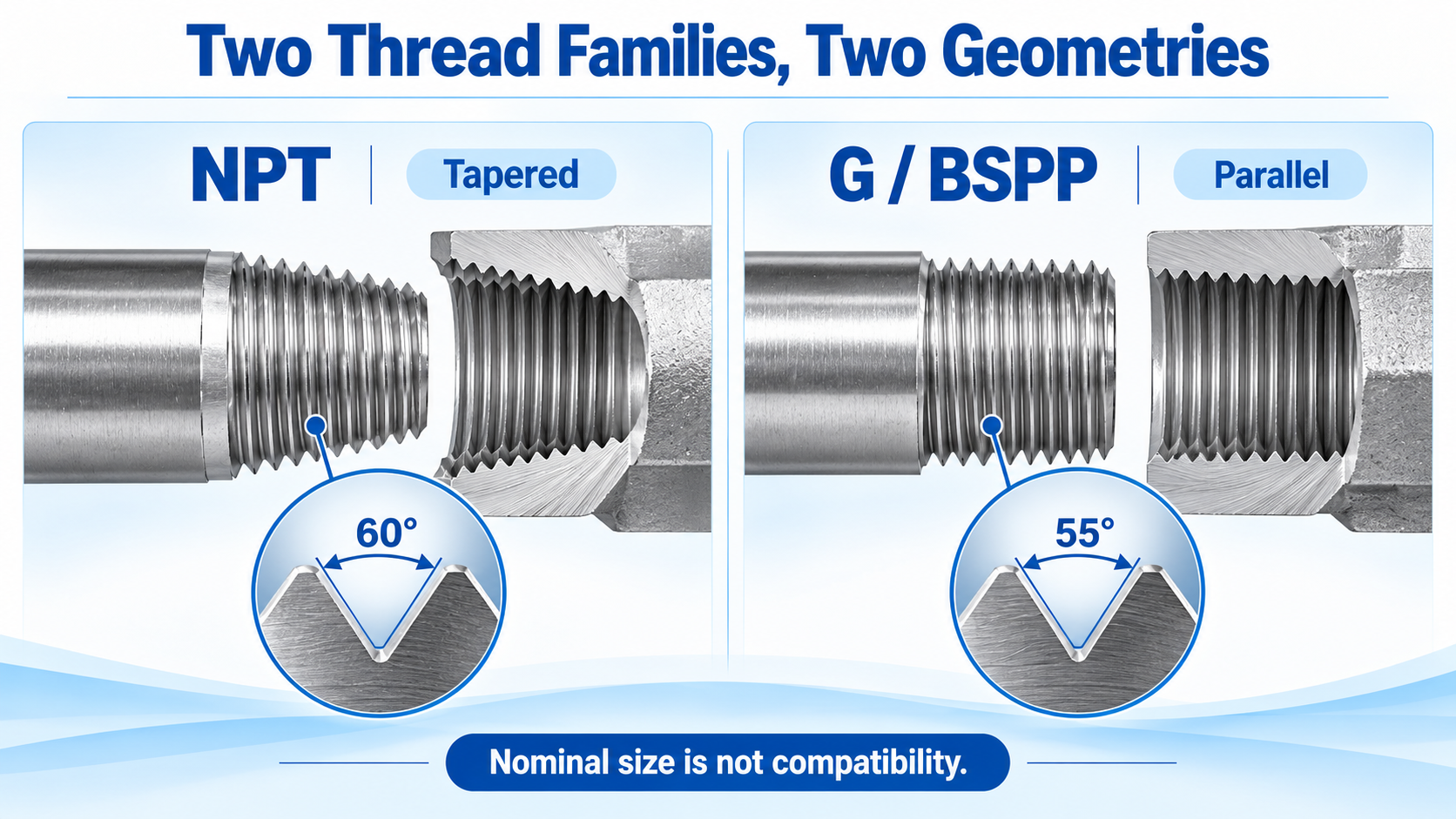
Do not confuse G/BSPP with R/BSPT. R is another tapered pipe-thread family, but it is not NPT and it is not the parallel G designation. Likewise, metric M20×1.5 identifies a metric thread rather than either G or NPT. Our broader OEM pressure-sensor selection guide covers the process port as one of several purchasing decisions; this guide concentrates on the mechanical interface itself.
Where does each connection actually seal?
For a correctly matched NPT pair, thread engagement produces a sealing interface along the tapered threads. The installer uses a sealant approved for the fitting, fluid, pressure, temperature and site procedure. A sealant does not make a mismatched thread family safe. Nor should excess tape or compound be allowed to obstruct the pressure passage or enter the process. Follow the particular transmitter and fitting instructions for application and tightening; a generic turn count or torque is not reliable across products.
A G male connection normally needs a separate seal at the specified face or shoulder. Depending on its detailed port design, that may be a flat gasket, bonded sealing washer, O-ring or another approved profile seal. Swagelok’s ISO 228-1 fitting examples show seals outside the parallel threads. The WIKA installation instructions likewise distinguish sealing at the face of a parallel connection from sealing within a tapered NPT thread.

Writing “G1/4” on a drawing is therefore incomplete if the instrument and receiving port must be machined independently. The sealing land, port depth, gasket or O-ring location and material still need to match. A washer sitting against an irregular or too-small surface cannot form the intended seal. Adding PTFE tape to a parallel G thread does not replace the designed face seal. Some G-interface variants use different sealing locations; obtain the exact manufacturer’s drawing rather than transferring one product’s washer arrangement to another.
G1/4 vs 1/4 NPT — and the more subtle half-inch case
Nominal pipe-thread fractions are designation sizes, not a promise that the male outside diameter equals 0.25 or 0.50 inch. For identification, measure and gauge the actual part and compare it with the relevant thread specification. The Swagelok identification tables separate tapered and straight families and give the relevant pitch and size information.
| Thread callout | Form | Threads per inch (TPI) | What this establishes |
|---|---|---|---|
| 1/4 NPT | Tapered | 18 | Not the same pitch or profile as G1/4 |
| G1/4 | Parallel | 19 | Requires its intended external sealing arrangement |
| 1/2 NPT | Tapered | 14 | A 14-TPI gauge alone cannot identify it |
| G1/2 | Parallel | 14 | Still not interchangeable with 1/2 NPT |

The half-inch row is an important trap. 1/2 NPT and G1/2 can both register 14 TPI, but they differ in taper, flank angle and sealing method. Matching pitch is only one observation. If a connector begins to turn into the wrong port, that is not proof of compatibility. Never force it or use sealant to compensate for uncertain thread identity.
How to identify an unknown pressure-sensor port
Use a drawing and basic inspection together. If the connection remains ambiguous after these checks, obtain the supplier’s part-specific drawing or use a qualified thread gauge before assembling a pressurized joint.
- Read the order code and drawings. Look for the complete designation—such as G1/4, 1/4 NPT or M20×1.5—on both the transmitter and its mating port. Confirm whether each side is male or female and where the seal is intended to sit. A family brochure may list several options without identifying the shipped one.
- Check for taper. Compare diameters near two locations along an accessible male thread or consult the dimensioned drawing. A visible taper suggests a tapered family; a uniform diameter suggests a parallel family. Very short threads or coating can make visual judgment unreliable.
- Gauge pitch and profile. Use a clean pitch gauge and caliper, then compare with a trusted thread chart or certified gauge. For the quarter-inch pair, 18 versus 19 TPI is informative; for the half-inch pair, both may show 14 TPI. Do not stop at pitch.
- Inspect the sealing interface. Is there a machined flat face, shoulder, groove or approved washer? Is the port depth adequate? Look for scratches, missing seals and damaged first threads. Confirm that the fitting and port drawings call for the same seal arrangement.

IL Swagelok thread-identification guide provides further gauge and form references. A field photograph and a nominal diameter measurement can start the investigation, but a pressure-rated assembly should ultimately be identified by a documented standard and mating-interface drawing.
Installation and leak troubleshooting
Before installation, isolate and depressurize the system under the site’s procedure. Inspect the fitting, receiving port and sensing opening for dirt or damage. Verify that wetted materials and seal material suit the medium, temperature and pressure. Keep sealant and debris out of the pressure passage. Apply tightening force at the intended wrench flats, not through the cable, connector or transmitter housing; use the manufacturer’s specified torque or method for the exact connection and seal.
Per NPT, use the specified mating NPT port and approved sealant, then tighten according to component instructions. For G, use the matching parallel port and the specified washer, gasket or O-ring against the designed surface. A G label does not itself select the seal. In both cases, perform the required controlled pressure/leak check after assembly. A leak check is not a substitute for confirming thread identity first.
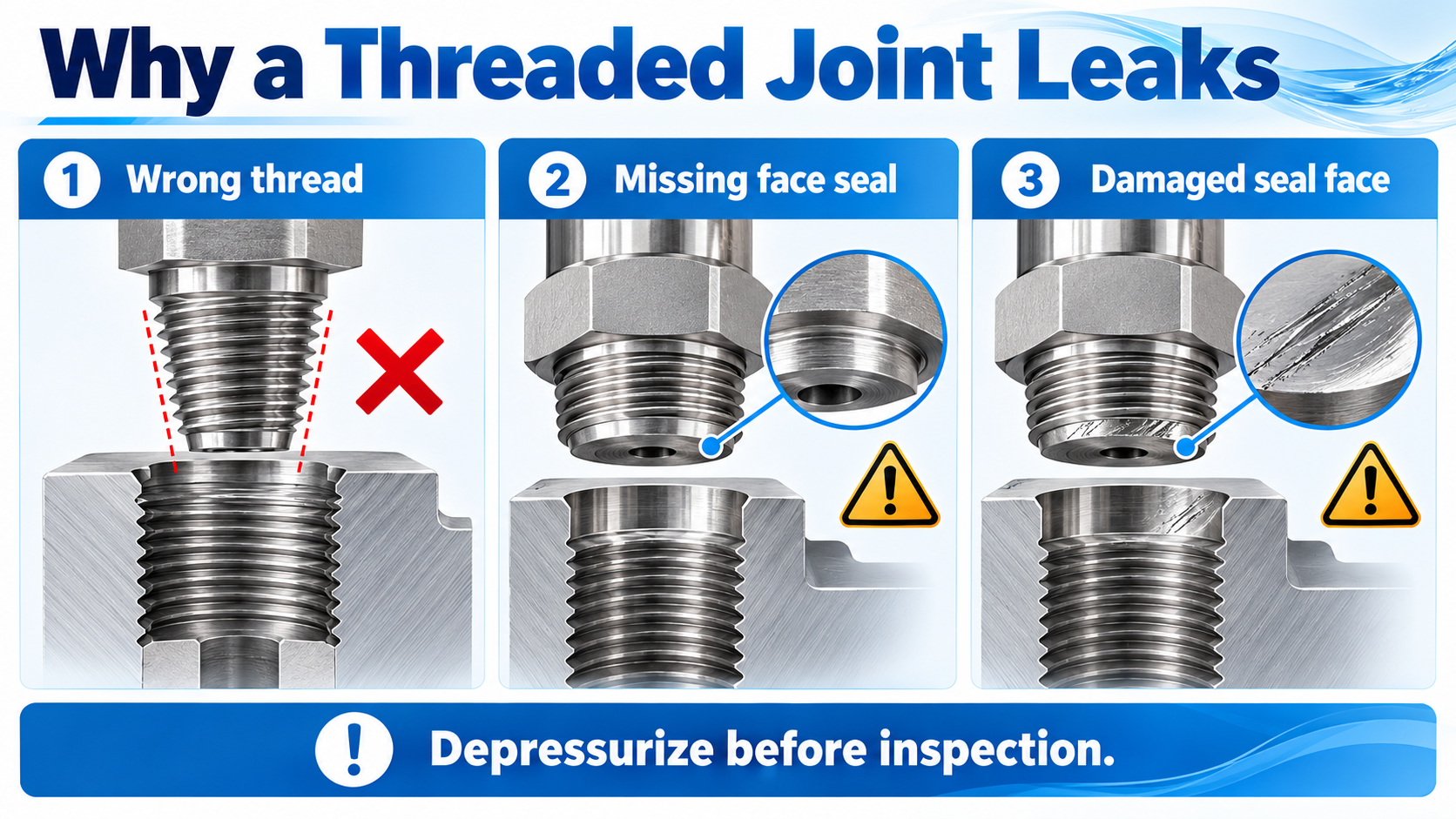
If a newly installed sensor leaks, stop and investigate in this order: correct family and size, damaged or cross-threaded entry, appropriate seal and seal material, condition of the sealing land, and whether the fitting has bottomed out before compressing the seal. Then consider pressure cycling, vibration, thermal change and installation stress. Repeatedly tightening a mismatched connection can ruin both the sensor and the port. If the plant uses one thread family and the chosen transmitter another, select a properly rated adapter with the correct seal on each side; the adapter’s pressure rating, materials and port geometry must also be verified.
What do the verified Winsen model pages say?
The thread discussion must not turn a model-family statement into a claim about the part in hand. Winsen’s current product pages and manuals provide the following starting points:
| Winsen model | Official connection evidence | Correct purchasing conclusion |
|---|---|---|
| WPCH04 ceramic pressure transmitter | The current product page lists G1/4, G1/2 and G1/8 among structural connection choices, as well as metric options; it says the connection can be customized. | It is a documented G-thread example. Specify the desired size and request the matching face-seal/port drawing for the ordered variant. The page does non establish a standard NPT option for WPCH04. |
| WPCK07 diffused-silicon pressure transmitter | The current page says multiple/customizable thread structures. Its older official manual gives M20×1.5 as the default connection, without enumerating NPT or G options. | Request written confirmation of any proposed G or NPT variant, the exact order code and current dimensional/seal drawing. Do not assume a WPCK07 has either one from the family description. |

These pages also contain electrical and pressure specifications, but thread selection cannot be deduced from those numbers. A transmitter’s output and a raw sensing element’s bridge signal are different interface questions; see our sensor, transducer and transmitter explanation. If the pressure range and error budget are also being decided, our accuracy guide explains why a quoted percentage needs a defined basis.
What belongs on the drawing or RFQ?
An actionable pressure-connection request should name the exact ordered variant, not only a product family. Send the following together:
- Thread family and complete callout for both mating parts, including nominal size and male/female designation.
- A dimensioned port and transmitter-process-connection drawing, including engagement, port depth and sealing surface.
- Seal location and type, seal material and compatibility with the process medium and cleaning agents.
- Operating and proof-pressure requirements, temperature range and any pressure cycling or vibration.
- Installation method: accepted sealant where applicable, wrench location, torque or engagement instruction and leak-test criteria.
- The pressure range/reference and electrical output needed for the complete transmitter order code.
For example, “G1/4 pressure transmitter” leaves the receiving port and seal undefined. A better request identifies the intended G1/4 variant and its approved face seal, attaches the female-port drawing, specifies the fluid and operating conditions, and asks the supplier to confirm the mating dimensions. For NPT, specify the corresponding NPT male/female parts and approved sealing/installation procedure. Do not issue a manufacturing drawing from the conceptual illustrations in this article.
Domande frequenti
Can a G1/4 pressure sensor screw into a 1/4 NPT port?
Do not use that combination as a pressure connection. They differ in pitch, taper, thread profile and sealing arrangement. Initial partial engagement is not evidence of a safe seal. Use correctly matched parts or a properly specified and rated adapter.
Are G1/2 and 1/2 NPT the same because both are 14 TPI?
No. A shared pitch does not make their taper, 55°/60° profiles or sealing systems the same. Confirm the complete thread standard and port drawing.
Should PTFE tape be applied to a G thread?
A standard G parallel-thread connection relies on its designed face or shoulder seal, not on tape wrapped around the thread. Follow the exact manufacturer’s approved seal arrangement. Tape does not repair a missing or damaged gasket seat.
Does every NPT pressure sensor need the same sealant and torque?
No. Select sealant and installation instructions for the fluid, materials, temperature, pressure and particular fittings. Follow the manufacturer’s data; no universal tape-wrap count or torque belongs in a generic guide.
How can I identify a thread when the marking is missing?
Start with the part/order drawing, then check taper, pitch, profile and sealing surface with suitable gauges. If that still leaves doubt, request a current dimensional drawing or have the port gauged before it is used under pressure.
Does Winsen WPCH04 or WPCK07 have an NPT version?
The current WPCH04 page documents G and metric connection choices but does not list a standard NPT option. The WPCK07 page describes customizable thread structures without naming an NPT size; its older manual names M20×1.5 as default. Ask Winsen to confirm NPT availability and provide the current variant drawing and seal instructions in writing before specifying it.
Confirm the connection before ordering
Send Winsen your receiving-port drawing, medium, pressure and temperature conditions, target output and the exact thread and seal required. Request the current model-specific process-connection drawing and installation instructions through the Winsen contact page. That is more reliable than choosing a fitting from its nominal fraction or from a family photo.
