
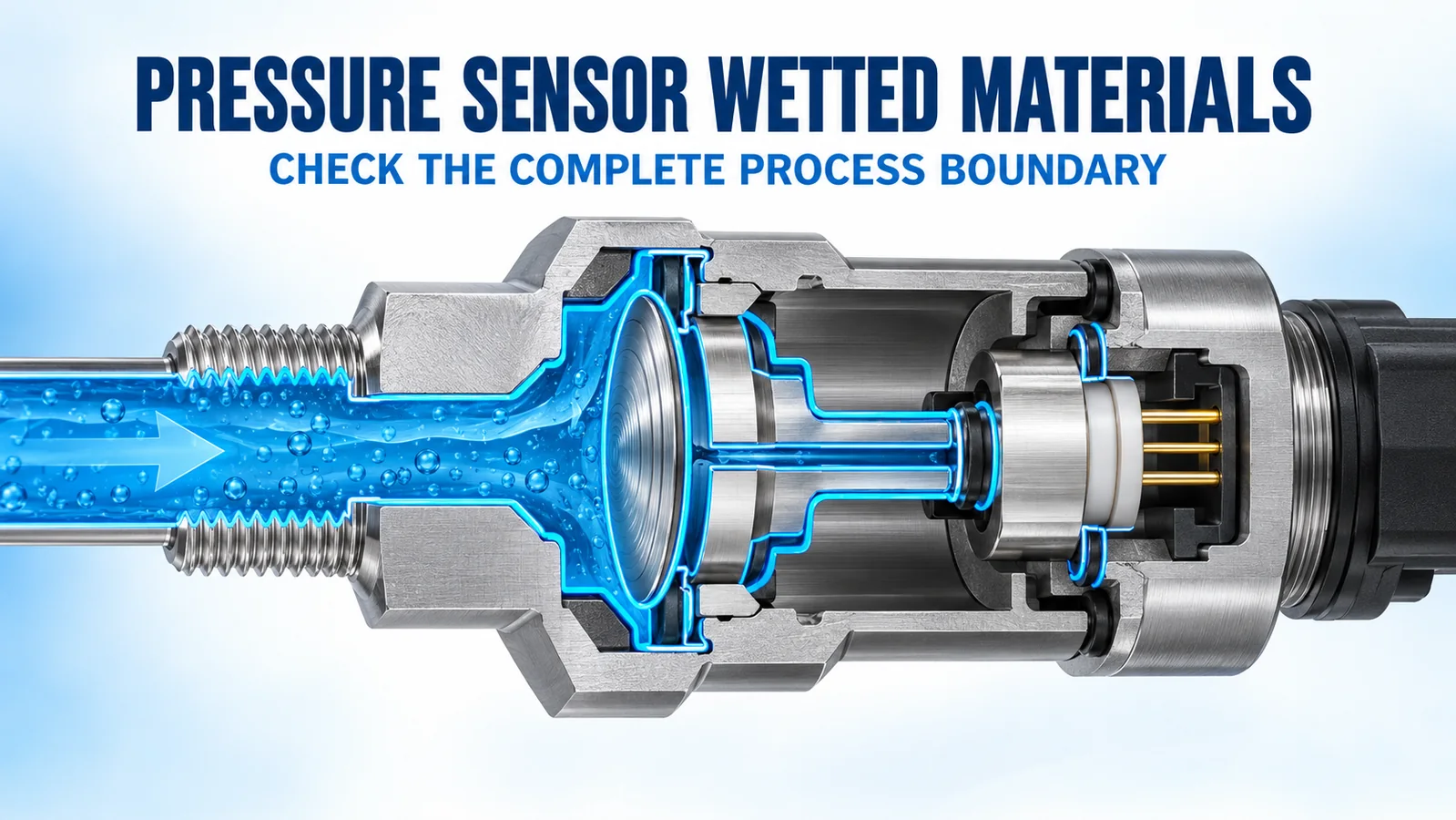
Pressure sensor wetted materials are every component that the process medium contacts during normal operation. Depending on the architecture, that can include a ceramic sensing face or metal diaphragm, the pressure port, lower housing, welds, internal seals and the process gasket supplied by the equipment maker.
External housing material is not a substitute for this list. A stainless steel enclosure can contain a ceramic cell with an elastomer seal, while a diffused-silicon chip can sit behind a metal isolation diaphragm without touching the process.
What Is the Quick Wetted-Parts Checklist?
Before approving media compatibility, identify:
- sensing diaphragm or direct sensing face;
- pressure port and lower housing;
- exposed weld, braze or joint;
- internal O-ring, gasket or adhesive;
- installation gasket, thread sealant or process seal;
- protective screen, coating or lining;
- flush port or cleaning connection;
- capillary and remote-seal components;
- transfer fluid that could contact the process after a defined failure.
For every item, request the exact grade or formulation. “Stainless steel,” “ceramic,” “rubber” and “Hastelloy” are incomplete material specifications.
What Does Wetted Mean?
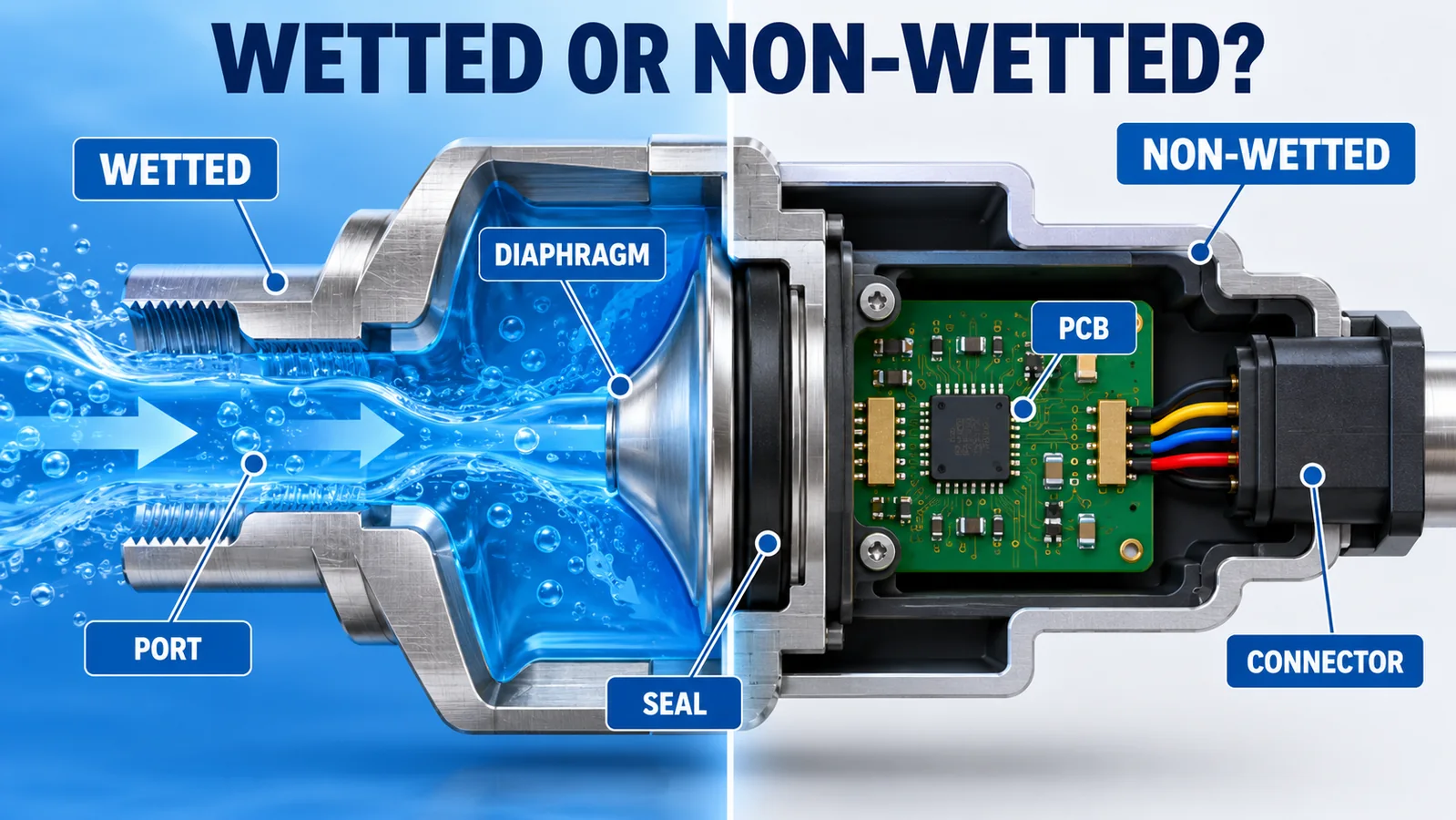
A wetted part is exposed to the measured medium. A non-wetted part remains on the dry side of the pressure boundary during normal operation. The PCB, connector and external cover are often non-wetted, although they still need environmental protection.
The boundary can change with installation. A vented gauge sensor exposes its reference path to ambient air and moisture. A process adapter can add a gasket and trapped volume. A diaphragm seal can remove the transmitter’s original port from direct contact while adding its own diaphragm, lower housing, gasket and fill system.
Itu Ashcroft diaphragm-seal selection guide identifies the diaphragm and lower housing as wetted parts and notes that process temperature and concentration are required in material selection.
Map the Complete Wetted Stack
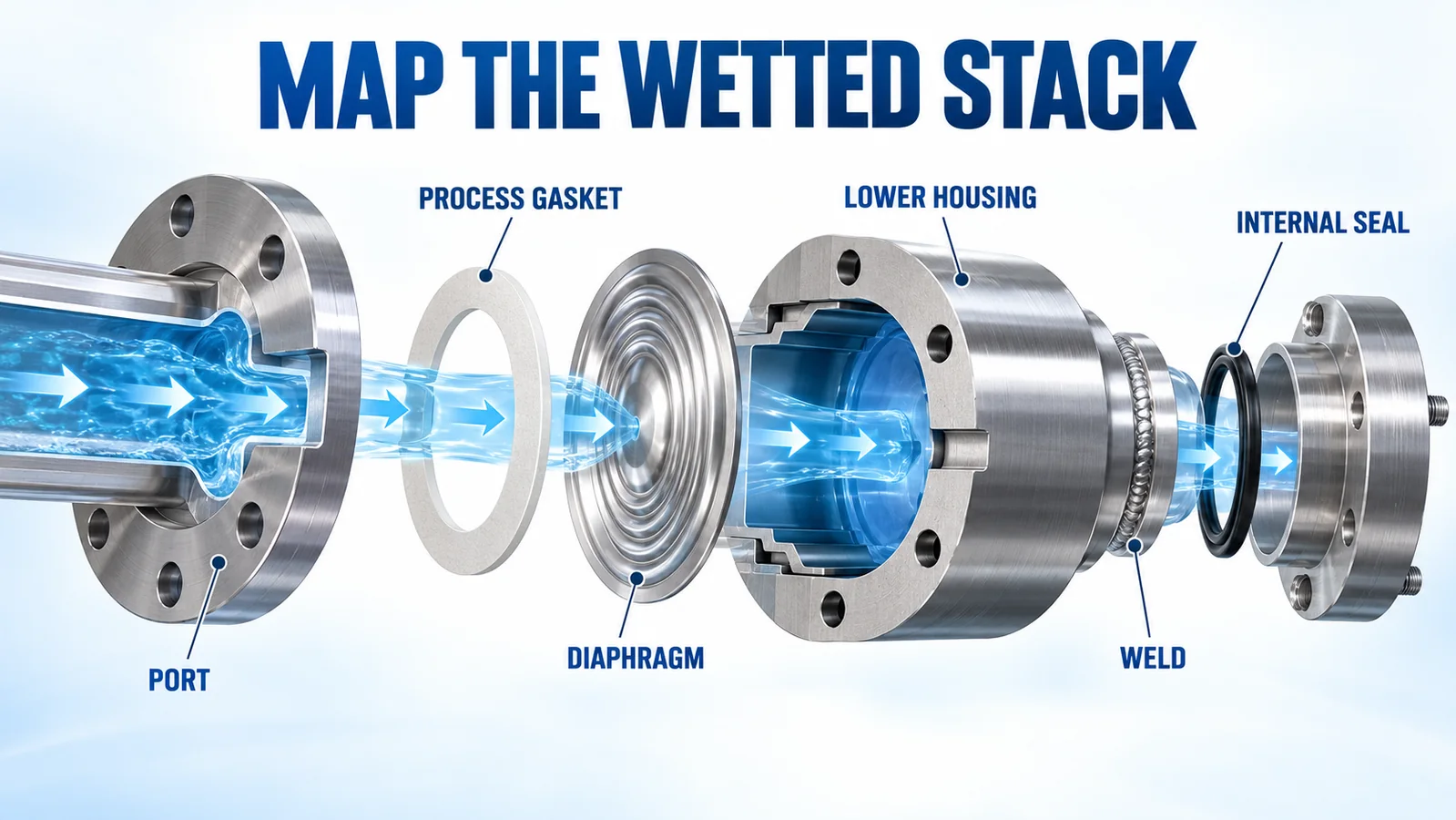
Sensing face or diaphragm
This is usually the most visible process barrier. It may be alumina ceramic, 316L stainless steel or another alloy. Its thickness, surface finish and forming process affect both corrosion and mechanical performance.
Pressure port and lower housing
The port can be a different material from the diaphragm. A thin compatible diaphragm mounted in an incompatible lower body is not a compatible assembly. Look for crevices where liquid can stagnate and concentrate.
Welds and joints
A weld changes local metallurgy and residual stress. Ask whether the wetted assembly is welded, brazed, bonded or sealed with an elastomer. For severe service, material certificates and weld procedure controls may be relevant.
Process gasket
The equipment maker often selects the gasket between the sensor and process connection. It is part of the compatibility boundary even if it does not appear on the sensor datasheet.
Why the Diaphragm Material Is Not Enough
A product page may emphasize a 316L diaphragm or ceramic sensitive film. That helps define the architecture but does not approve the complete system. Consider two examples:
- A ceramic cell survives the liquid, but its O-ring swells and leaks.
- A metal diaphragm survives general corrosion, but a crevice at the process gasket pits.
Material compatibility also depends on pressure and temperature strength. A chemically resistant polymer lower housing may not have the same pressure-temperature capability as metal. The Ashcroft material-selection article emphasizes both compatibility and structural limits.
Seals, Gaskets and Adhesives
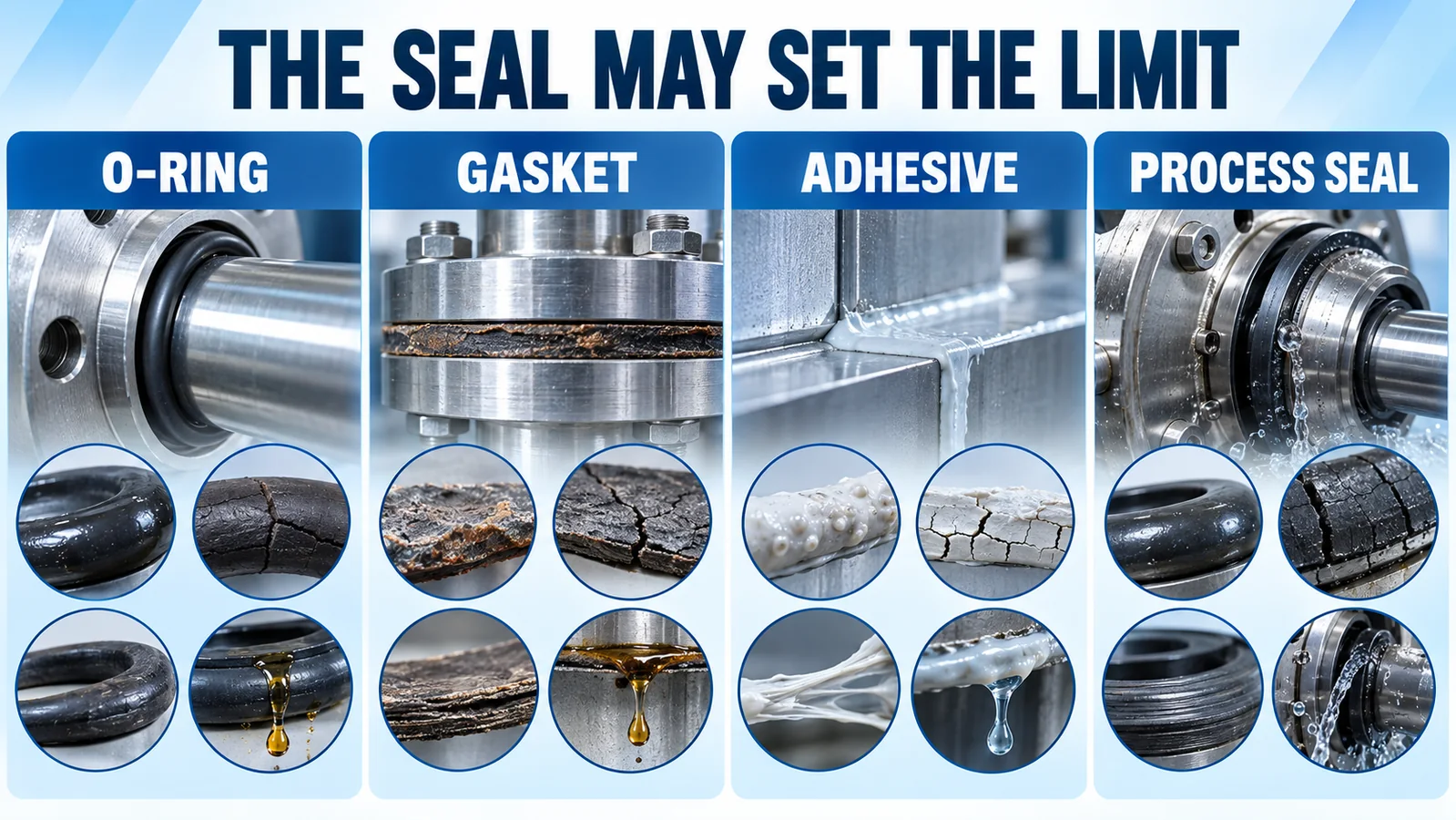
Elastomers can swell, shrink, harden, crack or become permeable. Their behavior depends on formulation, chemical concentration and temperature. A generic family name such as FKM or EPDM may not identify every compound ingredient.
PTFE and other fluoropolymers offer broad chemical resistance but have different creep, cold-flow and sealing characteristics. The groove, compression, surface finish and pressure cycling remain important.
Adhesives and potting materials can be hidden at a ceramic-cell edge. Ask whether they are exposed. Include cleaning and sterilization chemicals; the strongest attack may occur during maintenance rather than production.
Fill Fluid: Normally Dry, Still Relevant
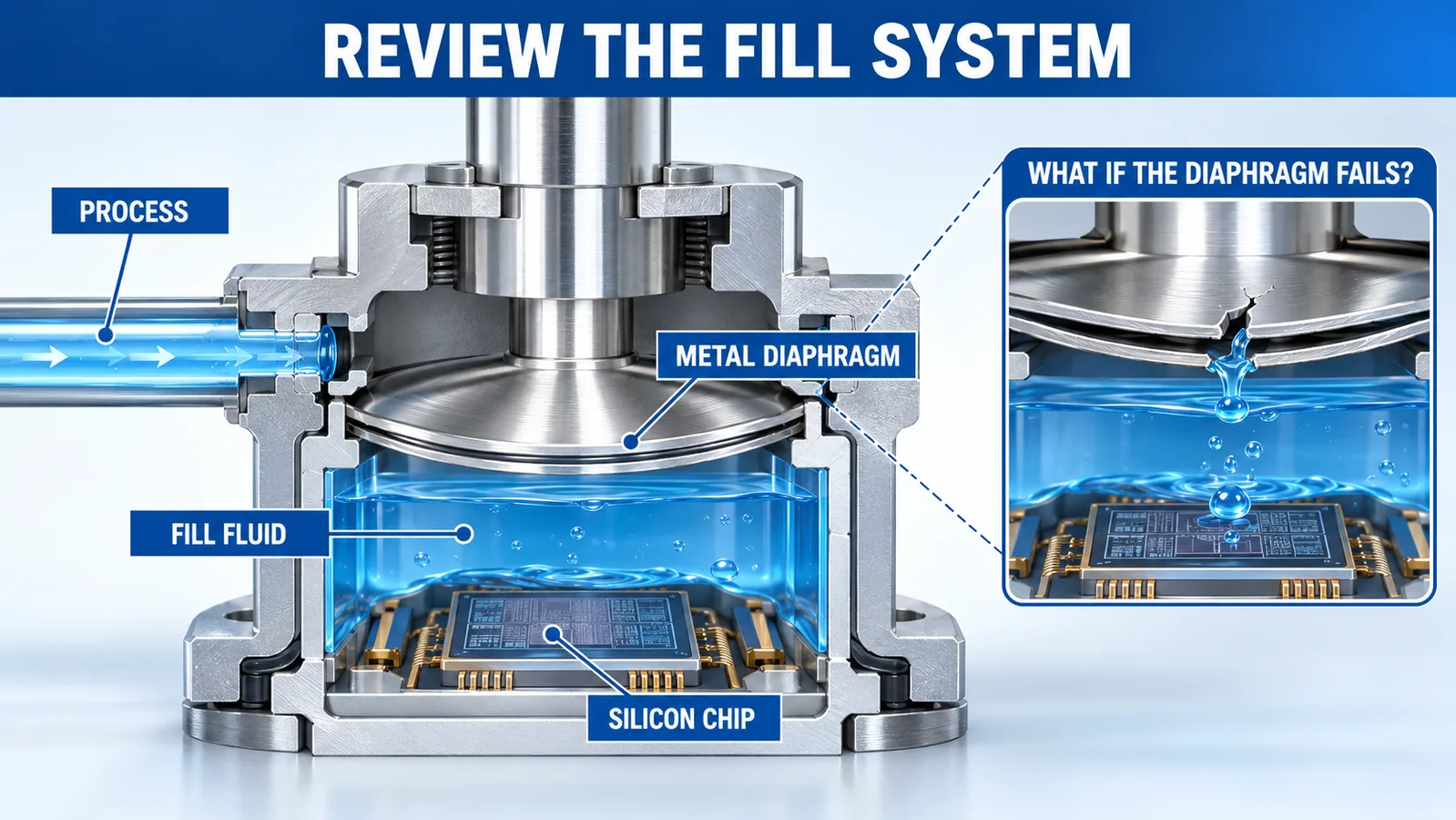
An isolated silicon core commonly uses a transfer fluid between the metal diaphragm and sensing chip. It is normally sealed away from the process and is not a wetted part during intact operation.
It is still relevant to:
- contamination consequences if the diaphragm fails;
- temperature expansion and measurement error;
- vacuum behavior;
- oxygen or strong oxidizer service;
- food, pharmaceutical and high-purity requirements;
- regulatory declarations.
Ask for the fill-fluid identity and allowed conditions when these issues matter. Do not assume that “oil-filled” identifies the actual fluid or its approvals.
Coatings and Linings
A coating can separate a base material from the process, but its value depends on continuity, thickness, adhesion, pinhole control and mechanical durability. Threads, sharp edges, flexing diaphragms and abrasive particles can be difficult coating locations.
Define whether the coating is a qualified pressure boundary or only an added protection layer. Ask how it is inspected and what happens if scratched. A coating should not be used to conceal an otherwise undefined substrate.
Flush, Recessed and Open-Port Geometry
Geometry changes exposure even when materials are identical. A recessed port can trap crystals, solids or cleaning liquid. A flush diaphragm reduces dead space but remains exposed to abrasion and installation damage. An open ceramic face may need a perimeter seal and controlled support.
Consider drainability, orientation, cleanability, particle size, viscosity and maintenance access. Hygienic or sanitary claims require more than a clamp shape; surface finish, gasket design, crevices and relevant approvals also matter.
For threaded installations, identify where the seal actually occurs. A tapered thread may use sealant on wetted threads, while a parallel thread normally relies on a face seal or bonded washer. The chosen adapter can therefore add both a new alloy and a new polymer to the wetted stack. The NPT versus G-thread guide explains the mechanical distinction, but the final drawing must show which surfaces see the medium.
For food, beverage or pharmaceutical equipment, document surface roughness, gasket geometry, drainability and cleaning chemistry in addition to the material names. The hygienic pressure sensor guide provides the related process-connection questions. A clamp fitting by itself does not prove a hygienic boundary.
How Should the Process Medium Be Specified?
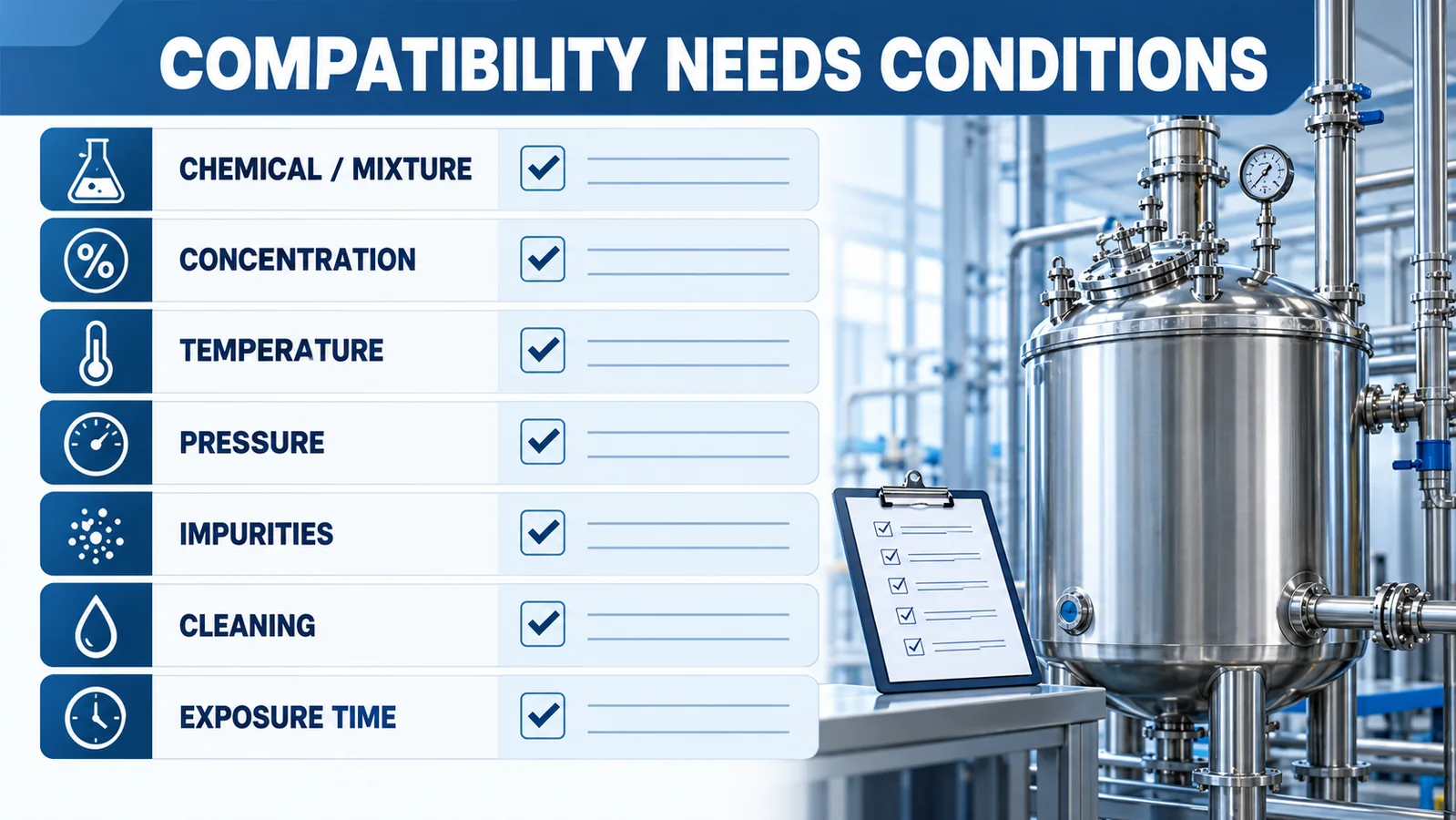
Menyediakan:
- complete chemical names and mixture percentages;
- concentration range, including cleaning and evaporation effects;
- operating, startup, shutdown and cleaning temperature;
- normal, vacuum, surge and test pressure;
- dissolved gases, chlorides, oxidizers and contaminants;
- solids, viscosity and flow velocity;
- exposure frequency and required service life;
- consequences of leakage or contamination.
“Water,” for example, can mean deionized water, seawater, chlorinated potable water, hot process water or wastewater with cleaning chemicals. Each creates a different review.
Supplier Evidence and Approval
A material chart can help eliminate poor candidates, but written supplier review is stronger. Request a statement tied to the defined conditions. Where data are missing, use representative sample tests and a qualified materials engineer.
Separate three decisions:
- chemical compatibility — will the material resist the medium?
- mechanical suitability — will the boundary withstand pressure, temperature and cycling?
- measurement performance — will zero, span and response remain acceptable?
Passing one does not prove the other two.
What Failure Evidence Should You Look For?
Material incompatibility does not always appear as obvious rust. Inspection and test plans should look for:
- pitting or discoloration on the diaphragm, port and heat-affected weld zone;
- swelling, flattening, cracking or hardness change in elastomer seals;
- loss of coating adhesion, pinholes or edge lifting;
- crevice deposits around gaskets and threaded adapters;
- zero drift caused by diaphragm attack or seal-induced mechanical stress;
- span change, hysteresis or slow recovery after pressure release;
- insulation resistance loss from permeation or leakage;
- particles or fill fluid where product contamination is unacceptable.
Photograph and weigh coupons where useful, but test the complete sensor as well. A coupon cannot reproduce diaphragm stress, a crevice, weld metallurgy or seal compression. Use the same calibrated pressure points before and after exposure, and state whether accuracy is calculated against full scale or the current reading. The pressure sensor accuracy guide helps keep that comparison unambiguous.
Build a Controlled Material Declaration
The approval record should connect the commercial order code to a controlled wetted-material list. Include drawing revision, diaphragm and port grades, weld or braze method, seal compound, process gasket, coating, fill fluid, surface finish and approved media envelope. Record the supplier evidence and qualification report used for each decision.
Change control matters because a substitute elastomer compound, new adhesive, altered welding process or different raw-material supplier can change compatibility without changing the model name. Require supplier notification, define which changes trigger requalification and retain representative samples when failure consequences justify it. This turns “compatible material” from an informal claim into a maintainable engineering decision.
Winsen Product Examples
Itu Winsen WPAH31 is a ceramic piezoresistive pressure cell. In an OEM assembly, ceramic may be directly exposed while the equipment maker supplies the surrounding seal and port. The finished wetted-material list therefore belongs to the final assembly, not the cell alone.
Saat ini WPAK76 page describes a flush isolation-diaphragm sensor with 316L as the default diaphragm material and Hastelloy C optional. Confirm the exact alloy grade and whether every other wetted component matches the selected diaphragm option.
Itu WPAK63 manual covers a general isolation-film pressure core. Its silicon sensing element is isolated from direct process contact, but the metal pressure boundary and fill system still require application review.
These examples illustrate architectures; they are not chemical compatibility approvals.
Qualification and Change Control
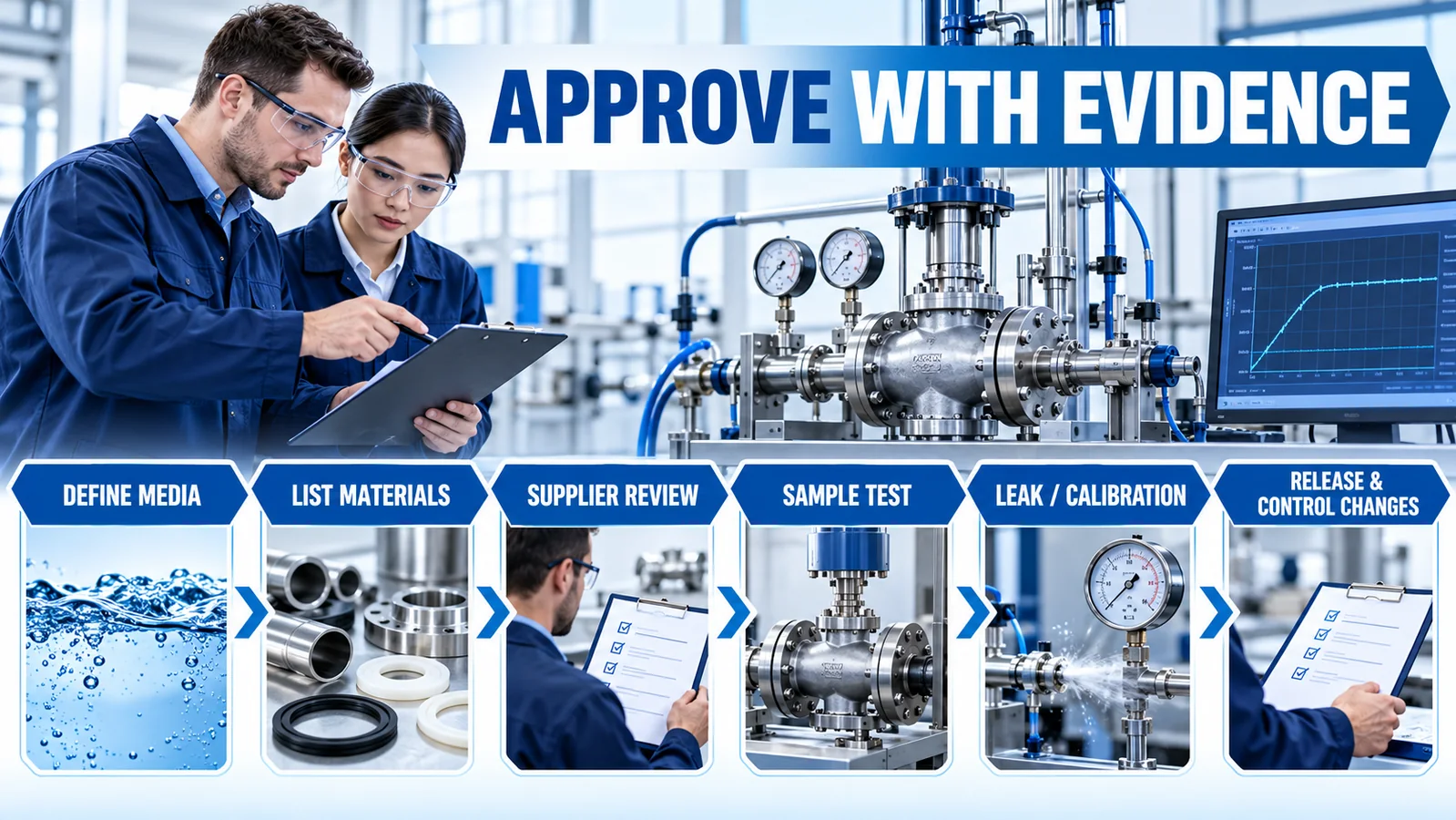
- Freeze the media and operating specification.
- Build a wetted-material bill of materials.
- Obtain supplier review and material declarations.
- Test representative samples in normal and cleaning media.
- Pressure- and temperature-cycle complete assemblies.
- Perform leak, insulation and calibration checks.
- Inspect seals, diaphragm and welds after exposure.
- Document approved models and order codes.
- Require notification before material, process or supplier changes.
Daftar Periksa RFQ
Send chemical composition, concentration, temperature, pressure/vacuum/surge, solids, cleaning sequence, exposure duration, required life, accuracy, output, process connection, wetted-material restrictions, gasket material, fill-fluid restrictions, surface finish, approvals, traceability and annual quantity.
The broader panduan pembelian sensor tekanan industri can be used for the electrical and mechanical fields outside material compatibility.
Pertanyaan Umum
Is the housing a wetted part?
Only the portion exposed to process is wetted. An external enclosure may be dry while a lower housing or port of different material contacts the medium.
Are threads wetted?
They can be. In a face-sealed connection, much of the thread may remain outside the process boundary; in another design, process liquid can reach engaged threads. Use the actual drawing.
Is fill fluid a wetted material?
Not during normal operation when the isolation diaphragm is intact. It can still be important to failure, contamination and regulatory analysis.
Can a compatibility chart approve a sensor?
It is a screening tool. Final approval needs exact material grade, process conditions, assembly geometry and supplier or engineering review.
Kesimpulan
Pressure sensor wetted materials form a complete pressure boundary, not a single diaphragm label. Map every exposed component, tie compatibility to real process conditions, qualify the full assembly and control material changes. For help defining an OEM wetted-material stack, hubungi Winsen.
