
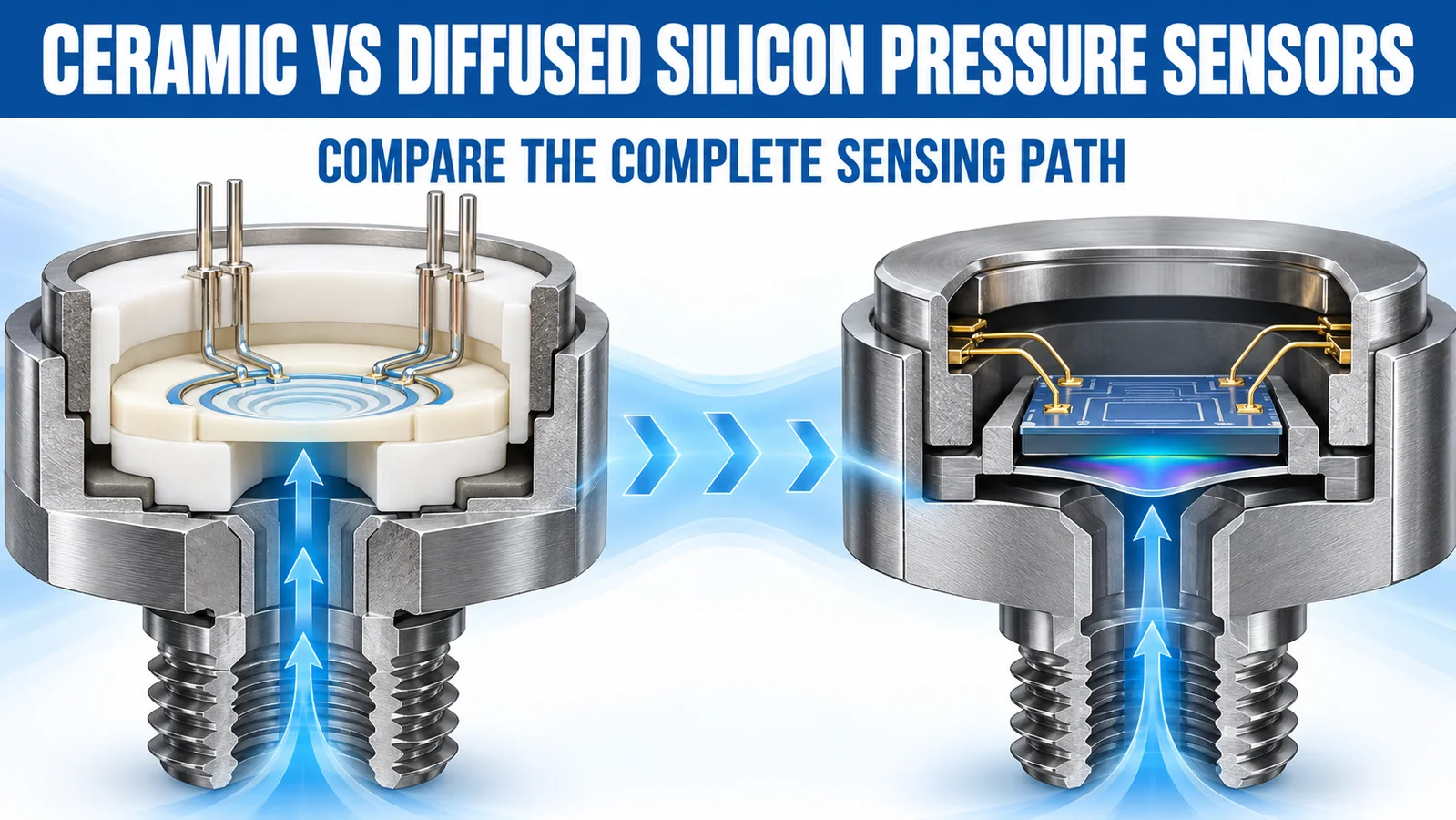
The ceramic vs silicon pressure sensor choice is often described as a material comparison, but the useful engineering comparison is between complete sensing architectures. A ceramic piezoresistive cell may place the medium directly against a ceramic diaphragm. A diffused-silicon chip may be isolated behind a welded metal diaphragm and transfer fluid, so the silicon never touches the process.
Neither technology is automatically best for all media, ranges or OEM programs. Select the complete pressure path, output level and package that fit the application.
¿Cuál es la respuesta corta?
Investigate a ceramic cell when a direct, often fill-fluid-free sensing path, robust ceramic diaphragm and custom OEM housing are desirable—and when the ceramic, perimeter seal and port are all compatible.
Investigate an isolated diffused-silicon core when a metal process diaphragm, compact pressure core and silicon piezoresistive performance fit the design—and when the diaphragm alloy, weld, transfer fluid and package are acceptable.
Choose a conditioned transmitter rather than a raw core when the equipment team wants a standard analog or digital output and less responsibility for bridge amplification, temperature compensation and calibration.
Sensing Material and Wetted Material Are Different
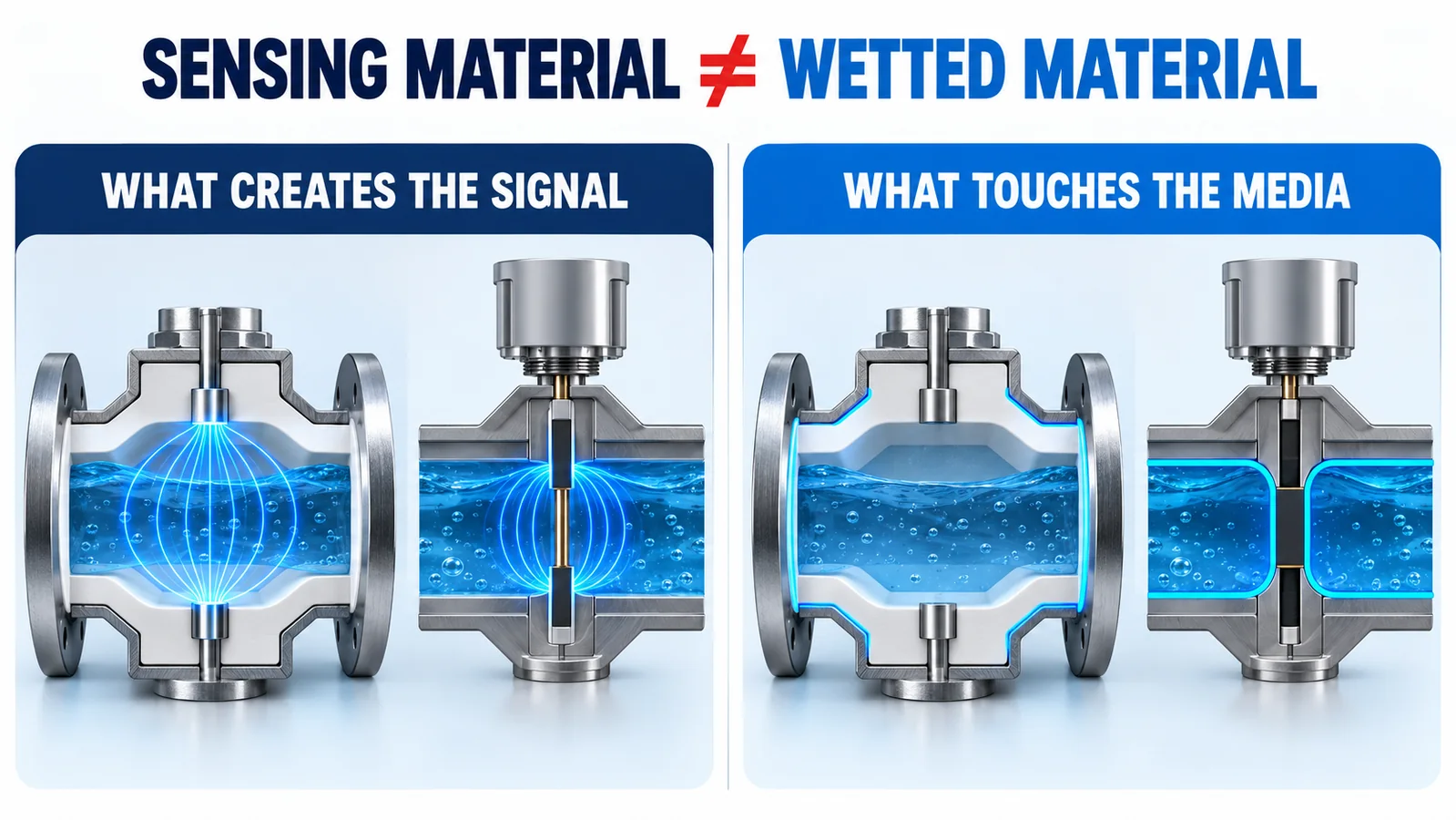
The sensing material is the element whose strain produces an electrical change. Wetted material is anything exposed to process fluid.
In a ceramic piezoresistive cell, the ceramic diaphragm can be both the sensing structure and a wetted surface. In an isolated diffused-silicon core, silicon creates the signal but a metal diaphragm is wetted. Marketing phrases such as “ceramic sensor” and “stainless sensor” often name different layers of the assembly.
This distinction prevents two common mistakes:
- rejecting silicon for a chemical that never contacts the chip;
- approving ceramic while ignoring an incompatible O-ring or port.
For a complete material review, use the pressure sensor wetted-material checklist prepared alongside this comparison.
How Does a Ceramic Piezoresistive Cell Work?
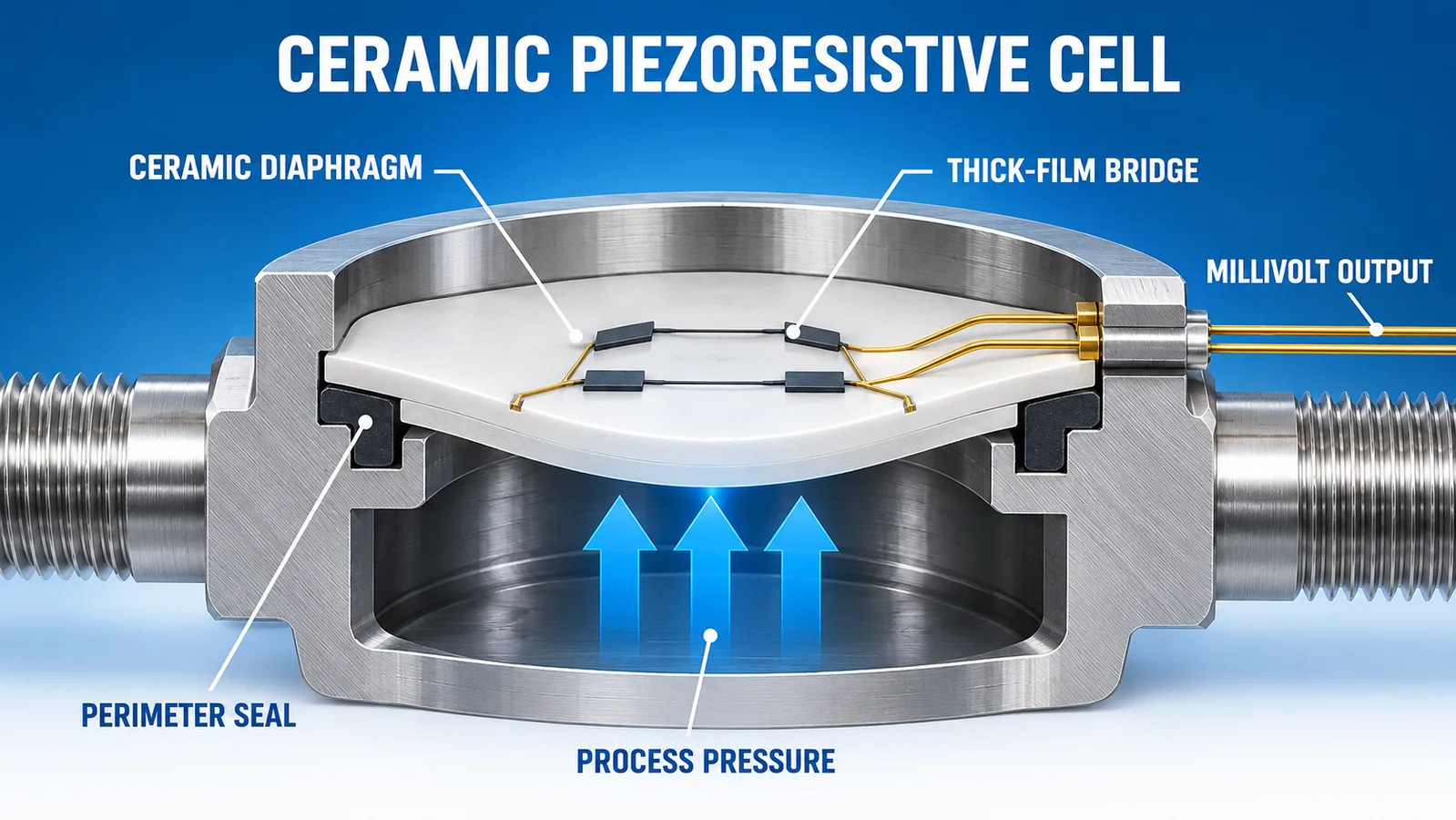
A ceramic cell uses a ceramic substrate and diaphragm with thick-film resistors arranged as a Wheatstone bridge. Pressure deflects the diaphragm, changes resistance and generates a differential millivolt signal.
The direct structure can avoid an internal metal isolation diaphragm and transfer fluid. It can offer high mechanical robustness and useful resistance to corrosion and wear. However, the final assembly commonly needs:
- a perimeter O-ring or gasket;
- a port and housing that support the cell;
- controlled compression without bending stress;
- stable excitation and differential amplification;
- temperature compensation and calibration;
- protection for the bridge and electrical contacts.
El Wheatstone bridge guide explains the low-level electrical output. A ceramic cell is not automatically a 4–20 mA transmitter.
How Does a Diffused-Silicon Pressure Sensor Work?
Diffused piezoresistors are formed in a silicon diaphragm and connected as a bridge. Silicon offers high strain sensitivity and supports compact structures. The media interface depends on packaging.
Direct-media silicon
Some MEMS designs expose silicon or protective layers to clean dry gas. Their compatibility is defined by the package and approved medium. They should not be assumed suitable for arbitrary liquid or corrosive service.
Isolated diffused-silicon core
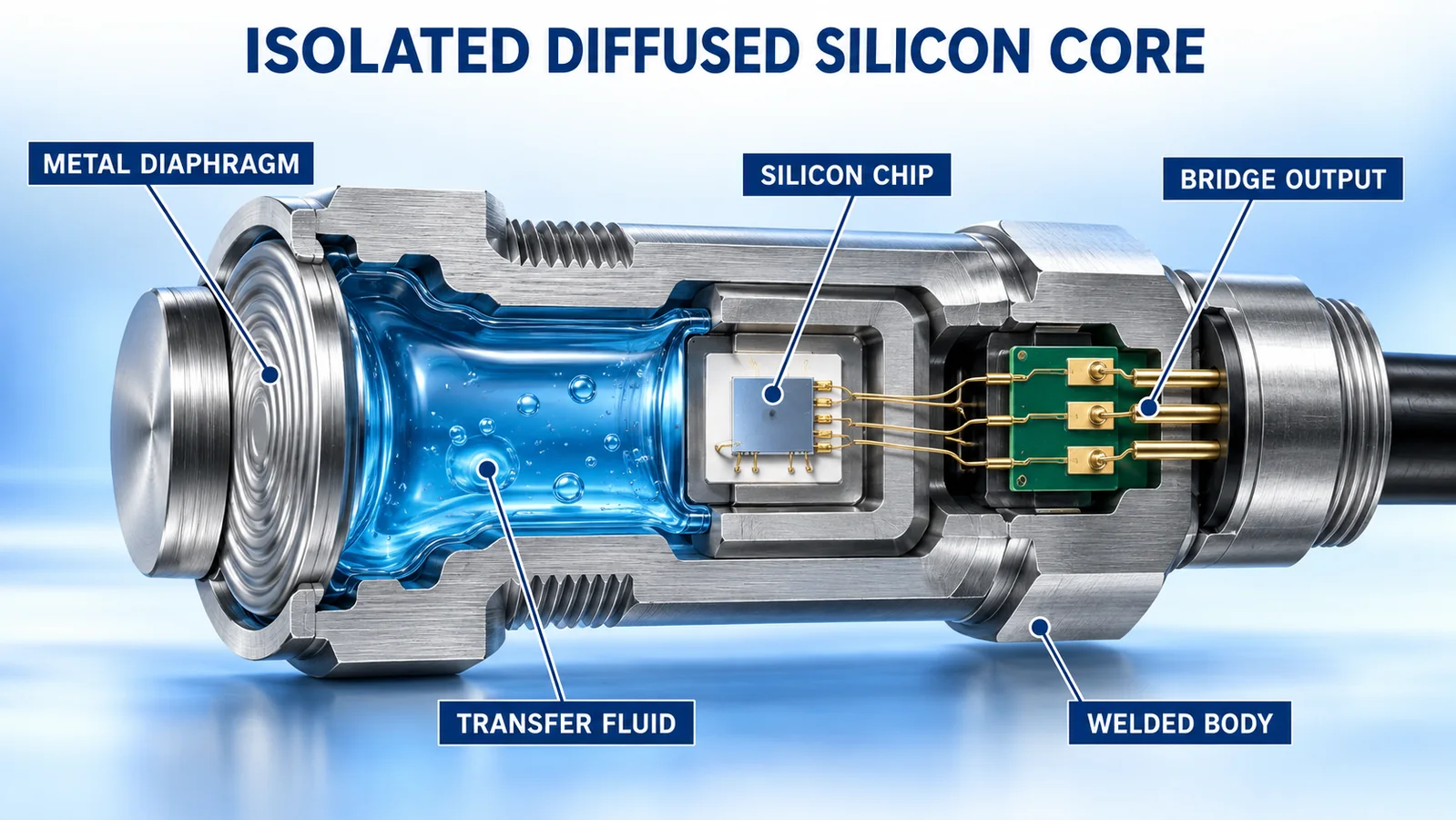
In an isolation-film core, process pressure acts on a metal diaphragm. Transfer fluid carries that pressure to the silicon chip. The metal diaphragm, housing and weld form the process barrier.
This architecture keeps silicon out of direct contact and allows the wetted diaphragm to be selected from an available alloy. It also introduces diaphragm stiffness, fill-fluid thermal expansion and additional assembly processes into the error and qualification model.
Media Compatibility Comparison
Compatibility belongs to the complete assembly.
Ceramic path
Check the ceramic grade, surface, perimeter seal, adhesive if exposed, port and installation gasket. Ceramic resistance does not approve the elastomer. Particle impact and uneven mounting can also damage a brittle cell.
Isolated silicon path
Check diaphragm alloy, lower housing, weld, process connection and gasket. Ask what fill fluid is behind the diaphragm and what a failure would mean for contamination-sensitive service.
For corrosive applications, follow the corrosive chemical pressure sensor guide and obtain approval for the exact chemical, concentration and temperature.
Ceramic vs Isolated Silicon Architecture
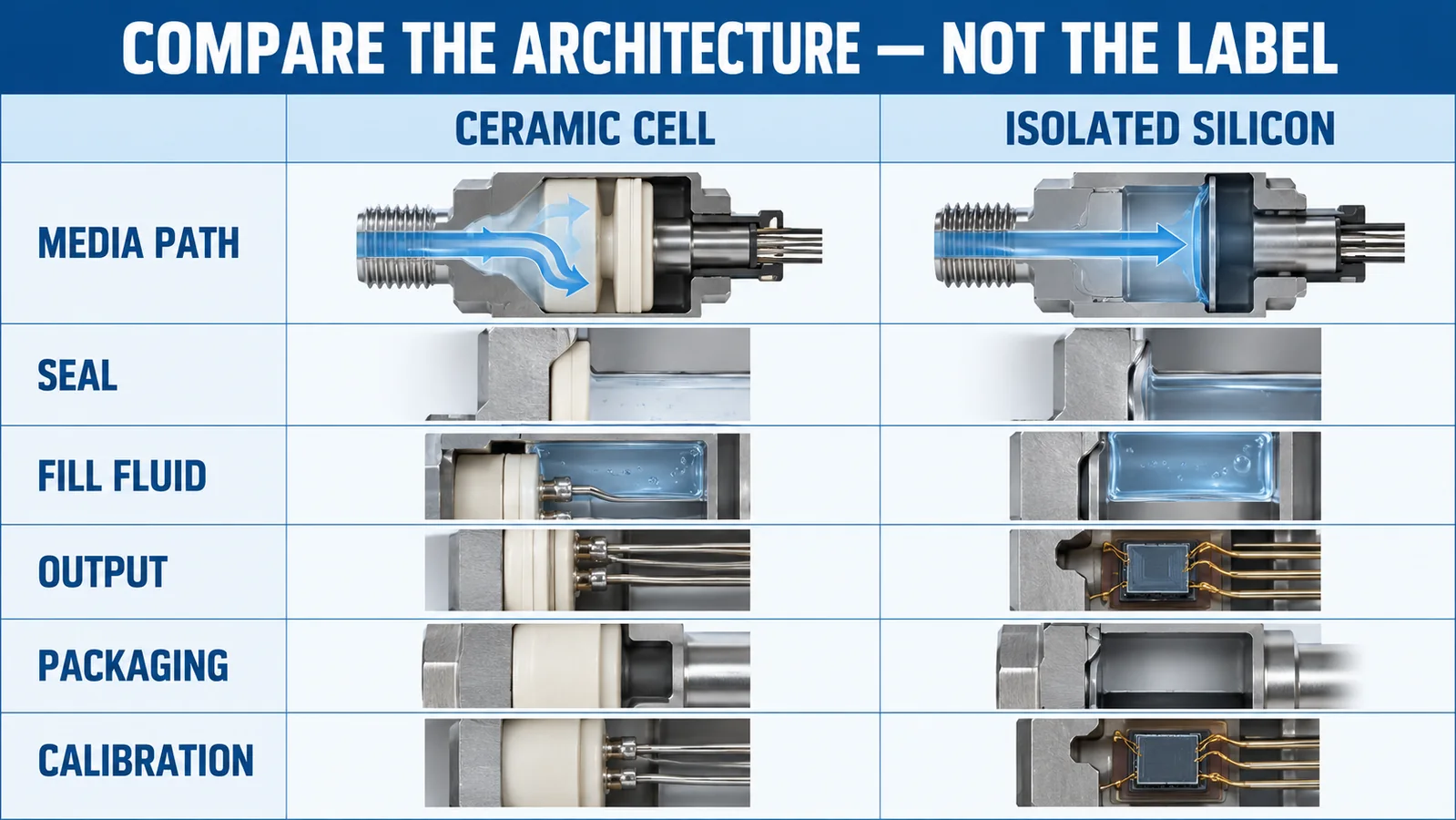
| Selection factor | Celda piezoresistiva de cerámica | Isolated diffused-silicon core |
|---|---|---|
| Signal source | Thick-film resistive bridge on ceramic | Diffused resistors on silicon chip |
| Typical media path | Medium acts on ceramic face | Medium acts on metal isolation diaphragm |
| Llenar liquido | Commonly absent in a direct cell | Common in isolated construction |
| Dependencia del sello | Often relies on perimeter seal in final housing | Welded internal barrier may reduce internal elastomers; process seal can remain |
| Raw output | Millivolt bridge common | Millivolt bridge common |
| Embalaje | OEM designs support, compression and seal | Core often supplied as metal package; OEM still designs connection and electronics |
| Main material review | Ceramic plus seals and port | Diaphragm alloy, weld, lower body, gasket and fill system |
| Main production review | Mounting stress and seal compression | Welding/package quality, excitation, compensation and calibration |
This table compares common architectures, not every ceramic or MEMS product.
Pressure Range and Overload
Both technologies cover broad ranges through different diaphragm geometries and packages. Do not select technology from range alone. Compare the exact model’s rated range, safe overload, burst pressure and reverse-pressure tolerance.
Ceramic cells can offer strong overload capability, but a thin ceramic diaphragm remains brittle and needs correct support. An isolated metal diaphragm can be very thin at low pressure and can be damaged by handling, water hammer or direct contact.
Choose range from normal pressure plus credible vacuum, surge and test conditions. A greatly oversized range reduces useful signal and magnifies percent-of-full-scale error in pressure units.
Temperature and Accuracy
Temperature affects ceramic elasticity, bridge resistance, silicon sensitivity, seal compression, metal diaphragm stiffness and transfer-fluid volume. Compare compensated temperature range separately from operating and storage limits.
A raw linearity number does not describe total error. Normalize nonlinearity, hysteresis, repeatability, zero error, sensitivity tolerance, thermal zero shift and thermal span shift. The accuracy FS versus reading guide provides a consistent comparison method.
Installed-package testing is essential. A ceramic cell can shift under housing stress. An isolated core can show thermal effects from diaphragm and fill fluid. Test complete assemblies after thermal soak and pressure cycling.
Raw Core or Conditioned Transmitter?
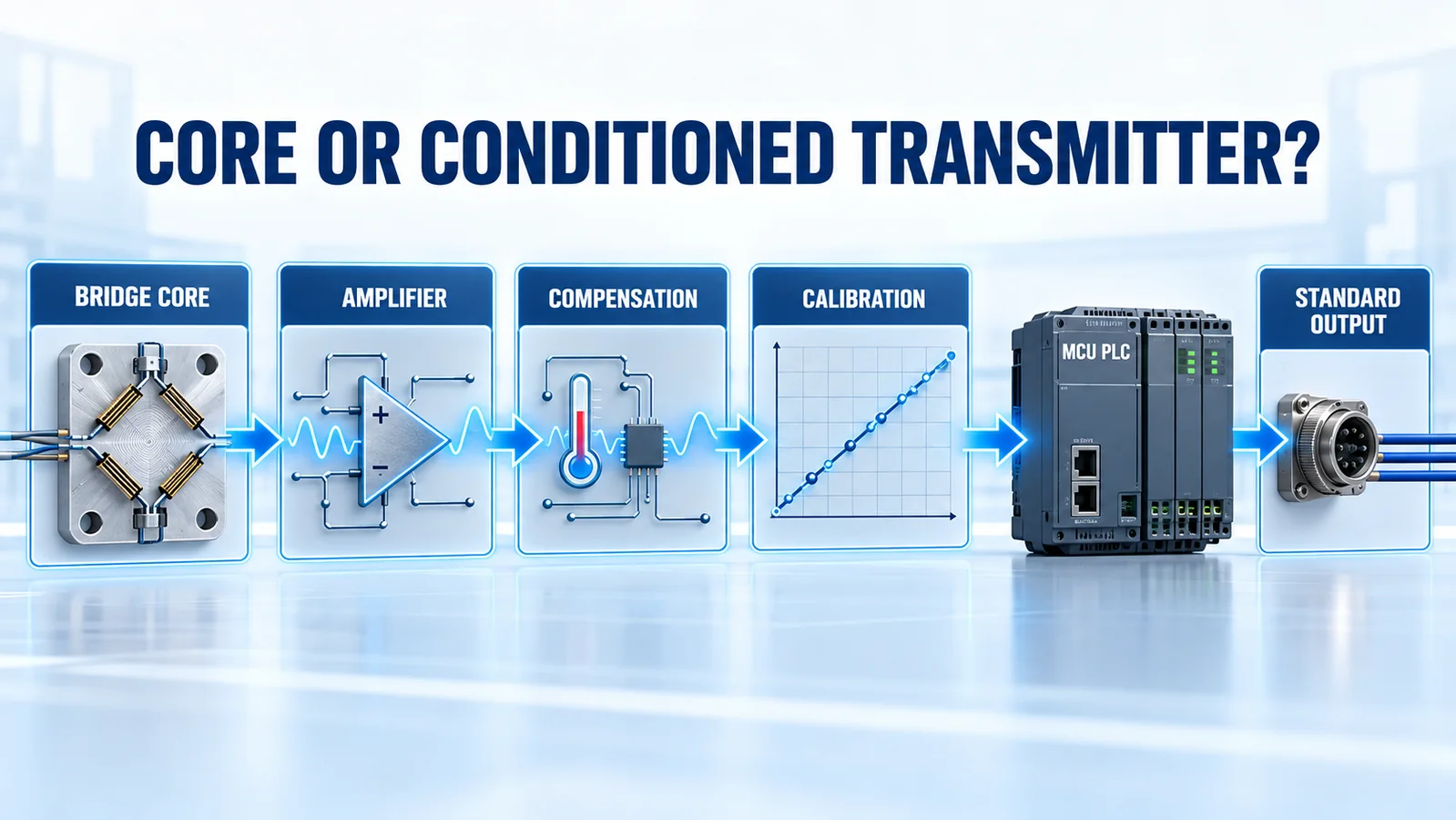
A raw bridge core offers packaging flexibility and lower component cost at volume, but the OEM owns:
- excitation stability;
- low-noise differential amplification;
- ADC range and common-mode design;
- calibration coefficients;
- temperature compensation;
- EMC and electrical protection;
- production test and traceability.
A conditioned transmitter supplies a standard voltage, current or digital output and normally includes compensation and calibration. It can shorten development but may be larger, cost more and offer less packaging freedom.
El core versus transmitter guide helps allocate this work.
Mechanical Packaging and Sealing
Ceramic cell packaging
Support the cell on defined surfaces, maintain uniform seal compression and avoid point loads. Account for ceramic-to-metal thermal expansion. The pressure cavity should not trap debris that loads the diaphragm or prevents drainage.
Isolated core packaging
Protect the thin diaphragm from tools and particles. Do not apply mounting torque through an electrical housing. Verify the thread and seal type, and avoid trapped gas in liquid systems or trapped liquid in gas systems.
For both, qualify vibration, shock, cable strain, connector ingress and pressure cycling. The guía de errores de instalación covers common field errors.
Packaging stress must also be checked at temperature. A seal that clamps a ceramic cell too tightly can move zero as the housing expands, while an isolated metal core can transmit installation torque or weld distortion into the sensing structure. Measure zero and span before assembly, after assembly and after thermal cycling so the source of any shift is visible. Define allowable assembly force, seal compression and torque in production instructions instead of relying on operator feel.
How Do WPAH01, WPCH04 and WPAK63 Fit?
La corriente Página de Winsen WPAH01 describes a ceramic piezoresistive pressure cell with a ceramic sensitive film and bridge-level output. It suits OEM teams prepared to design the housing, seal, electronics and calibration. Its material label does not approve the final assembly for a medium.
El Página WPCH04 describes a conditioned ceramic transmitter with a current page range family beginning at 0.2 MPa and extending to 40 MPa, standard output options and response at or below 1 ms. It illustrates how ceramic sensing can be delivered as a transmitter rather than a raw cell.
El Manual WPAK63 describes a general isolation-film pressure core using an isolated diffused-silicon architecture. It is a raw sensing component whose exact diaphragm, fill, range and output conditions must be confirmed.
Compare the latest datasheet and ordered configuration; do not transfer specifications between a cell, core and transmitter.
Five-Question Decision Gate
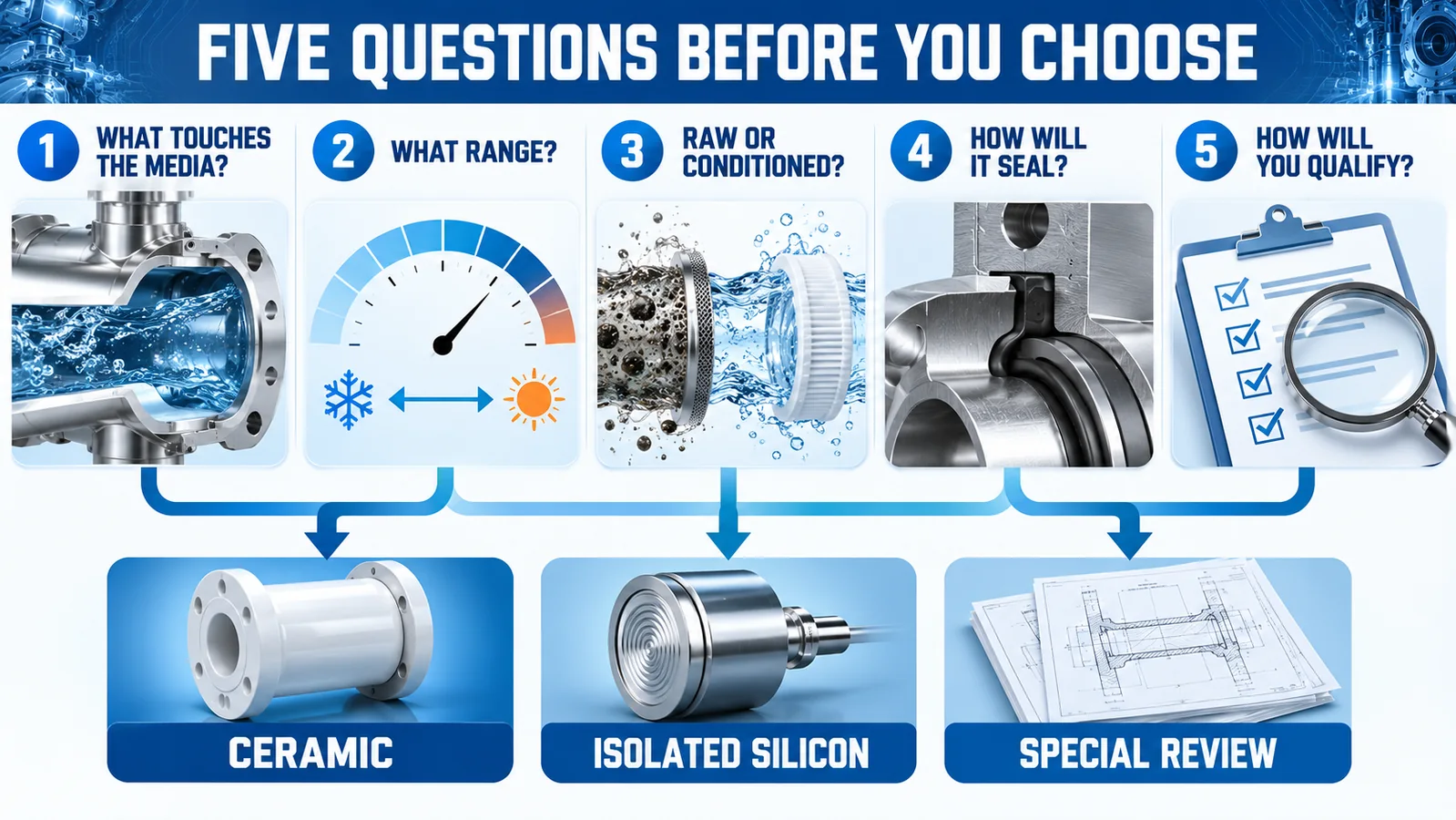
- What exactly touches the medium, including seals and cleaning chemicals?
- What normal, transient, vacuum and temperature range must survive?
- Does the OEM want a raw bridge or conditioned output?
- How will the component be sealed and mechanically supported?
- How will complete assemblies be calibrated, tested and change-controlled?
If any wetted material is uncertain, stop for a special material review. If production cannot support bridge calibration, investigate a conditioned transmitter even when the raw core looks cheaper.
Qualification Plan
Build representative assemblies and test zero, span, linearity, leak tightness, insulation and response. Add pressure cycling, overload, thermal cycling, vibration, media soak and cleaning exposure as required. Compare post-test drift against the system error budget.
For high-volume OEM programs, define calibration equipment, traceability, acceptable yield and supplier change notification. A technology decision is not complete until the production process can repeat it.
Preguntas frecuentes
Is ceramic more corrosion-resistant than silicon?
That question mixes sensing and wetted materials. In an isolated silicon core, the medium contacts metal rather than silicon. Compare the actual ceramic, metal, seal and process conditions.
Which technology is more accurate?
Either can be engineered for good performance. Compare complete specifications at the same range, temperature and accuracy definition rather than choosing from material alone.
Does a ceramic sensor need oil?
A direct ceramic cell commonly operates without internal transfer fluid. The exact product architecture must still be confirmed.
Can a raw core connect directly to a PLC?
Usually not when it produces a millivolt bridge signal. It needs excitation, amplification, calibration and a compatible analog or digital interface.
Which is better for hygienic media?
Hygienic suitability depends on flush geometry, surface finish, crevices, gasket, cleaning and approvals. Neither sensing material proves hygienic design.
Conclusión
Ceramic versus diffused silicon is not a contest between two isolated materials. It is a choice between pressure paths, packages and integration responsibilities. Define what touches the medium, compare range and total error, decide who owns signal conditioning, and qualify the complete assembly. For a model-level review, contacto winsen with the media and OEM integration specification.
