

A useful pressure sensor RFQ tells the manufacturer what your equipment must measure, what the sensor will experience, how it connects and what evidence you need before release. Put those requirements in editable tables, ask the supplier to identify the exact offered configuration, and keep every deviation visible. A family name and a desired price are rarely enough to compare quotations fairly.
The pressure sensor RFQ template below is designed for engineering and purchasing to complete together. Copy the Markdown tables into your project document or spreadsheet and replace the bracketed entries. Each field has a stable identifier so clarification survives email exchanges, drawing changes and a handover between colleagues. The tables are a request for review; they become purchase requirements only through your agreed technical and commercial process.
What should the RFQ establish before selection begins?
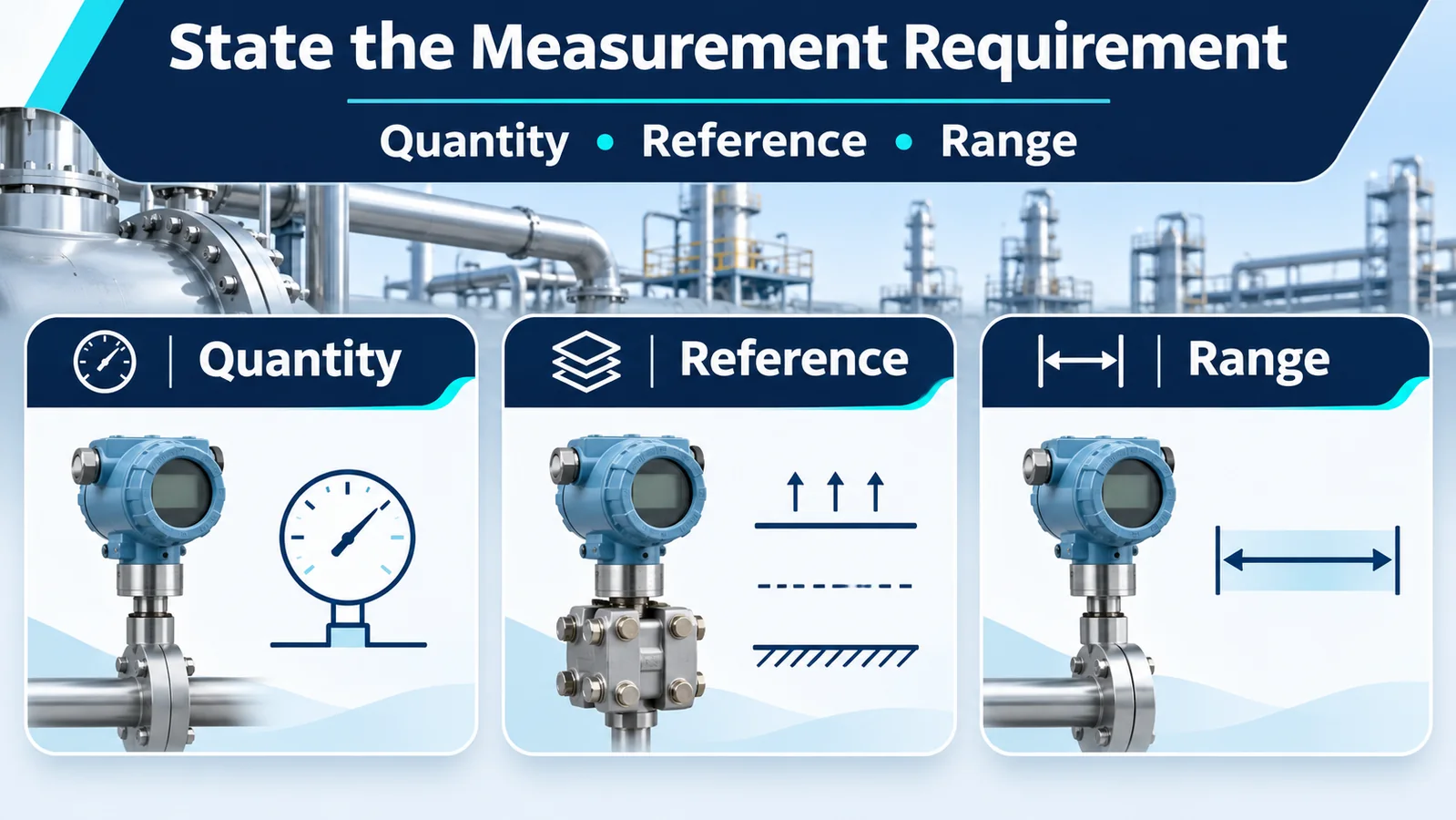
Start with the job the measurement performs. A pressure value used for a dashboard may have different timing, failure-response and acceptance needs from a value used to regulate a pump. Describe that function before asking for a sensor technology. This gives the manufacturer room to propose a suitable configuration while preserving your actual requirement.
Assign one technical owner and one purchasing owner. The technical owner resolves interfaces and test acceptance; purchasing resolves quantity, delivery and quotation scope. Use “open” for an unresolved requirement and name its owner. An empty cell can be mistaken for “no requirement,” while an invented number may become an expensive contractual assumption.
| Field ID | Buyer entry | Supplier response requested |
|---|---|---|
| PROJECT_ID | [Equipment, project and RFQ number] | Repeat reference in quotation |
| RFQ_REVISION | [Revision and issue date] | Identify revision reviewed |
| MEASUREMENT_FUNCTION | [Monitor, control or other function] | State proposed functional scope |
| TECHNICAL_OWNER | [Name and contact] | Name application contact |
| PURCHASE_OWNER | [Name and contact] | Name quotation contact |
| DEVELOPMENT_STAGE | [Concept, prototype, pilot or production] | State assumptions and next step |
| OPEN_ITEMS | [Unknown, owner and resolution date] | Identify missing decision inputs |
Avoid starting from a long list of preferred features without identifying which ones are mandatory. Mark requirements as mandatory, preferred or supplier-proposed in your working copy. A manufacturer can then distinguish a genuine feasibility constraint from a preference that could be changed to simplify integration.
How do you describe the operating envelope?
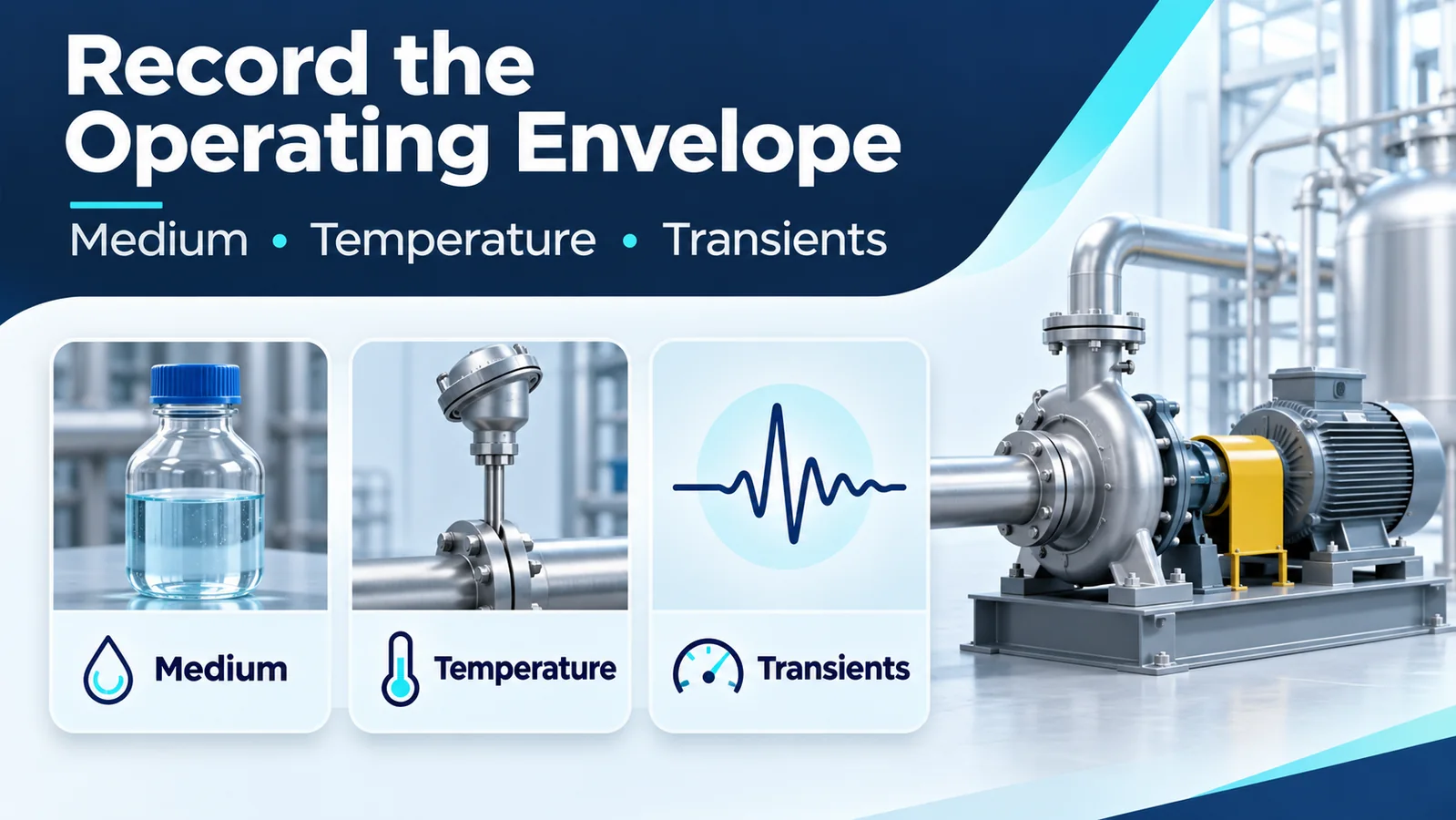
Give measurement limits and exposure limits separately. The normal operating band, the smallest important change and an exceptional start-up spike answer different questions. Include units and pressure reference beside every pressure value. Our tryktyper guide explains the differences between gauge, absolute and sealed gauge references when completing this section.
Temperature should describe both the fluid and the surrounding electronics. Include cleaning, shutdown, storage or freeze exposure when relevant. Name the actual medium and its concentration, rather than writing only “water” for a liquid containing treatment chemicals. The supplier should confirm all wetted materials, seals and any isolation arrangement against that description.
| Field ID | Buyer entry | Supplier response requested |
|---|---|---|
| PRESSURE_REFERENCE | [Gauge, absolute, sealed gauge or differential] | Confirm exact offered reference |
| MEASURING_RANGE | [Lower and upper limits, units] | State calibrated range and scaling |
| NORMAL_PRESSURE | [Minimum, typical and maximum] | Confirm measurement suitability |
| TRANSIENT_EXPOSURE | [Peak, duration, rise time and repetition] | Confirm applicable conditional limits |
| REVERSE_PRESSURE | [Vacuum or reverse exposure, if relevant] | State permitted conditions |
| MEDIUM | [Fluid, phase, composition, concentration] | List wetted materials and restrictions |
| FLUID_TEMPERATURE | [Continuous band and excursions] | Confirm operating/compensated limits |
| AMBIENT_TEMPERATURE | [Continuous band and excursions] | Confirm electronics/cable limits |
| ERROR_REQUIREMENT | [Allowed error, denominator, conditions] | Provide complete error definition |
| SERVICE_LIFE | [Hours, cycles and maintenance assumptions] | State supporting evidence and limits |
For differential measurement, specify each port’s maximum line pressure as well as the expected difference. A small differential range does not establish tolerance of large common pressure. Link the relevant process sketch and use the differential-pressure explanation to align terminology before requesting a quotation.
Write accuracy in usable terms. “High precision” is not an acceptance criterion. State the maximum permitted error at the equipment’s important operating points, the temperature band and whether the requirement includes the controller. Ask how nonlinearity, hysteresis, repeatability, thermal effects and drift are represented. Avoid adding supplier percentages that overlap or using room-temperature accuracy as a complete environmental error budget.
Which electrical and acquisition fields prevent surprises?
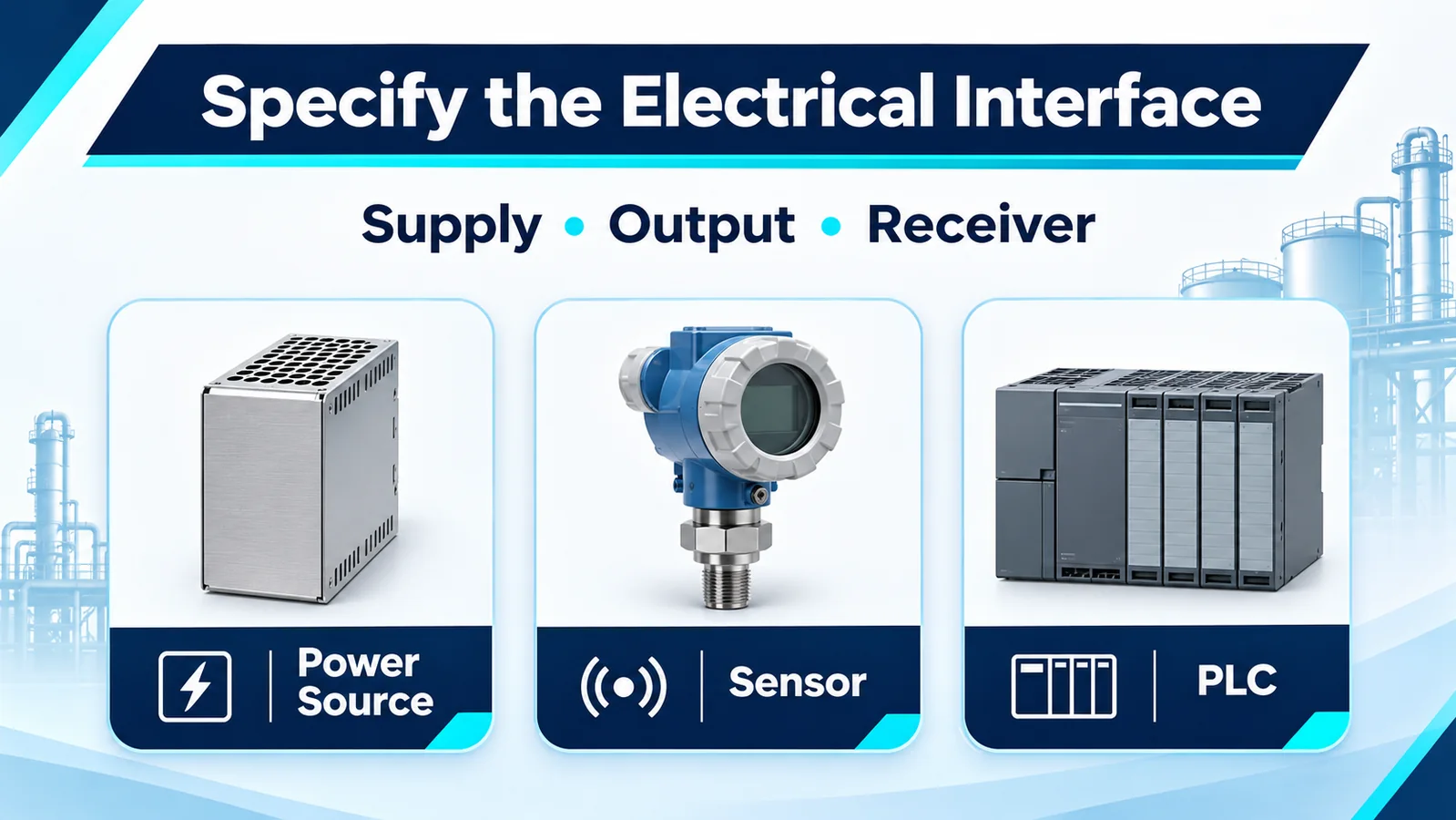
Identify the receiving controller before choosing an output. A conditioned voltage signal, current loop and digital interface require different inputs, power arrangements and diagnostics. Even a familiar connector can have different pin assignments between variants. Attach the controller input specification rather than relying on the phrase “PLC compatible.”
For digital signals, request the actual protocol documentation, address behavior, units, scaling, timing and recovery procedure. An electrical interface name alone does not define the application protocol. For analog signals, define transfer-function endpoints, usable load, reference arrangement and how the equipment detects an invalid reading.
| Field ID | Buyer entry | Supplier response requested |
|---|---|---|
| OUTPUT_INTERFACE | [Current, voltage or named digital interface] | Exact offered output variant |
| SUPPLY_AT_SENSOR | [Nominal, minimum, maximum and disturbances] | Allowed supply and current demand |
| CONTROLLER_INPUT | [Module or MCU input specification] | Loading and interface compatibility |
| TRANSFER_FUNCTION | [Requested endpoints, units and sign] | Confirm voltage/current/code mapping |
| ACQUISITION_TIMING | [Fresh-data interval and maximum latency] | State conversion and response conditions |
| CABLE_ENVIRONMENT | [Length, route, shielding and grounding] | Wiring and installation guidance |
| STARTUP_BEHAVIOR | [Time until valid data is required] | Validity indication and initialization |
| FAULT_RESPONSE | [Required equipment response] | Available detection/status behavior |
| DIGITAL_DOCUMENTS | [Protocol, register and software needs] | Supply revision and known restrictions |
Do not assume that a digital output also provides wireless communication or that a current loop includes every diagnostic you want. Keep equipment fault handling as a buyer requirement and ask what the offered sensor actually supports. Any external conversion or gateway belongs in the scope and cost comparison.
How should mechanical requirements be recorded?
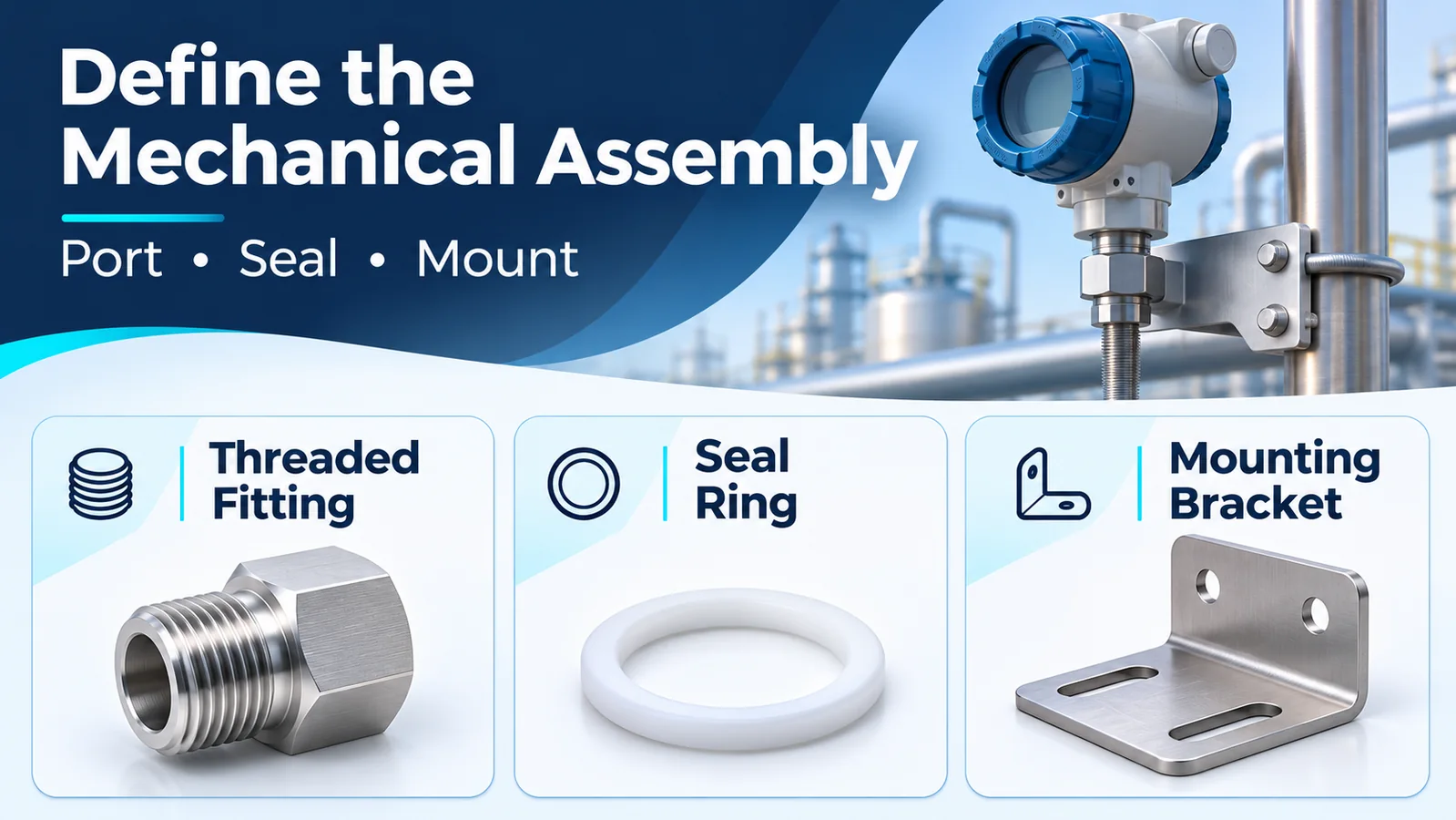
An RFQ should define the mating interface, not just the sensor’s thread label. Include thread standard, size, gender, sealing method, required insertion length and the space available for installation tools. A drawing should show where the sensing surface sits relative to the process and whether an adapter creates a trapped volume or unwanted restriction.
If the product is a module, identify who supplies the housing, process seal and environmental protection. Module specifications do not automatically qualify the completed assembly. Review cable strain relief, connector access, drainage and service replacement in the real equipment position.
| Field ID | Buyer entry | Supplier response requested |
|---|---|---|
| DRAWING_REFERENCE | [Drawing number and revision] | Offered drawing and deviations |
| PROCESS_CONNECTION | [Standard, size, gender and tolerances] | Exact connection and mating detail |
| SEAL_INTERFACE | [Face, cone, thread or other arrangement] | Seal material and installation instructions |
| WETTED_PARTS | [Restrictions and compatibility needs] | Complete wetted-material list |
| SPACE_ENVELOPE | [Dimensions and tool clearance] | Dimensions including connector/cable |
| ENVIRONMENT | [Ingress, vibration, shock and cleaning] | Evidence applicable to offered assembly |
| MOUNTING_OWNERSHIP | [Supplier assembly or buyer integration] | Scope boundary and responsibilities |
Our pressure transducer selection page is useful for exploring product categories. The RFQ adds the specific interfaces, evidence and ownership needed to turn that exploration into a reviewable offer.
What evidence and commercial details belong in the request?
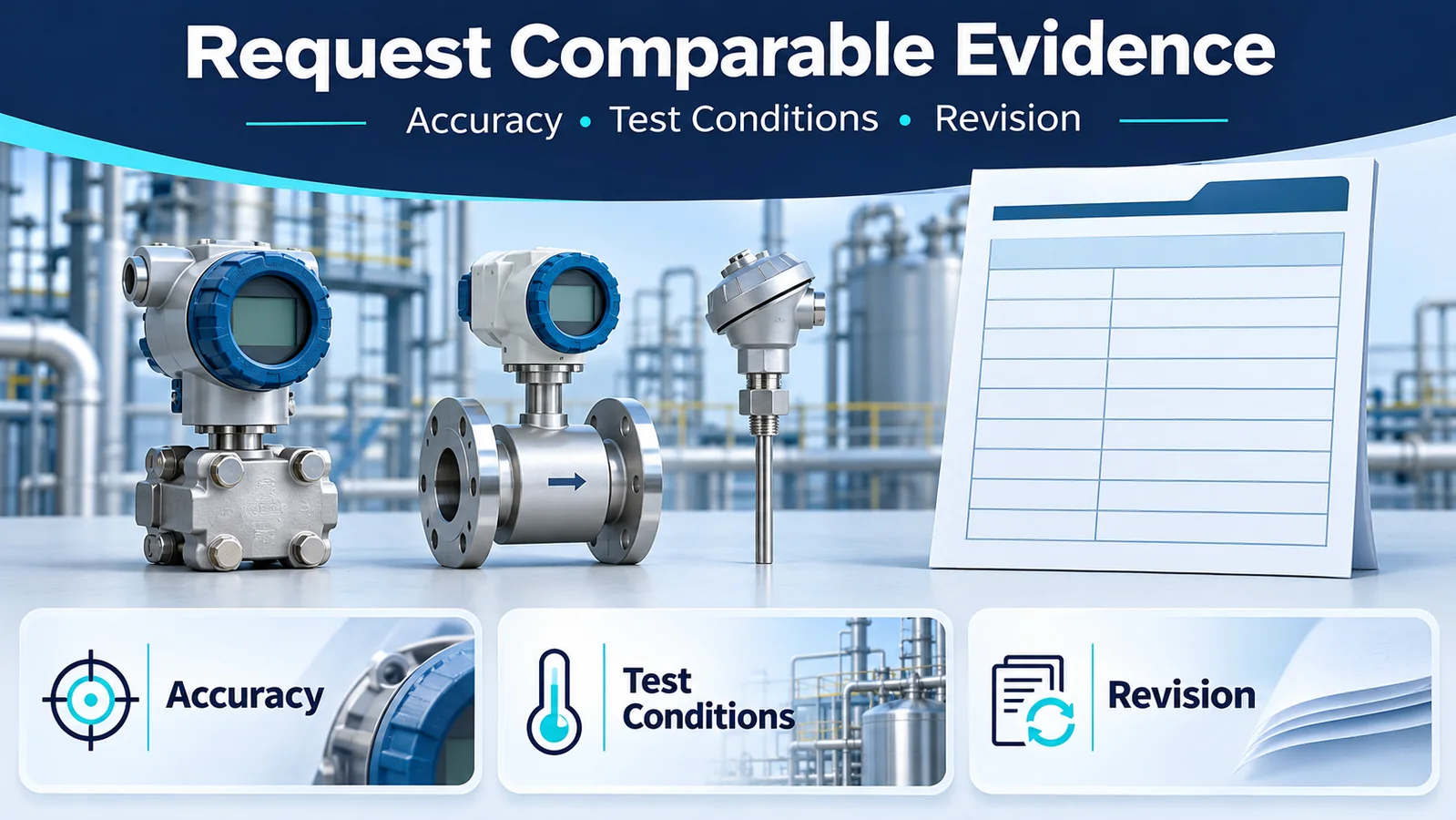
Ask for evidence that supports the project decision. “Provide all certificates” is often ambiguous: do you mean a calibration record, a material declaration, a regulatory document or a qualification report? Name the document, the configuration it must cover and whether you need a sample record before ordering.
Separate prototype and production quotations. Engineering samples, tooling, documentation, special testing and recurring unit supply can have different scope. Request line items so the initial purchase price does not hide an integration cost that appears later.
| Field ID | Buyer entry | Supplier response requested |
|---|---|---|
| SAMPLE_QUANTITY | [Units and required date] | Price and confirmed delivery basis |
| PRODUCTION_FORECAST | [Pilot, annual volume and order pattern] | Quantity breaks and minimum order |
| ACCEPTANCE_PLAN | [Tests, limits and decision owner] | Agreement or explicit deviations |
| CALIBRATION_RECORD | [Points, temperature and traceability needs] | Record scope, uncertainty and cost |
| QUALIFICATION_EVIDENCE | [Pressure, environmental or EMC evidence] | Applicable report/configuration reference |
| COMPLIANCE_DOCUMENTS | [Named requirements and market] | Applicable documents and exclusions |
| IDENTIFICATION | [Serial/lot and marking needs] | Proposed traceability arrangement |
| CHANGE_NOTIFICATION | [Required change-review process] | Available notification arrangements |
| COMMERCIAL_SCOPE | [Currency, destination and delivery terms] | Validity, warranty and exclusions |
What does a completed OEM example look like?
Consider a hypothetical liquid-cooling skid. Engineering expects normal gauge pressure between 2 and 6 bar and wants to measure up to 10 bar. The controller has an existing current input. Purchasing needs 12 pilot units and a budget for 1,000 units annually. These are example buyer targets, not specifications or availability claims for a Winsen product.
| Krav | Example RFQ entry | Clarification before release |
|---|---|---|
| Fungere | Regulate pump discharge pressure | Confirm required loop response |
| Måling | 0–10 bar gauge; normal 2–6 bar | Confirm exact offered reference |
| Exceptional event | Estimated 14 bar during valve closure | Measure duration and repetition |
| Temperatur | Fluid 5–70°C; ambient 0–50°C | Confirm total error over both bands |
| Error target | Whole input chain within ±0.15 bar | Allocate sensor/controller contributions |
| Produktion | 4–20 mA to existing input | Confirm supply/load and fault handling |
| Medium | Water with specified glycol additive | Attach composition and seal requirements |
| Purchase | 12 pilot units; forecast 1,000/year | Separate sample and recurring quotations |
The strongest next step is resolving the transient, not assuming that a published overload multiplier covers it. Give that open item an owner and request a conditional technical response while the event is characterized. A supplier may propose a different range, mechanical protection or test scope; each proposal should show its effect on measurement performance and integration.
De official Winsen pressure-sensor catalogue provides a starting point for family discussion. The WPCK07 produktside, for example, lists multiple analog and digital output options. That breadth makes the ordered variant essential: a family name does not fix the power supply, wiring or exact interface. Ask Winsen to identify the offered configuration against your completed fields.
How do you reconcile revisions and release the quotation?
Maintain one master RFQ revision. When a supplier answers in email, copy the decision back into the appropriate field and record the evidence reference. Attach a deviation register to the quotation review rather than allowing exceptions to disappear across message threads.
| Field ID | Requested revision | Offered configuration | Status | Owner and evidence |
|---|---|---|---|---|
| [ID] | [Requirement] | [Supplier response] | [Agreed/open/deviation] | [Name, document, date] |
Before release, reconcile the quotation part number, drawing, output, range, materials and test plan. A sample passing one bench check does not resolve an undocumented material or interface substitution. Preserve the approved sample configuration and record which remaining production checks will establish conformity of delivered units.
FAQ
Can I send an RFQ before every parameter is known?
Yes. Mark unresolved fields as open, explain the application and assign owners. Request alternatives with stated assumptions. This supports an honest feasibility discussion without converting guesses into hidden requirements.
Is an RFQ the same as a purchase specification?
An RFQ requests a technical and commercial offer. The agreed specification and accepted order documents define what will be supplied. Reconcile them explicitly so an early draft is not confused with the final configuration.
Should I ask for a specific Winsen model?
Include a candidate family if useful, but keep the application requirements visible. Ask the manufacturer to confirm the exact orderable configuration and explain any deviation from the requested envelope.
What should I send Winsen first?
Send the completed project, pressure, medium, temperature, interface and quantity fields, together with the mating drawing and known open items. Request a written configuration response, supporting documents and quotation scope so engineering and purchasing can review the same offer.
