
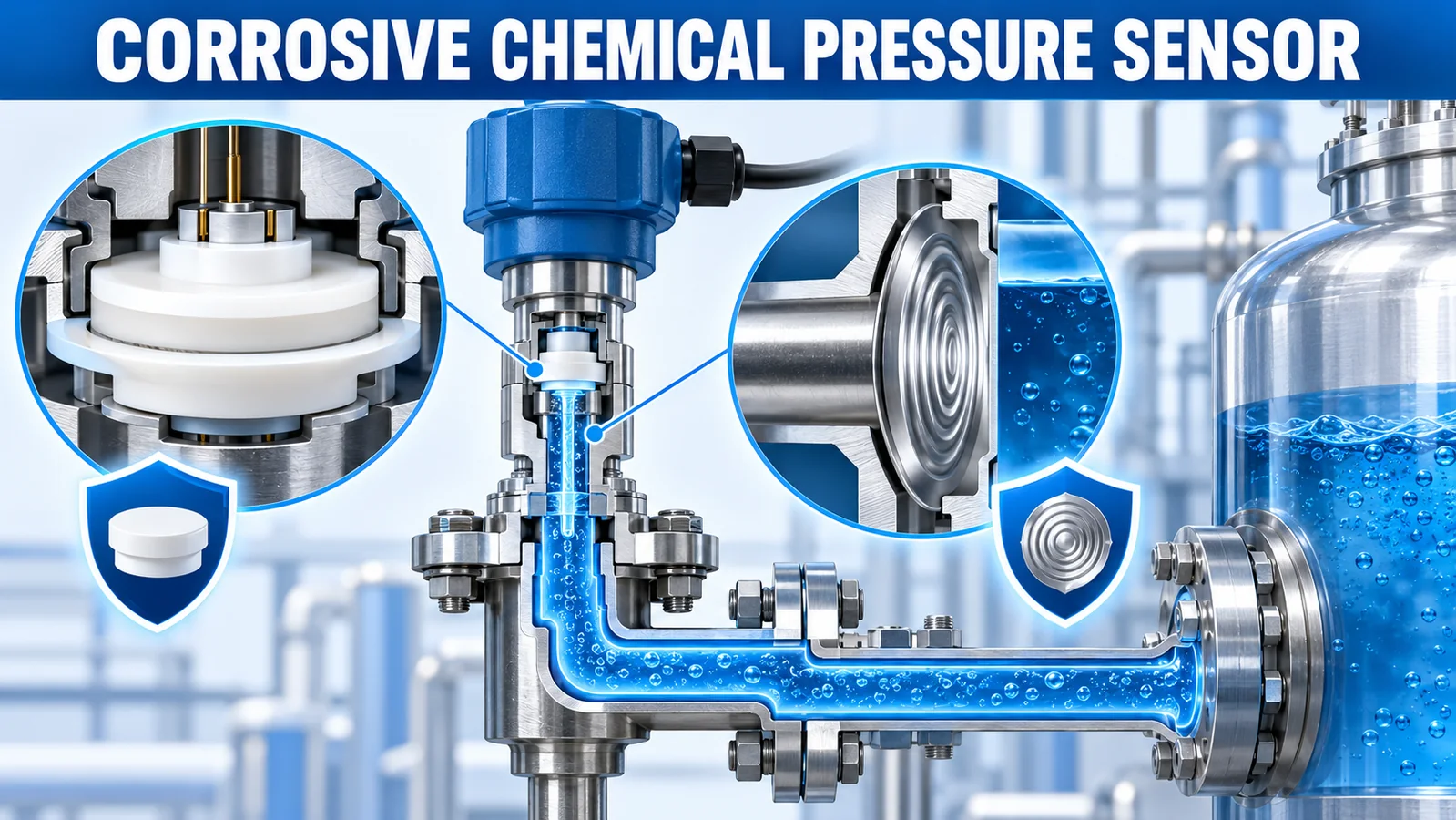
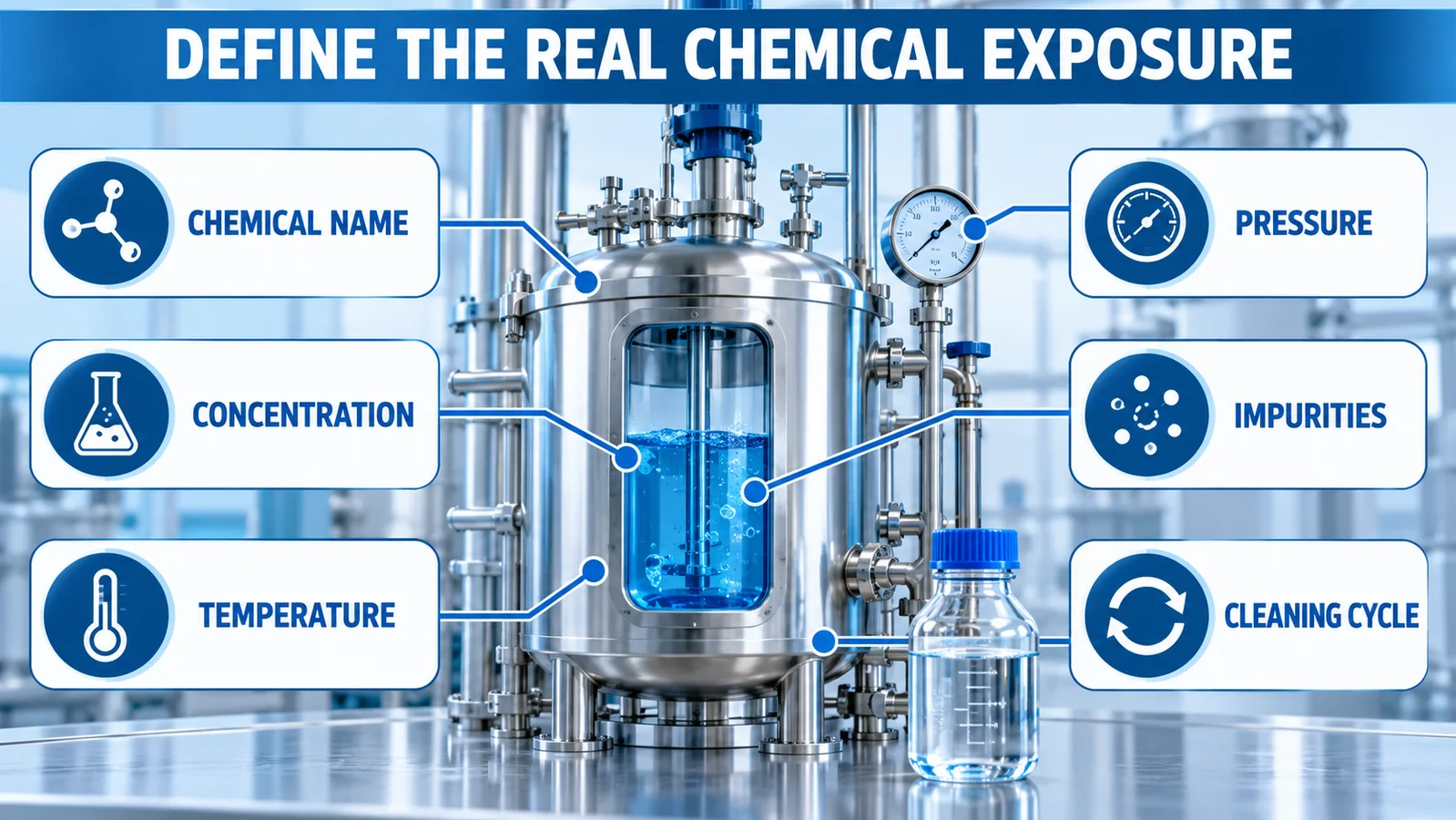
A corrosive chemical pressure sensor cannot be selected from the word “corrosive” or from one material label. The chemical name, concentration, temperature, pressure, phase, impurities, cleaning cycle and exposure time all affect compatibility. Every wetted part must survive those conditions.
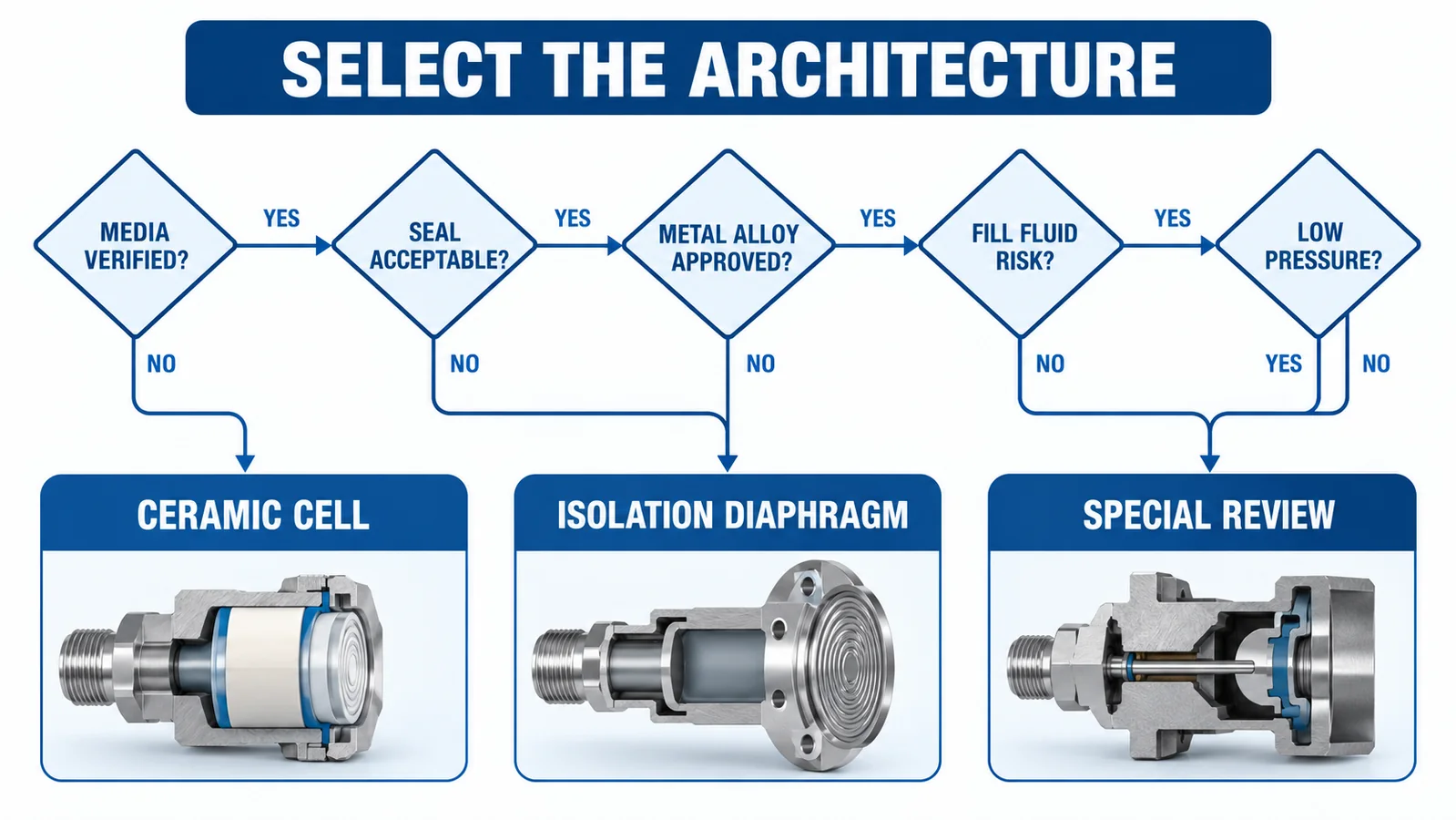
The practical comparison is between two common architectures: a direct ceramic pressure cell and a silicon sensing chip protected behind a metal isolation diaphragm. Neither is universally superior. The best architecture is the one whose complete pressure boundary has documented compatibility and acceptable measurement performance.
Why Is There No Universal Corrosion-Proof Sensor?
Corrosion behavior changes with concentration and temperature. A material that performs well in a dilute solution at room temperature may pit, crack, swell or lose strength in a hotter or more concentrated process. Mixed chemicals and contaminants can behave differently from pure laboratory reagents.
De Ashcroft low-pressure diaphragm-seal guidance makes the core point clearly: no common material is immune to all chemicals, and concentration, temperature and contamination influence corrosion.
Therefore, a generic internet compatibility table is only a screening reference. Final approval should come from the sensor or material supplier for the actual conditions, supported by tests when consequences are significant.
Define the Complete Exposure First
Before comparing products, record:
- chemical names and all components of a mixture;
- normal, minimum and maximum concentration;
- operating, cleaning, sterilization and upset temperature;
- pressure range, vacuum and surge;
- gas, liquid, slurry or two-phase condition;
- dissolved gases, chloride, oxidizer and contaminant content;
- viscosity, crystals, solids and abrasion;
- continuous or intermittent exposure;
- cleaning chemicals and rinse sequence;
- allowable contamination if a diaphragm fails;
- required approvals, traceability and leak testing.
Do not specify only “acid,” “alkali,” “solvent” or “water treatment chemical.” Those descriptions are too broad for material approval.
How Does a Direct Ceramic Pressure Cell Work?
A ceramic piezoresistive cell uses a ceramic diaphragm and thick-film resistive bridge. Process pressure deflects the diaphragm, changes bridge resistance and produces a small differential output.
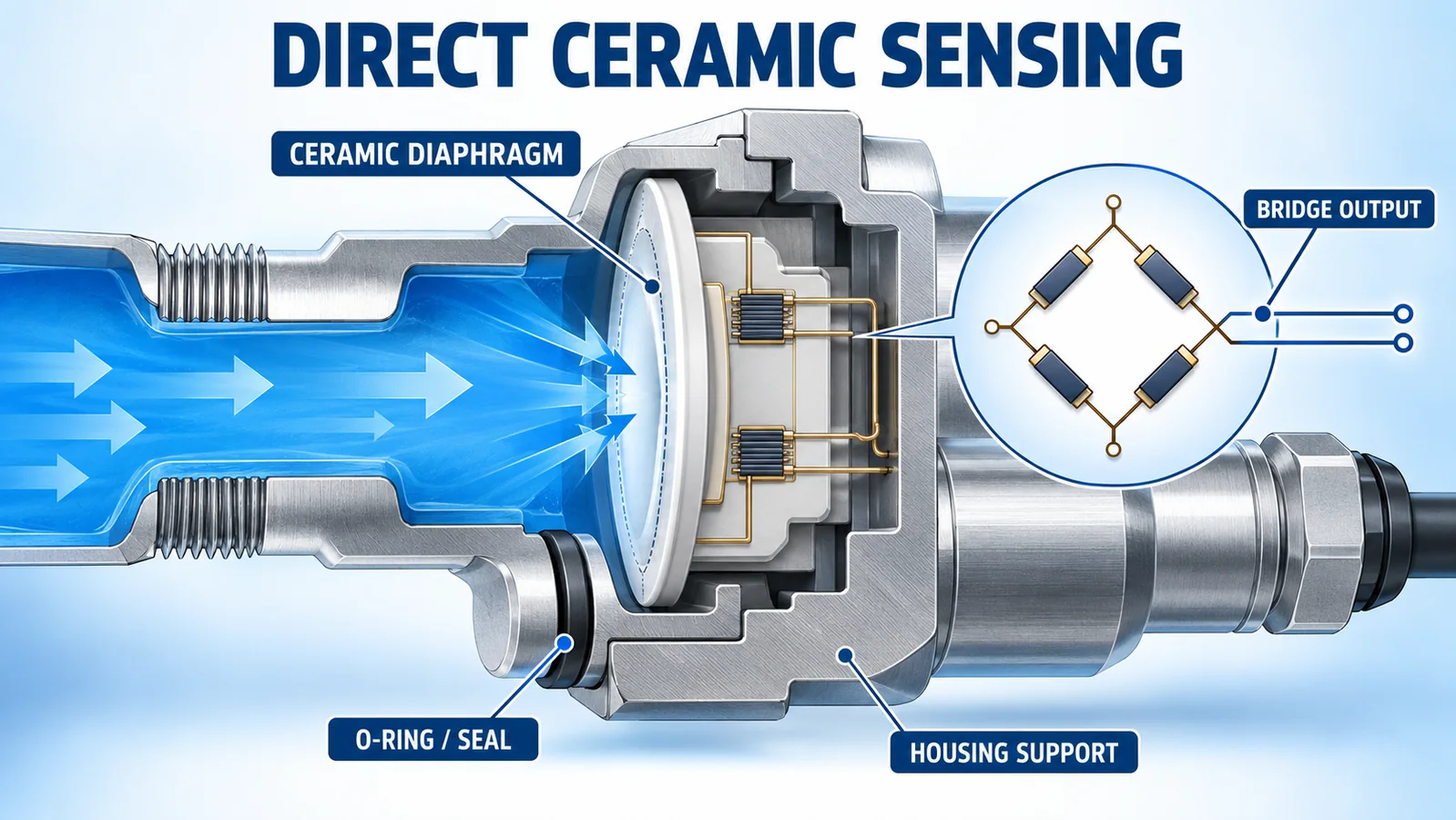
The direct architecture can avoid a metal isolation diaphragm and internal transfer liquid. This can simplify the pressure path and remove fill-fluid contamination risk. Ceramic materials can offer useful corrosion and wear resistance.
However, “ceramic” does not describe the complete device. The assembled sensor may expose an O-ring, gasket, adhesive, port or supporting metal. The ceramic grade and surface finish also matter. A chemically resistant ceramic diaphragm does not rescue an incompatible elastomer.
The final housing must support the cell without uneven clamping or thermal stress. Seal compression, groove design and assembly tolerances can shift zero or create leaks. OEM validation must test the ceramic cell inside the production package, not only as a loose component.
How Does an Isolation-Diaphragm Sensor Work?
An isolation-film design places a thin metal diaphragm between the process and a silicon sensing chip. Pressure deflects the diaphragm and is transmitted through a fill medium to the chip. The chip performs the piezoresistive conversion while the diaphragm provides the wetted barrier.
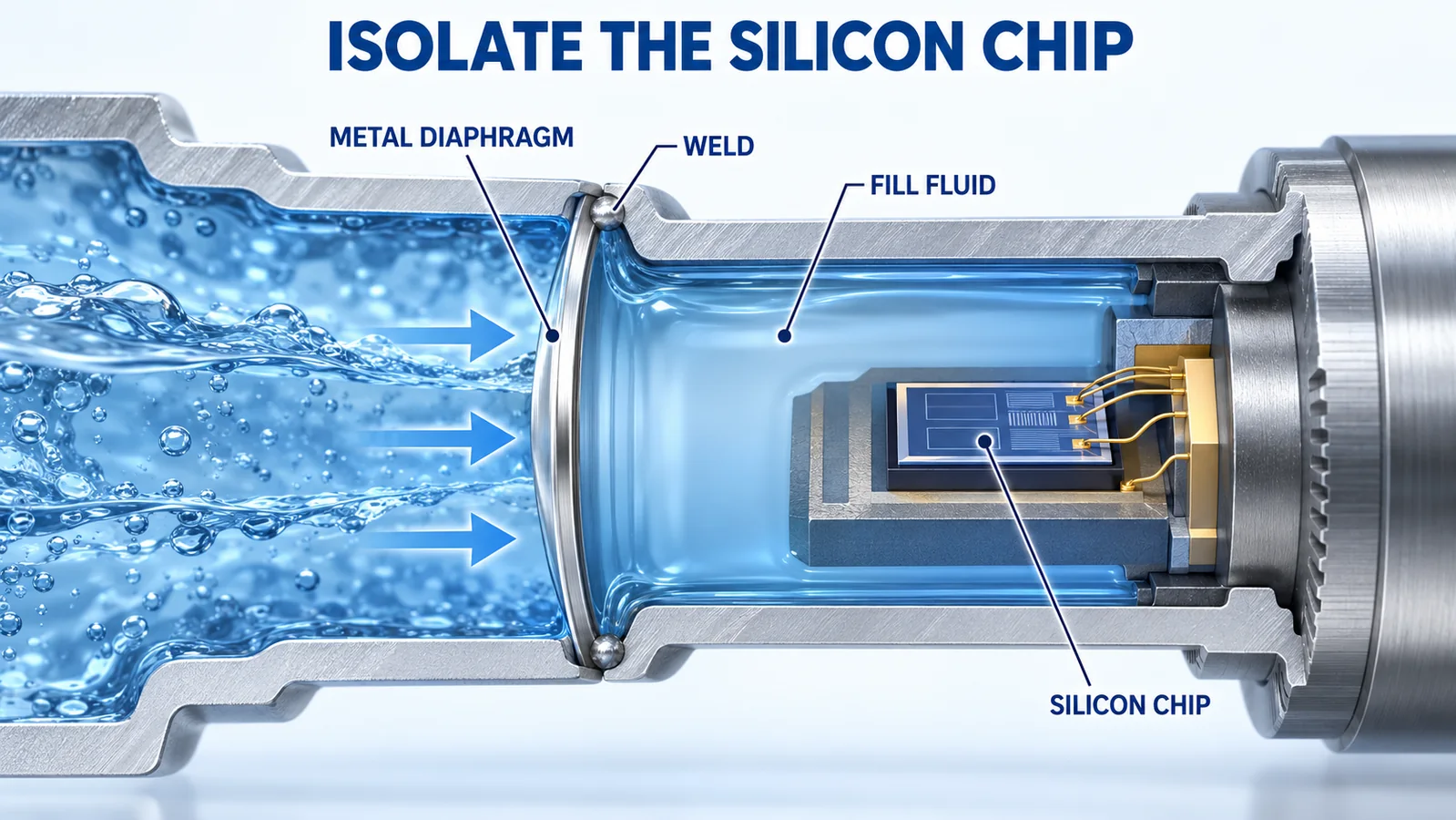
This architecture allows the process interface to use a selected metal alloy and supports welded pressure boundaries. A flush diaphragm can reduce dead volume and clogging compared with a small recessed port.
The material review must include diaphragm alloy, lower housing, process connection and welds. It must also consider the fill fluid behind the diaphragm, especially where a leak could contaminate food, pharmaceutical, oxygen, semiconductor or high-purity processes.
De Ashcroft diaphragm-seal selection document notes that diaphragm and lower housing are in direct process contact and that fill-fluid choice depends on temperature and process conditions. The same system-level thinking applies to compact isolated pressure cores.
What Exactly Counts as a Wetted Part?
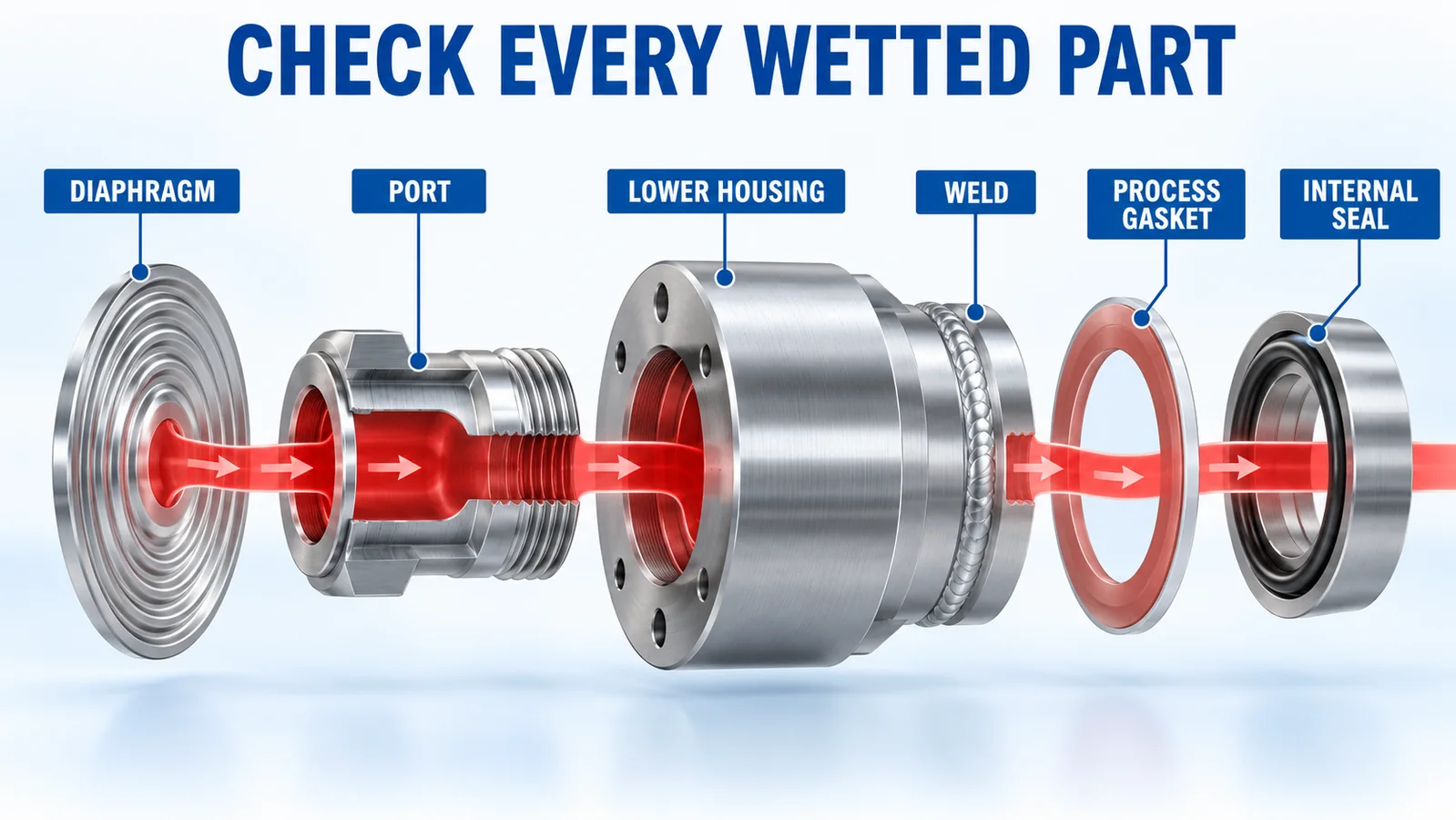
Wetted parts can include:
- ceramic or metal diaphragm;
- pressure port and lower housing;
- weld or braze exposed to the process;
- internal O-ring, gasket or adhesive;
- process gasket supplied by the equipment maker;
- flush port or protective screen;
- coating or lining;
- capillary and remote-seal components;
- fill fluid if a failure can expose it.
External housing material is not enough. A “stainless body” may still use a different diaphragm or an elastomer seal. Request a drawing or declaration that identifies each wetted material by grade.
Ceramic vs Isolation Diaphragm Comparison
| Spørgsmål | Direct ceramic cell | Metal isolation diaphragm |
|---|---|---|
| Process contact | Ceramic face plus assembly seal/port | Metal diaphragm, lower body, weld and gasket |
| Internal fill fluid | Commonly absent in a direct dry cell | Almindelig i en isoleret siliciumarkitektur |
| OEM work | Housing, seal, amplification, compensation, calibration | Amplification and calibration for raw cores; packaged transmitter may reduce work |
| Clogging | Depends on port and mounting | Flush design can reduce recesses |
| Low-pressure behavior | Depends on diaphragm geometry and mounting stress | Isolation diaphragm stiffness and fill system can affect low ranges |
| Chemical decision | Ceramic grade and all seals must be approved | Exact alloy, weld, gasket and fill system must be approved |
| Best use | When the complete dry-cell package fits chemistry and production | When a documented metal process barrier or flush geometry fits better |
What About 316L and Hastelloy C?
316L stainless steel is widely used, but it is not a universal chemical material. Chloride concentration, temperature, oxygen content, crevices and stress can change its behavior. “Hastelloy C” also needs an exact grade and product configuration; it should not be treated as proof of compatibility with every aggressive chemical.
If a product offers an optional alloy diaphragm, confirm whether the lower housing, weld and connection share that alloy or remain another material. A special diaphragm alone may not create an all-alloy wetted path.
When process risk is high, involve the plant materials engineer, chemical supplier and instrument supplier. Written approval should state the actual process window rather than a generic media name.
Seals and Gaskets Often Set the Limit
Elastomers can swell, harden, crack, permeate or extract components. PTFE has broad chemical resistance but different elasticity, creep and sealing behavior from an elastomer. A ceramic cell commonly relies on a seal around its perimeter, making groove geometry and compression part of the design.
List every normal and cleaning chemical. A seal compatible with the production fluid can fail during an alkaline wash, steam cycle or solvent cleaning step. Include storage and shutdown exposure, when concentration can increase as liquid evaporates.
Temperature Changes Both Chemistry and Measurement
Higher temperature can accelerate corrosion and change seal properties. It also changes diaphragm stiffness, bridge output, transfer-fluid volume and electronics. Distinguish media temperature at the port from ambient electronics temperature.
A remote seal or cooling element may protect electronics, but it adds fill volume, thermal effects and response delay. Review the complete assembly’s compensated range, operating range and temperature error. Do not combine a sensor’s ambient rating with a seal’s process rating as if they were one specification.
Low Pressure, Viscous Media and Crystals
Low pressure requires a compliant sensing element. Adding an isolation diaphragm can increase stiffness and thermal sensitivity, especially with a small diaphragm or long capillary. Verify minimum span for the complete assembly.
Viscous media, polymer, slurry or crystallizing chemicals can block a recessed port and trap old material. A flush diaphragm may reduce dead space, but its surface must still tolerate cleaning and abrasion. Orientation and flushing access affect maintenance.
Do not protect a sensor with a random narrow snubber when the medium can polymerize or crystallize. The protection device can become the first blockage point.
Process geometry must be reviewed together with chemistry. A threaded adapter can introduce a different metal, sealant and crevice, so confirm the real pressure boundary before selecting an NPT or G-thread connection. Where cleanability is critical, use the same system-level review described in the hygienic pressure sensor guide: connection shape, gasket, surface condition, drainability and cleaning method all affect suitability. A flush face is useful only when the installed assembly preserves those properties.
How Do WPAH31, WPAK76 and WPAK63 Fit?
De Winsen WPAH31 product family is a ceramic piezoresistive pressure cell with bridge-level output. It is an OEM component, not a complete chemical transmitter. The equipment maker owns the housing, seal, excitation, amplification, calibration and chemical qualification of the finished assembly.
Den nuværende WPAK76 page describes a flush isolation-diaphragm sensor with a clamp connection, a range family from 0–10 kPa to 0–6 MPa, millivolt bridge output, 316L diaphragm by default and Hastelloy C as an option. It is a candidate when flush geometry and a documented metal diaphragm fit. Confirm the exact alloy scope, connection, surface requirements and approvals.
De WPAK63 manual describes a general isolation-film pressure core. Its isolated silicon architecture can keep the silicon chip out of direct process contact, but media approval still depends on all wetted materials and the exact ordered configuration.
None of these model names is a blanket approval for a chemical. Submit the complete conditions and request written compatibility review.
Qualification Plan Before Production
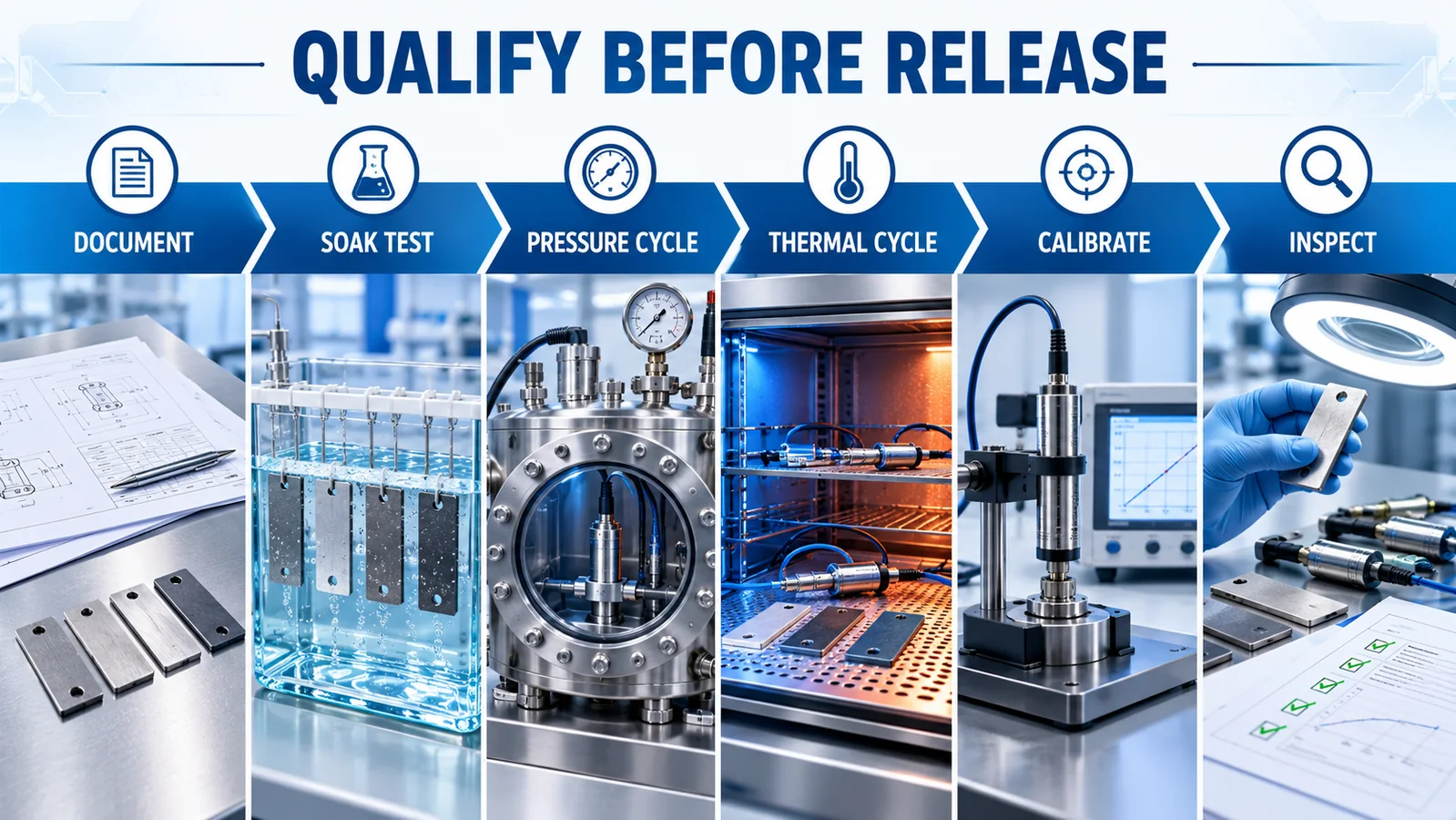
- Freeze the chemical composition and operating envelope.
- Obtain material declarations for every wetted part.
- Review corrosion, swelling, permeation and stress-cracking risks.
- Test material coupons when published evidence is insufficient.
- Soak representative sensor assemblies in normal and cleaning fluids.
- Pressure-cycle at process temperature and credible peaks.
- Perform thermal cycling and leak tests.
- Compare zero, span and insulation before and after exposure.
- Section or inspect diaphragms, seals and welds.
- Define incoming inspection and supplier change notification.
A short soak can miss slow permeation, crevice corrosion or stress-related failure. Test duration should reflect the required service life and consequence of failure.
Record baseline and post-test accuracy using the same pressure points and temperature conditions. Separating zero shift, span shift, hysteresis and leakage makes the result more diagnostic than a single pass/fail value; the FS versus reading accuracy guide explains why the error basis must be stated when comparing results.
RFQ-tjekliste
Provide chemical composition, concentration range, impurities, phase, viscosity, solids, operating and cleaning temperatures, pressure/vacuum/surge, exposure duration, required accuracy, output, process connection, desired wetted materials, seal restrictions, fill-fluid restrictions, surface finish, approvals, traceability, cleaning method, annual volume and expected life.
FAQ
Is ceramic always better for acids?
No. Compatibility depends on the ceramic grade and every other exposed material. The surrounding seal or port may be the limiting component.
Does a 316L diaphragm make a sensor chemical resistant?
It makes 316L part of the process boundary. Whether that is acceptable depends on the exact chemical, concentration, temperature, stress and geometry.
Does an isolation diaphragm keep all liquid away from the sensor?
It keeps process liquid away from the silicon chip when intact. The process still contacts the diaphragm, lower body, weld and gasket.
When is a flush diaphragm useful?
It can reduce dead volume and clogging for viscous or crystallizing media and can improve cleanability. It does not prove material or hygienic compliance by itself.
Konklusion
Selecting a corrosive chemical pressure sensor is a material-system decision. Define the complete exposure, identify every wetted component, compare direct ceramic and isolated silicon architectures, and qualify the final assembly. For a documented product review, kontakt Winsen with the actual chemical and process envelope.
