Industrial equipment builders (HVAC, pumps, compressors, hydraulics, process skids, energy systems) rarely want a “one-size-fits-all” pressure sensor. You typically need the right pressure type (absolute/gauge/differential), the right core technology (capacitive or piezoresistive), the right mechanical interface, and the right compliance package—delivered consistently, in volume.

This article explains what an OEM pressure sensor manufacturer should provide, what you should put in your RFQ, and how to choose between capacitive and piezoresistive pressure sensors for industrial equipment.

What “OEM pressure sensor” really means in industrial equipment

An OEM pressure sensor program is more than supplying a catalog part. In practice, it covers:

  • Customization (range, port, materials, output, connector, labeling)
  • Calibration + compensation (temperature, linearity, total error band)
  • Production consistency (traceability, process control, change control)
  • Compliance support (IP rating, EMC, RoHS/REACH, hazardous area where needed)
  • Lifecycle support (PCN/EOL policy, long-term availability)

Many established sensor brands explicitly offer OEM integration options plus customer-specific and private label solutions for machine designs.

Capacitive vs piezoresistive pressure sensors: which is better for your equipment?

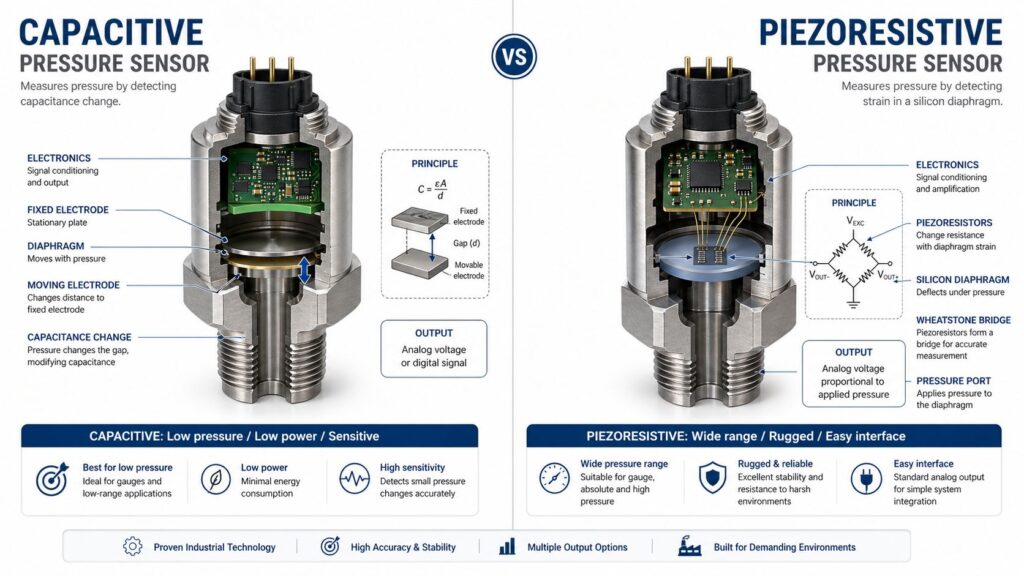
Piezoresistive pressure sensors (most common “industrial default”)

How it works: Pressure deflects a diaphragm; strain changes the resistance of piezoresistors in a Wheatstone bridge; electronics convert mV/V to usable output.

Where it shines

  • Broad pressure ranges (including medium/high pressure)
  • Rugged industrial packaging is mature and widely available
  • Straightforward signal chain (bridge → amplifier/ADC)

Typical tradeoffs

  • Needs temperature compensation for offset/span drift
  • Long-term stability depends heavily on packaging, media isolation, and stress management

Capacitive pressure sensors (often strong in low pressure and DP)

How it works: Pressure deflects a diaphragm, changing capacitance (gap/electrode geometry), read by capacitance-to-digital or AC front-end.

Where it shines

  • Very good sensitivity at low pressure / low differential pressure
  • Low power potential (depends on readout architecture)
  • Excellent repeatability in many low-pressure designs

Typical tradeoffs

  • More sensitive to parasitic capacitance, EMI/layout, humidity/contamination (system-level design matters)
  • Can be more nonlinear over large deflections (managed by mechanical design, differential capacitors, or touch-mode variants)

A practical engineering overview groups both capacitive and piezoresistive as major “core technologies” used in pressure sensors (including absolute/gauge/differential implementations).

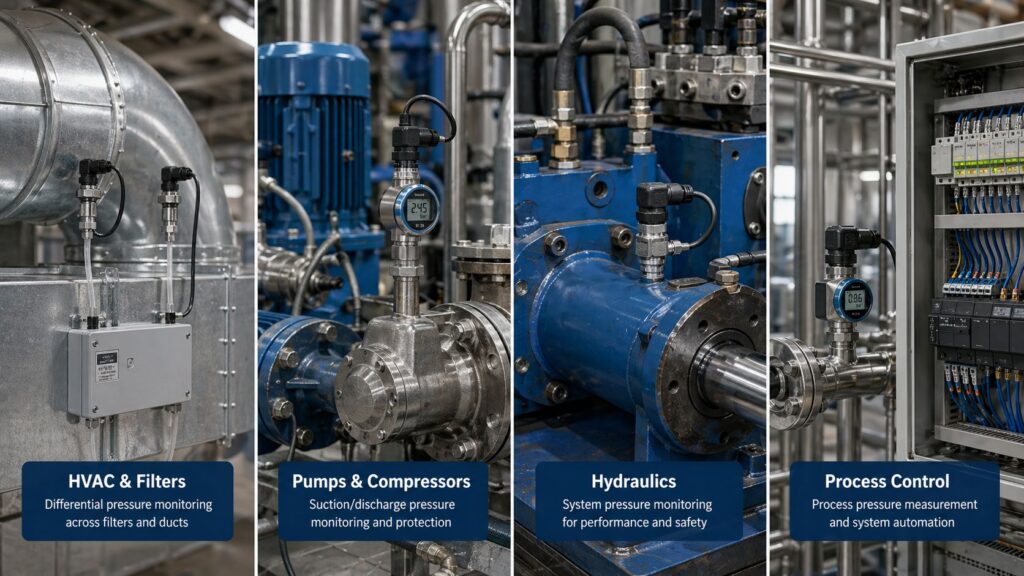
Typical industrial applications and recommended sensor direction

طلبTypical pressure typeCommon rangeOften favorsلماذا
HVAC duct static / filter monitoringالتفاضليPa → low kPaCapacitive DPHigh sensitivity at very low ΔP
Pumps / compressors / pneumaticsكَيّلkPa → barpiezoresistiveRobust, broad range, simple interface
Hydraulic systemsكَيّلMPapiezoresistiveHigh pressure durability, mature packaging
Process skids / general automationالمقياس / المطلقkPa → barEitherDecide by media + EMC + accuracy + cost
Sealed chambers / vacuum-adjacentمطلقkPa(a) down to lowCapacitive or piezoresistive (case-by-case)Reference stability is key; choose by range + drift

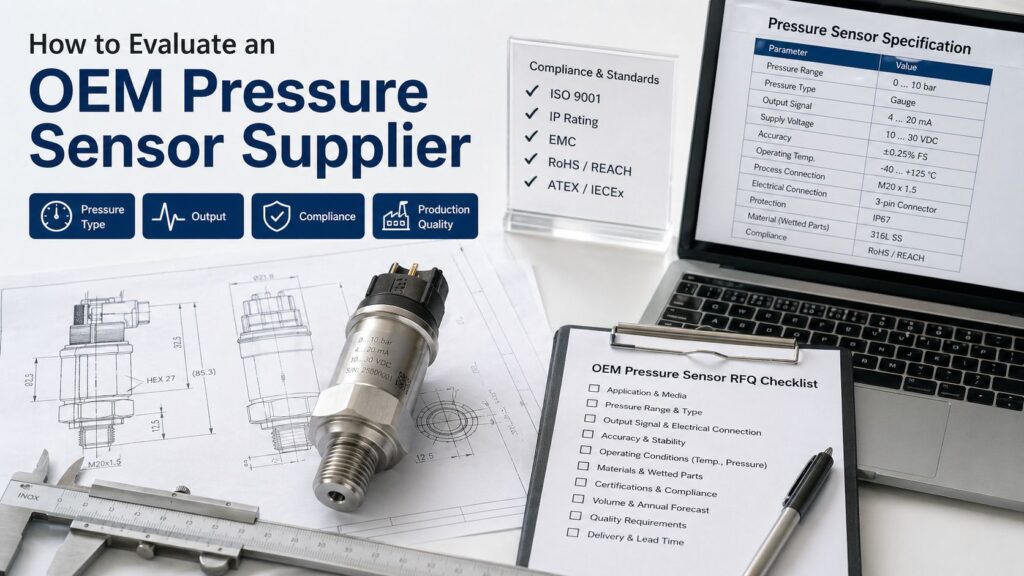
What to specify in an OEM pressure sensor RFQ

1) Pressure reference (avoid the #1 OEM mistake)

  • مطلق (psia, kPa(a), bar(a))
  • كَيّل (psig, kPa(g), bar(g))
  • التفاضلي (Pa DP, kPa ΔP)

2) Range and overload requirements

  • Operating range
  • Proof pressure
  • Burst pressure (if safety-critical)

3) Media compatibility and isolation

  • Dry gas vs water vs oil vs refrigerant vs corrosives
  • Need for isolation diaphragm / fill fluid (if required by media)

4) Electrical interface

  • Analog: 0.5–4.5 V, 0–10 V, 4–20 mA
  • Digital: I²C/SPI/UART, CAN/LIN (if applicable)
  • Supply voltage, output scaling, diagnostics

5) Accuracy definition (be explicit)

Ask for accuracy in a form you can validate:

  • %FS vs %reading
  • Temperature-compensated range
  • “Total error band” or separate terms (linearity, hysteresis, repeatability, temp effects)

6) Environmental targets

  • Ingress rating (IP)
  • EMC environment
  • Vibration/shock
  • درجة حرارة التشغيل

Standards and compliance that often matter for industrial OEMs

Ingress protection (IP rating)

If your sensor is used outdoors, washdown areas, or dusty sites, you’ll see requirements like IP65/IP67/IP69K. IP ratings are defined by IEC’s IP system (IEC 60529).

EMC (electromagnetic compatibility)

Industrial equipment often requires the sensor/transmitter electronics to meet EMC immunity and emissions expectations. IEC 61326-1 is a widely referenced EMC standard for electrical equipment used in measurement/control/lab contexts.

RoHS / REACH (materials compliance for electronics sold into the EU)

  • روهز restricts certain hazardous substances in electrical/electronic equipment.
  • REACH is the EU’s main chemicals regulation for protecting health and environment.

Hazardous area (if your equipment is used in explosive atmospheres)

  • ATEX Directive 2014/34/EU covers equipment intended for potentially explosive atmospheres in the EU.
  • IECEx is a global IEC-based certification system for Ex equipment used in explosive atmospheres.

Functional safety (only when relevant)

If your pressure sensor is part of a safety function (not “just monitoring”), IEC 61508 is commonly referenced as a functional safety framework for E/E/PE safety-related systems.

Quality management baseline

Many OEMs expect the factory to operate under a recognized QMS such as ISO 9001, which defines requirements for establishing and continually improving a quality management system.

What a strong OEM pressure sensor manufacturer should offer

Engineering and customization capabilities

  • Range optimization and diaphragm selection (sensitivity vs overload)
  • Port/threads (G1/4, NPT, M10/M14, custom manifolds)
  • Housing materials (stainless steel grades, seals, wetted parts)
  • Output options and firmware trimming
  • Connector ecosystem (DIN, M12, cable pigtail, board-level)
  • Private label: laser marking, label layout, packaging

Validation and reliability testing (ask what’s done internally)

A credible OEM supplier should be able to discuss:

  • Pressure cycling and fatigue testing
  • Temperature cycling and thermal shock
  • Vibration/shock profiles
  • Leak testing and sealing validation
  • EMI/ESD test approach (and whether third-party labs are used)
  • Incoming inspection + in-process QC + final test automation

Production controls you can audit

  • Traceability (lot/date code mapping to calibration/test records)
  • Change control (PCN policy, process/material substitutions)
  • Yield metrics and corrective actions (8D/5Why)
  • Capacity planning and safety stock options

A simple OEM project workflow (prototype → mass production)

  1. Requirement freeze (RFQ): pressure type, range, media, output, environment, compliance
  2. Design selection: capacitive vs piezoresistive, package architecture, porting
  3. Prototype build: samples + initial calibration curve
  4. Verification: accuracy across temperature, EMC sanity checks, sealing checks
  5. Pilot run: process capability, yield, test fixtures, packaging validation
  6. Mass production: traceability + QC plan + ongoing change control

الأسئلة الشائعة

Are capacitive sensors always more accurate than piezoresistive sensors?

Not always. Capacitive sensors can be excellent—especially at low pressure—but overall accuracy depends heavily on packaging, calibration, electronics, and installation (EMI/parasitics). Piezoresistive sensors can be highly accurate too, but often require strong temperature compensation.

Which is better for low differential pressure in HVAC?

Often capacitive DP is a strong choice because of sensitivity at very low ΔP, but you must manage humidity/condensation and EMC in real installations.

What is the difference between OEM and private label pressure sensors?

OEM typically means the supplier designs/manufactures to your technical specification; private label means your branding/labeling is applied (often both are offered together).

What IP rating should an industrial pressure sensor have?

It depends on environment. Many outdoor or washdown applications target IP65–IP67 or higher. IP ratings are defined under IEC’s IP system (IEC 60529).

Do I need ATEX or IECEx for all industrial pressure sensors?

Only if the equipment is intended for use in potentially explosive atmospheres. ATEX applies to the EU market for such equipment, and IECEx is widely used internationally.

Why do OEMs ask for ISO 9001?

ISO 9001 is a globally recognized QMS framework used to ensure consistent processes and continual improvement—common as a baseline supplier requirement.

اترك الرد

لن يتم نشر عنوان بريدك الإلكتروني. يتم وضع علامة على الحقول المطلوبة *